


3 DEADLY Errors that are killing your Restaurant business? | Restaurant Blueprint | Zorawar Kalra
Executive Summary
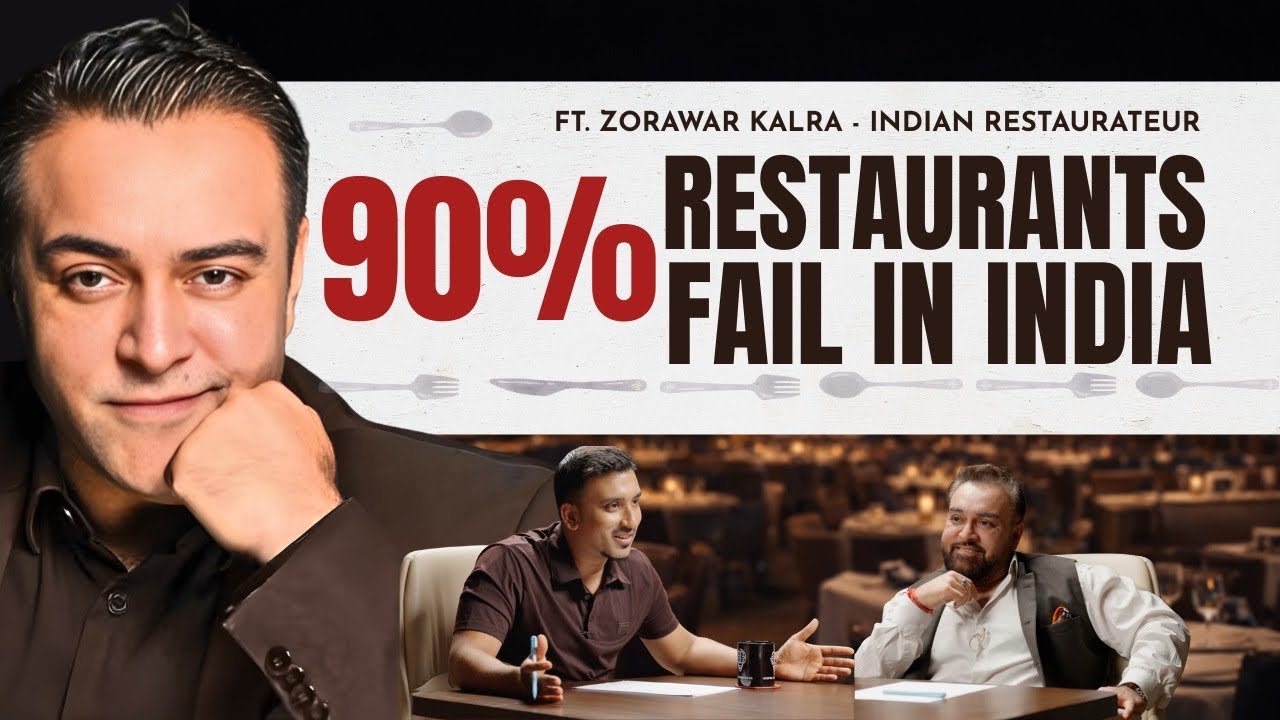
Zorawar Kalra and Ganesh Prasad discuss restaurant positioning, working capital, menu development, location and teams. Selected coverage from approximately the first 50,000 characters of third-party English captions, not the full interview; the unseen ending is not summarized. Failure-rate figures, company anecdotes and generational consumption claims are not independently verified; broad health and lifestyle prescriptions and sponsor material are omitted. Budget suggestions are the guest's heuristics, not guarantees or financial advice. Captions contain recognition errors and no speaker labels; attribution follows the exchange. Topics are untimed; metadata follows YouTube. Source: https://youtubetotranscript.com/transcript?v=juaz3DitPJ0
Key Takeaways
Keep cash for the months after opening
Kalra warns against spending the entire budget on building a restaurant. He recommends allowing for a gestation period and keeping a reserve for rent, salaries, electricity and other fixed costs. His six-month suggestion is a planning heuristic; test it against your own cash flow and downside cases.
Choose a gap, not only a trend
He identifies weak positioning, wrong pricing and insufficient capital as causes of failure. A popular category does not establish demand for another venue in a particular neighborhood. Define why the customer would choose this restaurant and how they will discover it before treating a trend as a business plan.
Give the team room for menu experiments
Kalra describes research, repeated trials and an innovation day where teams contribute ideas. The useful distinction is between testing a dish and assuming the first version belongs on the menu. Create a safe trial process, learn from failures and check whether the result improves the eating experience.
Make presentation support the dish
He describes adapting familiar food into a different format, while warning against changing a dish merely for presentation. Appearance can invite interest without replacing flavor and execution. Ask what a new format adds to texture, taste or the experience before choosing novelty for its own sake.
Price for the concept and its economics
Kalra connects pricing with nearby alternatives, the intended customer and fixed costs such as rent. A low menu price does not help if the location's cost structure cannot support it. Compare genuinely similar concepts and model the costs rather than copying another restaurant's price mechanically.
Match the site with customers and dayparts
His Pa Pa Ya example links location to surrounding offices and residents, including the ability to fill lunch as well as dinner. A prestigious address is not enough on its own. Inspect who is nearby, when they eat and whether those occasions fit the proposed restaurant.
Build a hiring and training pipeline
The discussion treats kitchen, service and housekeeping staff as parts of the guest experience. Kalra emphasizes people who care about the work and complement the founder. Plan how key roles are recruited, trained and replaced rather than relying on the owner to cover every gap.
The Conversation Breakdown
Keep cash for the months after opening
⏱ Untimed topicKalra warns against spending the entire budget on building a restaurant. He recommends allowing for a gestation period and keeping a reserve for rent, salaries, electricity and other fixed costs. His six-month suggestion is a planning heuristic; test it against your own cash flow and downside cases.
Choose a gap, not only a trend
⏱ Untimed topicHe identifies weak positioning, wrong pricing and insufficient capital as causes of failure. A popular category does not establish demand for another venue in a particular neighborhood. Define why the customer would choose this restaurant and how they will discover it before treating a trend as a business plan.
Give the team room for menu experiments
⏱ Untimed topicKalra describes research, repeated trials and an innovation day where teams contribute ideas. The useful distinction is between testing a dish and assuming the first version belongs on the menu. Create a safe trial process, learn from failures and check whether the result improves the eating experience.
Make presentation support the dish
⏱ Untimed topicHe describes adapting familiar food into a different format, while warning against changing a dish merely for presentation. Appearance can invite interest without replacing flavor and execution. Ask what a new format adds to texture, taste or the experience before choosing novelty for its own sake.
Price for the concept and its economics
⏱ Untimed topicKalra connects pricing with nearby alternatives, the intended customer and fixed costs such as rent. A low menu price does not help if the location's cost structure cannot support it. Compare genuinely similar concepts and model the costs rather than copying another restaurant's price mechanically.
Match the site with customers and dayparts
⏱ Untimed topicHis Pa Pa Ya example links location to surrounding offices and residents, including the ability to fill lunch as well as dinner. A prestigious address is not enough on its own. Inspect who is nearby, when they eat and whether those occasions fit the proposed restaurant.
Build a hiring and training pipeline
⏱ Untimed topicThe discussion treats kitchen, service and housekeeping staff as parts of the guest experience. Kalra emphasizes people who care about the work and complement the founder. Plan how key roles are recruited, trained and replaced rather than relying on the owner to cover every gap.
Core Frameworks & Ideas
Opening plus gestation - discussed planning rule
Budget for operations after launch rather than only the build cost.
Concept-customer-location fit - editorial label
Match the venue and dayparts with the customers who can sustain it.
Menu trial cycle - discussed approach
Give teams room to test ideas and use the result to improve the dish.
Actionable Next Steps
- ✓Model a post-opening cash reserve and test downside cases.
- ✓Check lunch and dinner demand before choosing a site.
- ✓Define a trial process for new menu items.
- ✓Create a backup hiring and training plan for key roles.
Notable Quotes
“Great food comes with a lot of effort behind the scenes.”
“always surround yourself with people smarter than you”
“There is no 9 to5 here.”
The One Thing to Remember
Match the concept, customer, site and cash plan before opening, then build the people and food-development routines to sustain it.