


AIR INDIA IS BROKEN: Why Air India Can Never Be Fixed? | Business Case Study
Executive Summary
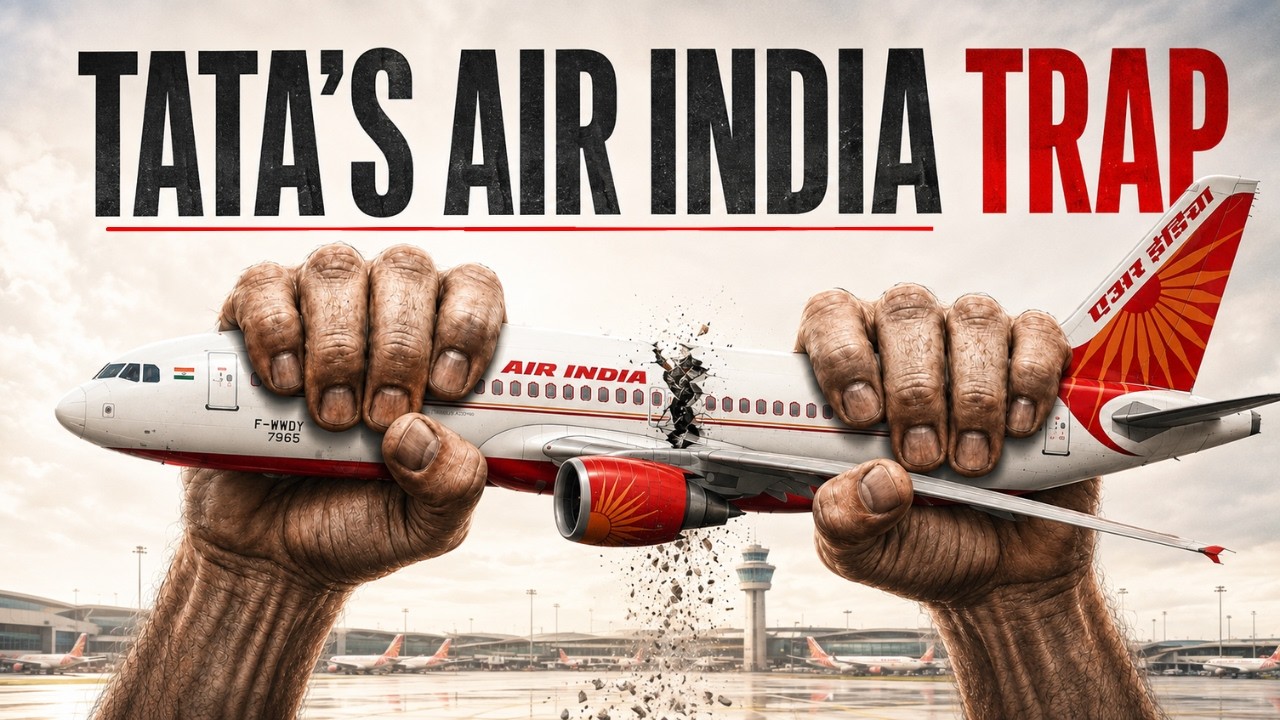
Think School reads supply chain reports, Boeing and Airbus order books and Air India's filings to answer one question: how can Air India lose 42 crores a day under the Tatas when it lost 19.2 crores a day under the government? The answer is four traps - a geopolitical detour around Pakistan's closed airspace that adds 2,500 km and 4.5 hours to Delhi-Chicago and has cost about 4,000 to 5,000 crores, a product lottery after the Vistara merger that killed willingness to pay, a hardware trap where certified seats and engines come from a handful of delayed suppliers, and a 69-year-old inherited operating system showing up as recurring defects in 137 of 166 aircraft. The hope is new CEO Tewolde GebreMariam, who turned Ethiopian Airlines into Africa's most profitable airline group, and his plan to make Delhi a sixth-freedom global hub on the Emirates model. FULL COVERAGE: the captions appear to cover the entire episode. All figures are as stated by the channel, not independently verified. Sponsor: Odoo. Nothing here is investment advice.
Key Takeaways
Losses doubled under Tata ownership
Air India went from losing 19.2 crores a day in FY21 under the government to 42 crores a day in FY26, even after Tata and Singapore Airlines infused 9,558 crores, announced a 3,300 crore retrofit and placed a record 470-aircraft order.
The Pakistan airspace closure is a 5,000 crore problem
After Operation Sindoor, Pakistan closed its airspace to Indian carriers only; Delhi-Chicago now flies 2,500 km extra and 4.5 hours longer, and an internal Air India document reviewed by journalists estimates about $591 million, almost 5,000 crores, over 12 months.
The product lottery killed willingness to pay
After Vistara merged into Air India, a customer cannot know whether they will get an old Air India aircraft or a clean ex-Vistara one - and that uncertainty killed the willingness to pay even among the most loyal Vistara customers.
Seats are aerospace machines, not furniture
A business-class seat must survive a 16G crash test and win regulatory sign-offs; only a handful of companies make them, four of Air India's five seat suppliers ran chronic delays, one exited the program, and the $400 million retrofit is two years late.
New aircraft are a decade away
Airbus and Boeing hold a 10-to-12-year backlog of 16,683 aircraft; Pratt & Whitney's contaminated powder metal grounded 648 A320neo-family aircraft; Russia supplied 65% of Airbus's and 35% of Boeing's titanium before the war; and Boeing can deliver only two aircraft a month to all Indian carriers combined.
You cannot uninstall a 69-year-old operating system
Lok Sabha data shows 137 of Air India's 166 aircraft had recurring defects; moving Vistara pilots onto Air India's pay structure triggered revolts, mass sick leaves, cancelled flights and a culture war between Vistara and the sarkari legacy.
The fix is a Delhi hub, Emirates-style
New CEO Tewolde GebreMariam, who grew Ethiopian Airlines from $1 billion to $4.5 billion in revenue, wants Delhi as the principal global hub - London to Singapore via Delhi is only an 8 km detour versus 462 km via Dubai - using traffic aggregation, network effects, and new MRO and cargo verticals.
The Conversation Breakdown
Air India's FY21 versus FY26 daily losses
⏱ Untimed topicUnder government ownership Air India lost 19.2 crores a day in FY21; under the Tatas in FY26 it loses 42 crores a day, despite 9,558 crores of infusion and the largest aircraft order in aviation history.
Operation Sindoor and the airspace detour
⏱ Untimed topicPakistan closed its airspace to Indian carriers only, forcing Delhi flights west to route via Ahmedabad, the Arabian Sea and Muscat - 2,500 km and 4.5 hours extra per flight, and foreign airlines now carry 58.4% of India's international passengers and 95% of its international cargo.
The Vihaan.AI merger and the product lottery
⏱ Untimed topicThe Tata plan merged AirAsia, Vistara, Air India and Air India Express into two airlines and ordered 470 aircraft - but mixing old Air India and new Vistara cabins turned customer comfort into a lottery ticket.
The hardware trap: seats, engines and titanium
⏱ Untimed topicCertified seats come from a handful of suppliers running chronic delays, contaminated powder metal in Pratt & Whitney GTF engines grounded 648 aircraft, and the Russia-Ukraine war cut off most of Airbus's and a third of Boeing's titanium.
The 69-year-old operating system
⏱ Untimed topicTata inherited a government-built organization with decades of deferred maintenance; 137 of 166 Air India aircraft showed recurring defects, and the Vistara merger set off pilot revolts and a culture war.
Sixth-freedom traffic and the Emirates playbook
⏱ Untimed topicAn airline earns from its home market or by carrying passengers between two other countries through its hub; Dubai's location built Emirates, and Delhi sits at a similar intersection of Europe, West Asia and South Asia.
GebreMariam's three-hub plan
⏱ Untimed topicDelhi as the principal global hub, Mumbai secondary and Bengaluru southern, plus maintenance-repair-operations and cargo verticals - all dependent on Airbus and Boeing delivering on time and the titanium crisis resolving.
Core Frameworks & Ideas
The Four Traps of a Turnaround
Air India is stuck in the product lottery (inconsistent product after a merger), the hardware trap (certified parts from a handful of suppliers), the delivery trap (decade-long manufacturer backlogs) and the operating system trap (a 69-year-old inherited organization). Capital fixes planes, not systems.
Sixth Freedom Hub Economics
An airline earns from its home market or by carrying passengers between two other countries through its own hub. Geography plus traffic aggregation and network effects built Emirates - a third of the world's population lives within a four-hour flight of Dubai - and Delhi has the same advantage.
Technical Debt in Legacy Organizations
Sixty-nine years of deferred maintenance, delayed processes and departing engineers behave like software technical debt: you can buy new planes, but you cannot simply uninstall a 69-year-old operating system in four years.
Actionable Next Steps
- ✓When you evaluate a turnaround story, separate the capital injected (planes, brand, routes) from the inherited operating system, and ask whether the operating system itself is being rebuilt.
- ✓Before paying a premium for a merged brand, check product consistency - uncertainty about which version of the product you will get kills willingness to pay.
- ✓When a supply chain depends on a handful of certified suppliers (seats, engines, titanium), treat delivery timelines as multi-year risks, not quarter-long delays.
- ✓Track Air India's actual aircraft deliveries, the titanium supply situation and the Delhi hub build-out as the real signals of whether the comeback plan is working.
Notable Quotes
“In FY21, when Air India was owned by the government of India, it was losing 19.2 crores every single day. But shockingly, in FY26, Air India loses 42 crores every single day.”
“Air India's biggest competitor isn't an airline, it's geography and geopolitics.”
“you cannot simply uninstall a 69-year-old operating system in four years.”
The One Thing to Remember
Tata bought the planes, the brand and the routes, but it inherited a 69-year-old operating system - and you cannot uninstall a 69-year-old operating system in four years.