


Budget 2024 : Biggest Mistake or a Masterstroke by the Modi govt? | Complete analysis
Executive Summary
Think School's breakdown of India's Union Budget 2024 - the Finance Minister's record seventh consecutive budget, presented right after the elections. The episode walks the four themes (employment and skilling, MSMEs, farmers and rural development, the middle class), the tax slab revision versus the capital gains hike, improving fiscal numbers, the Andhra Pradesh and Bihar allocations and the Manipur criticism, and the sectors the budget is bullish on - with the host's own verdicts, all attributed to him.
Key Takeaways
A record seventh budget, delivered into chaos
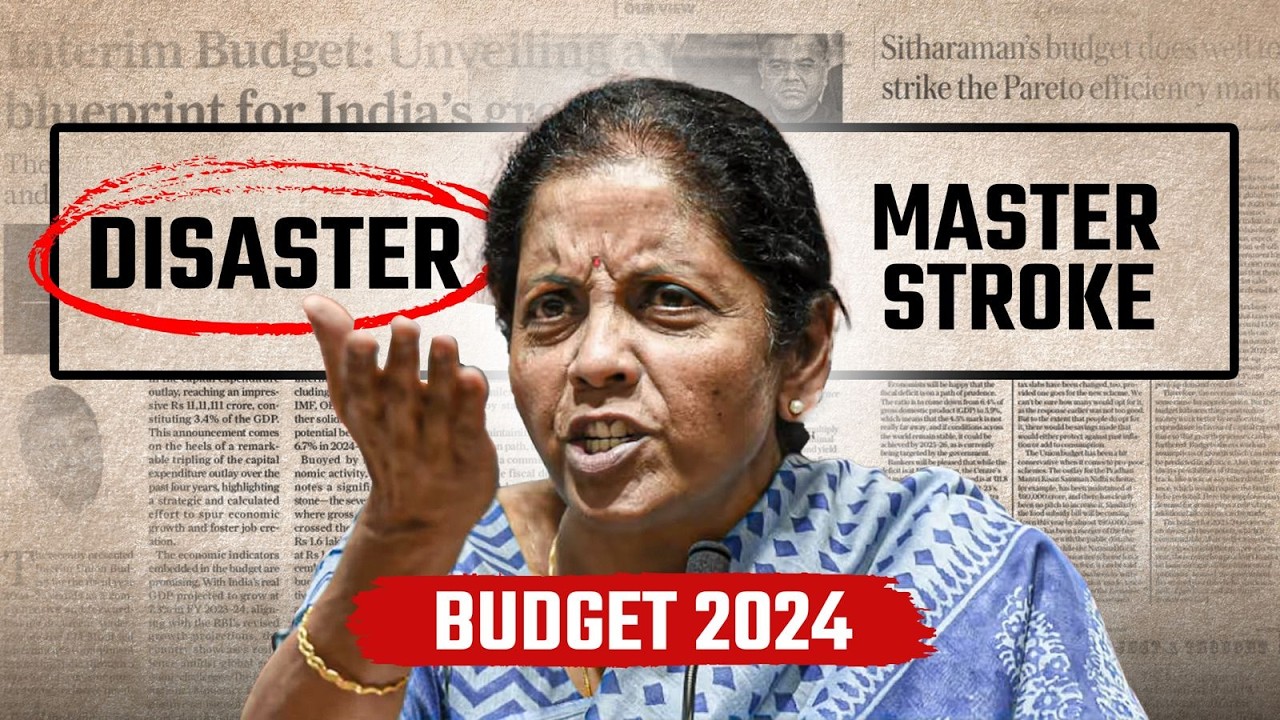
Per the video, the FM's seventh consecutive budget - the most by any Indian finance minister - landed right after the elections, drawing fire on jobs, taxes, and state favoritism from opposition figures and even Nitin Gadkari.
Rs 2 lakh crore for jobs, questioned
The employment package spans first-timer wages, manufacturing incentives and employer EPFO reimbursements; the host, as a business owner, calls it useless because freshers lack skills, not wage support - his opinion, stated in the video.
Skilling gets the host's vote
1,000 ITIs upgraded, 20 lakh youth trained with states and industry, Rs 7.5 lakh guaranteed education loans and Rs 10 lakh e-vouchers with 3% interest subvention - against an economic survey calling for 7.8 million non-farm jobs a year.
MSMEs: the strongest package
Only 14% of 64 million MSMEs have credit access; the budget answers with collateral-free machinery loans, Mudra doubled to Rs 20 lakh, in-house bank assessment, stress-period funding, a Rs 250 crore TReDS threshold and export hubs.
Rural goes big
Agriculture and rural spending became the second and third highest allocations after defense: Rs 1.52 lakh crore and Rs 2.66 lakh crore, climate-resilient crops, natural farming for 1 crore farmers, 25,000 villages connected.
Give on slabs, take on gains
The revised slabs and Rs 75,000 standard deduction save an average Rs 17,500 per taxpayer per year, while STCG rose 15% to 20% and LTCG 10% to 12.5% - the source of middle-class anger per the video.
Fiscal repair is real
Deficit 9.2% to 4.9%, borrowings 34% to 27% of revenue, debt-to-GDP 89% to 81%, external debt 21.2% to 18.7% - still above the 3% ideal but closing.
The AP-Bihar politics
Andhra gets up to Rs 15,000 crore for its new capital plus Polavaram; Bihar gets Rs 26,000 crore for roads and Rs 21,000 crore for power. Critics in the video note crisis-hit Manipur received nothing significant.
The Conversation Breakdown
The seventh budget and the backlash
⏱ Untimed topicA record for any finance minister, the post-election context, and the criticism chorus: jobs, the middle class, copied manifestos, and state favoritism.
Employment: Rs 2 lakh crore, four schemes
⏱ Untimed topicFirst-timer wages, manufacturing incentives for freshers and employers, EPFO reimbursements, women's hostels - and the host's skills-not-money objection.
Skilling and education loans
⏱ Untimed topic1,000 ITIs, 20 lakh youth with states and industry, Rs 7.5 lakh guaranteed loans and Rs 10 lakh e-vouchers at 3% subvention; the 7.8 million jobs-a-year requirement.
MSMEs: fixing credit access
⏱ Untimed topicThe 14% credit-access problem and the five-part answer: guarantee scheme, Mudra doubling, in-house assessment, stress funding, TReDS at Rs 250 crore, export hubs.
Farmers and the rural economy
⏱ Untimed topicRs 1.52 lakh crore for agriculture, Rs 2.66 lakh crore rural, climate-resilient crops and millets, natural farming, and PMGSY connectivity.
Taxes: slabs up, gains up
⏱ Untimed topicThe Shashank example across revised slabs, standard deduction Rs 50,000 to Rs 75,000, cess explained, and the STCG/LTCG hikes that angered the middle class.
The fiscal scorecard
⏱ Untimed topicDeficit, borrowings, debt-to-GDP and external debt all improving since 2021; the 3% ideal still ahead.
Andhra, Bihar and the Manipur question
⏱ Untimed topicAmaravati, Polavaram, roads, power and temple economies for the allies' states - and the criticism that Manipur's crisis got no mention.
Sectors the budget bets on
⏱ Untimed topicRenewables to 500 GW, FMCG on rural income, jewellery on the customs cut, pharma on PLI - with the host's not-an-advisor disclaimer.
Core Frameworks & Ideas
Skills before subsidies
The host's hiring-market argument: employers pay for capability, so skilling infrastructure outperforms wage subsidies when the constraint is employability, not money.
Credit as the MSME unlock
With 14% credit access among firms producing 30% of GDP, removing collateral and assessment bottlenecks moves the whole economy, not just the borrower.
Tax trade-offs
A relief on one line (slabs, standard deduction) can be reclaimed on another (capital gains); judge a budget by the net across both.
Budget as sector signal
The host's framing: the government is the market's godfather - allocations are an early map of which industries get tailwinds.
Actionable Next Steps
- ✓If you hire, read the employment incentives (first-timer wages, EPFO reimbursements) before your next recruitment cycle - per the episode, they apply broadly.
- ✓If you run an MSME, check eligibility for the collateral-free credit guarantee scheme and the Rs 20 lakh Mudra limit.
- ✓Recompute your own tax under the revised slabs and Rs 75,000 standard deduction, and factor the 20%/12.5% capital gains rates into any planned selling.
- ✓If you are in solar, FMCG, jewellery or pharma, study your value chain for the budget tailwinds the episode flags - educational research, not investment advice.
- ✓Students: note the Rs 7.5 lakh guaranteed education loans and 3% interest subvention e-vouchers announced in the budget.
Notable Quotes
“It was her seventh consecutive budget speech, the most by any finance minister in this country.”
“the problem is not money, it is skill and education.”
“budget has not been for the middle class.”
“the government is the godfather of the market.”
The One Thing to Remember
The host's core split verdict: the Rs 2 lakh crore employment outlay treats the wrong constraint (money, not skills) while the MSME credit package is 'absolutely amazing' - and the middle class gains Rs 17,500 a year in income tax only to hand it back through higher capital gains.