


CIA's Secret : How Peter Thiel built a 200 Billion dollar Weapon for America?
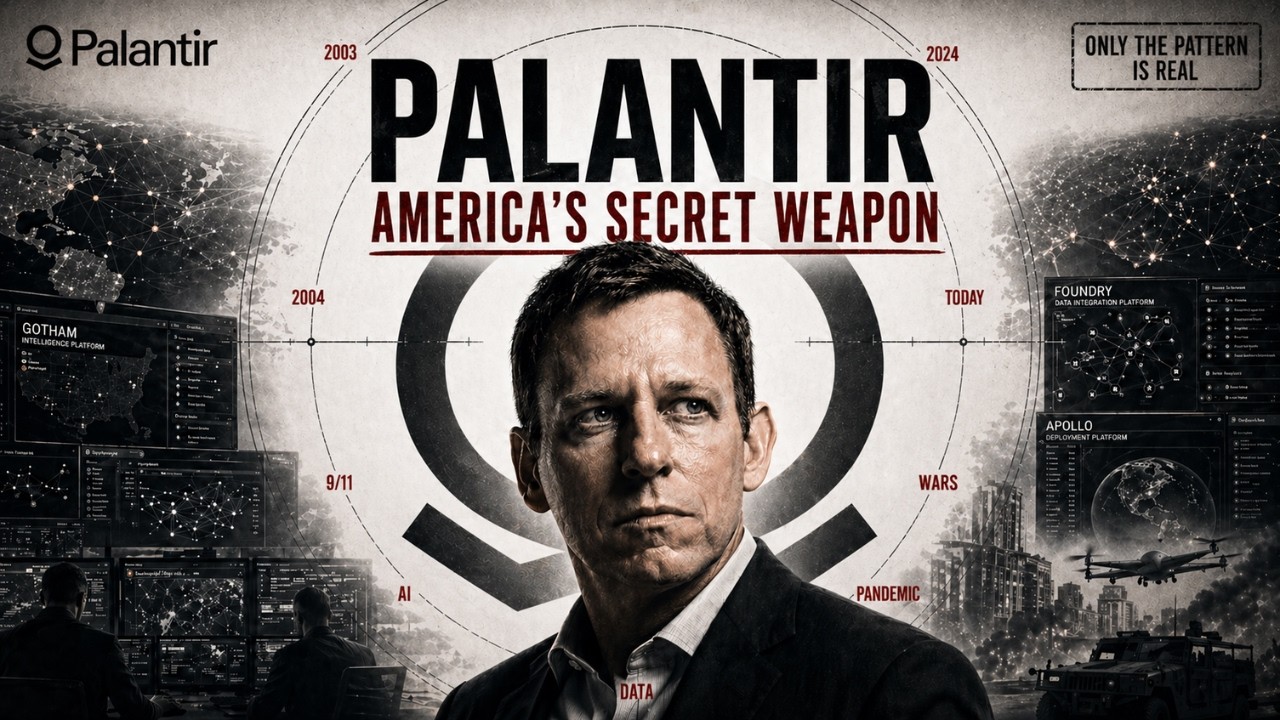
Executive Summary
Palantir's origin is one idea applied twice. At PayPal, rule-based fraud systems lost a chess match to adaptive Russian hackers until Max Levchin flipped the model: software (Igor) that visualized connections and flagged the weird 20 transactions out of 10 million, while humans made the calls - fraud losses fell 70%. After 9/11, Thiel saw the same shape in America's spy agencies: all the data, no shared picture. Rejected by every VC, he funded Palantir himself, bought credibility with a $2 million In-Q-Tel check, survived a failed first CIA demo by inventing the forward deployed engineer - engineers coding inside Langley beside analysts - and won the wars: Gotham mapped IED networks in Iraq and Afghanistan and, per press reports (never officially confirmed), traced bin Laden's courier through 3 million diplomatic telegrams, 170,000 satellite images and 8,000 hours of calls, cutting a 72-hour money-trail analysis to 12 minutes. The three stealable lessons: build software that makes humans superhuman rather than replacing them; sit next to your customer because the strength of your business is inversely proportional to that distance; and chase the legendary client, not the biggest check. FULL COVERAGE: captions appear complete. Sponsor: Wested. Not investment advice.
Key Takeaways
9/11 was a systems problem, not a data problem
The US had the flight school records, the money transfers, the watchlist names and the travel patterns - but the CIA's computer could not talk to the FBI's or the NSA's. The official report called it a failure of imagination, not intelligence.
PayPal's $10M-a-month fraud war
Russian hackers drained PayPal with stolen cards and fake accounts. Rule-based systems (block Russian IPs, flag $500 transfers) worked for two hours before the attackers adapted - a chess match rules could never win.
Igor: the founding DNA of Palantir
Max Levchin stopped trying to replace humans and built software to make one analyst superhuman: ingest everything, visualize the network, flag the weird few, let the human freeze - then learn from the click. Fraud losses fell 70%, and PayPal went on to IPO and a $1.5 billion eBay sale.
Every VC said no; the CIA's VC arm said $2M
Silicon Valley rejected 'government tech' as boring, so Thiel put in $30 million of his own money in 2003 and took $2 million from In-Q-Tel 'just for the tag' - suddenly every three-letter agency took Palantir's calls.
The forward deployed engineer
The first CIA demo failed because engineers had built for an imagined problem. The fix was a job title Silicon Valley had never seen: engineers living inside Langley and later in war-zone tents, coding features overnight from direct analyst feedback, 2005-2008.
Gotham in the wars
IEDs caused roughly 60% of US combat deaths in Iraq; Palantir's Gotham found patterns - roads, times, phone numbers active before blasts - that humans could not. The 82nd Airborne reported a 12% jump in finding bombs, and 691 bomb makers were killed or captured in 18 months.
The bin Laden hunt, attributed
Per Business Insider and TechCrunch reports cited in the video - never confirmed by the CIA or Palantir - Gotham mapped al-Qaeda's courier network from millions of cables, images and call recordings, cutting 72-hour traces to 12 minutes and following the courier 'Kuwaiti' to the Abbottabad compound.
The Conversation Breakdown
A failure of imagination
⏱ Untimed topic9/11 as a data-sharing failure: every piece existed, no agency could see the whole picture.
PayPal vs the Russian hackers
⏱ Untimed topic$10 million a month in fraud, rules that lost in two hours, and Levchin's insight that humans see stories while computers see rules.
Igor makes analysts superhuman
⏱ Untimed topicNetwork visualization, human-in-the-loop decisions, a 70% fraud reduction - the exact model Palantir would later sell to the CIA.
Thiel's $30 million rejected bet
⏱ Untimed topicEvery VC passes on government tech; Thiel self-funds, recruits Alex Karp, and buys credibility with In-Q-Tel's $2 million.
The failed demo and the forward deployed engineer
⏱ Untimed topicBuilding for an imagined problem fails; engineers move inside Langley and co-build with analysts for three years.
IEDs, Gotham and Abbottabad
⏱ Untimed topicPattern-finding in Iraq and Afghanistan, the 12% detection jump, 691 bomb makers, and the reported - unconfirmed - role in finding bin Laden.
The three-lesson playbook
⏱ Untimed topicSuperhuman software over replacement, proximity to the customer, and chasing the legendary client over the biggest check.
Core Frameworks & Ideas
Superhuman, Not Replacement
Design software so the machine ingests, connects and flags while the human judges: machine flags, human decides, machine learns. The loop compounds - each decision trains the next flag.
Forward Deployed Engineering
Put your best builders physically inside the customer's workflow - their desk, their tent, their factory - and ship overnight from direct observation instead of building for an imagined problem.
Chase the Logo, Not the Check
One legendary client or endorsement (In-Q-Tel's $2M) opens more doors than a hundred average ones; credibility compounds faster than revenue early on.
Actionable Next Steps
- ✓In your own product, list what your software decides versus what it merely surfaces - then move one more decision back to the human with better-flagged context.
- ✓Schedule real observation time beside your customer this month; one day watching them work beats a quarter of imagined roadmaps.
- ✓Audit your data silos: which two systems in your work cannot talk to each other, and what 'failure of imagination' could that cause?
- ✓When choosing clients or employers, weigh the doors a name opens, not just the size of the check.
Notable Quotes
“humans could see the stories, but computers could only see the rule.”
“He stopped trying to build software that could replace the humans. He started building software that turned a human analyst into a superhuman.”
“the strength of your business is actually inversely proportional to the distance between you and your customer.”
The One Thing to Remember
The machine flags, the human decides, the machine learns - Palantir's whole empire is software built to make analysts superhuman, not to replace them.