


Dictator vs Democracy: The rise of Xi Jinping and China? Explained
Executive Summary
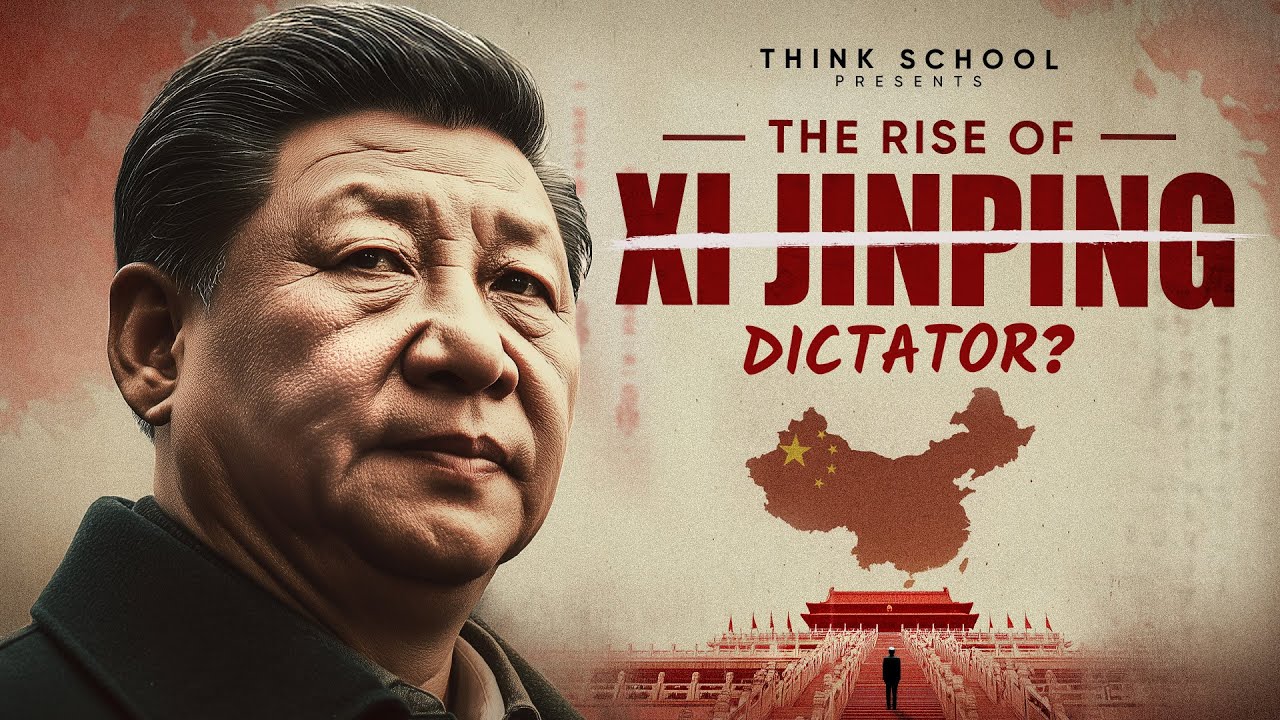
A Think School political case study in which the presenter tells the story of Xi Jinping's rise, from a teenager whose family was purged during the Mao era to China's top leader. He covers the Great Famine and Cultural Revolution background, Xi's repeated rejected party applications, his years as a local official, and his record of running provinces such as Hebei, Fujian, Zhejiang and Shanghai. He then describes Xi becoming general secretary in 2012, the anti-corruption campaign that removed rivals, and China's industrial and military growth, and asks whether a system built on control can keep delivering prosperity. Sponsor: Odoo, thanked mid-video for supporting the content. PARTIAL COVERAGE: this note is based on the opening, the early-life and patience section, a section on his provincial record, the rise to power and anti-corruption section, the closing and the description, and does not cover every point in the roughly 23 minute video. The history and the opinions about a living political leader are the presenter's own and are not independently checked or endorsed.
Key Takeaways
Early years
The presenter says Xi was a 15-year-old in 1968 whose father was purged during Mao's rule, at a time he describes as hunger, terror and chaos.
Patience and the party
He says Xi concluded real power came from the Communist Party, and kept applying to join despite repeated rejections because of his father's record.
Staying out of the capital
The presenter says serving away from the capital's politics kept Xi from being seen as a threat while he rose slowly.
A provincial record
He says Xi turned around four provinces, Hebei, Fujian, Zhejiang and Shanghai, and describes a semi-urban economic model in Zhengding County in 1982.
Seen as controllable
The presenter says in 2012 party elders wanted an experienced leader who seemed neither too ambitious nor too strong, and saw Xi that way.
The anti-corruption campaign
He says that after becoming general secretary Xi removed potential rivals under an anti-corruption banner, including senior officials and military generals.
The big question
The presenter says Xi's record suggests dictatorship can deliver economic results faster than democracy, and asks if a system built on fear and control can do so forever.
The Conversation Breakdown
Early years
⏱ Untimed topicThe presenter says Xi was a 15-year-old in 1968 whose father was purged during Mao's rule, at a time he describes as hunger, terror and chaos.
Patience and the party
⏱ Untimed topicHe says Xi concluded real power came from the Communist Party, and kept applying to join despite repeated rejections because of his father's record.
Staying out of the capital
⏱ Untimed topicThe presenter says serving away from the capital's politics kept Xi from being seen as a threat while he rose slowly.
A provincial record
⏱ Untimed topicHe says Xi turned around four provinces, Hebei, Fujian, Zhejiang and Shanghai, and describes a semi-urban economic model in Zhengding County in 1982.
Seen as controllable
⏱ Untimed topicThe presenter says in 2012 party elders wanted an experienced leader who seemed neither too ambitious nor too strong, and saw Xi that way.
The anti-corruption campaign
⏱ Untimed topicHe says that after becoming general secretary Xi removed potential rivals under an anti-corruption banner, including senior officials and military generals.
The big question
⏱ Untimed topicThe presenter says Xi's record suggests dictatorship can deliver economic results faster than democracy, and asks if a system built on fear and control can do so forever.
Core Frameworks & Ideas
Strategic patience - the presenter's central idea
Rise slowly inside the system rather than by rebellion.
Prove it locally first - the presenter's reading of Xi's career
Build a track record running provinces before seeking the top job.
Look at the system's incentives - the presenter's closing question
Ask whether prosperity delivered through control can last.
Actionable Next Steps
- ✓Read independent histories and several viewpoints on Xi Jinping and modern China.
- ✓Check the presenter's casualty and economic figures against reliable sources.
- ✓Notice how a person's early experiences are used to explain later decisions, and treat that as interpretation.
- ✓Treat all claims about a political leader as the presenter's own view and verify them independently.
Notable Quotes
“what happened next was nothing less than a masterclass in strategic patience.”
“real power did not come from rebellion.”
“can a system built on fear and control keep delivering prosperity forever?”
The One Thing to Remember
The presenter argues that Xi Jinping's rise was built on strategic patience, working inside the system, and a record of local economic results, and he asks whether control and prosperity can last together.