


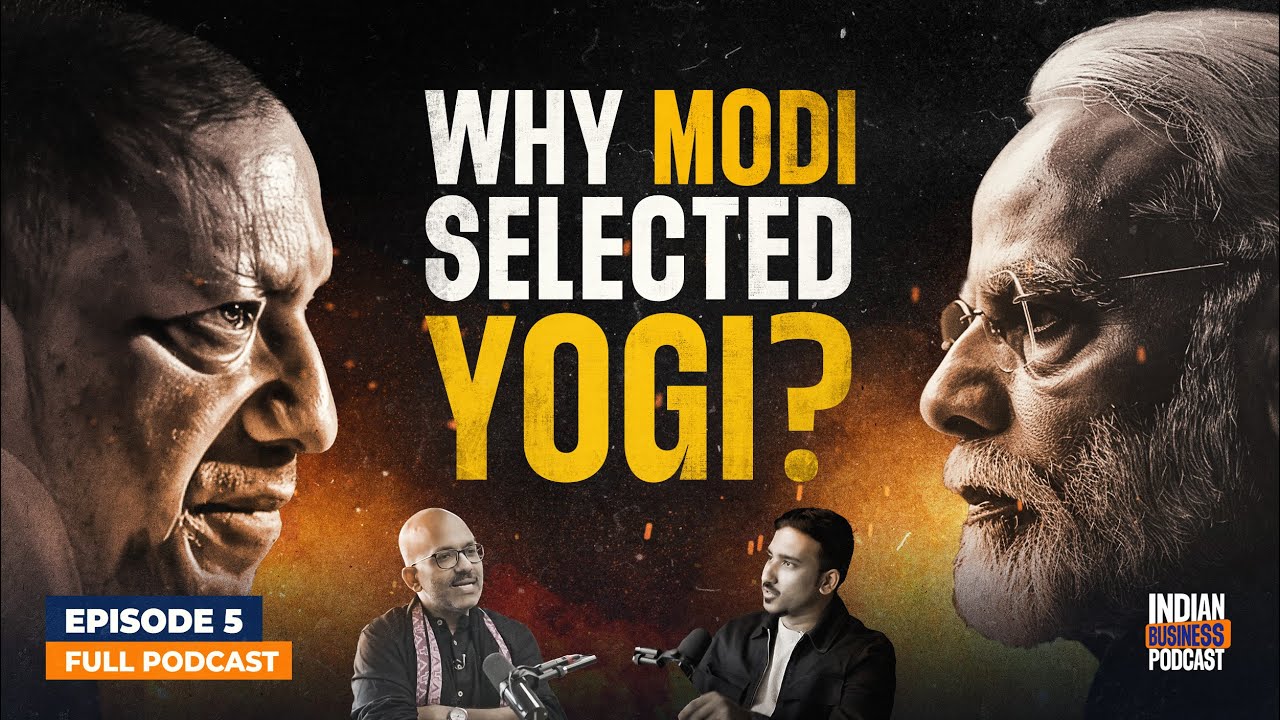
How did BJP become a Political Superpower? | ft. Shantanu Gupta : Indian Business Podcast| Episode 5
with Shantanu Gupta
Executive Summary
Political analyst and author Shantanu Gupta makes his case that politics is a core business subject - regulation shapes every company, unicorns run policy teams, and budgets move stocks - then reads the BJP's rise through his frameworks: vote-bank 'social engineering' (which he attributes to Congress), his ABCD voter equation (life improvement, identity, national pride, leader trust), and the RSS as a leadership factory with Narendra Modi as its 'best product'. He traces Yogi Adityanath's path from Mahant to five-term MP to Chief Minister, argues effective governance shrinks identity politics and created a 'Labharthi' beneficiary vote bank, and defends the UP model: a one-trillion-dollar economy target, loan waivers as a weaning dose, and an investment-first push. Pressed on Manipur, unemployment at 6.57% and manufacturing's slide, he answers with his own data readings, including PF-registration and gig-work gaps in official employment numbers. All views, statistics and historical readings are the speakers' own.
Key Takeaways
Politics is a business input, not a side show
Gupta's opening argument: every business lives in a government-shaped ecosystem, from commodity prices to licenses. Unicorns now run policy teams - Dream11 litigates skill vs chance, Zomato answers to FSSAI, Uber to taxi definitions - and top executives watch the budget with analyst teams because single announcements (ethanol, rooftop solar) move whole sectors' stocks.
Formal status formalizes money
His Bollywood example: until the Vajpayee government gave film industry status, contracts were unenforceable and insurance unavailable, so informal and underworld money filled the gap. Once film became an industry, corporate banners and formal finance entered and the black-money share shrank to a fraction.
The 'sudden' monk-CM had two decades of training
Before becoming Chief Minister in 2017, Yogi Adityanath was a five-term MP from Gorakhpur (elected in 1998 at 26), a Mahant from 1994, mentored by Vajpayee, Advani, Sushma Swaraj and Pramod Mahajan, and a constant winner in 2004 and 2009 when the BJP was weak - the viral videos, Gupta says, hid 19 years of parliamentary work.
Caste-agnostic, family-agnostic, corruption-agnostic
Gupta's reading of the 2017 decision: UP politics ran on caste combinations, family networks (he cites 40 politicians from one family) and corruption, so Modi and Shah picked a sadhu - technically casteless, without heirs, and trained in non-attachment - as the counter to all three.
The ABCD voter equation
Gupta's theory of what goes through a voter's mind: A - did my life improve; B - identity (caste, religion, age, gender, region, language); C - national pride; D - trust in the executing leader and their party. Different voters weight the terms differently, but all four play out before the button is pressed.
Governance delivery shrinks identity politics
His seesaw: when schemes needed a caste-broker to reach you, identity ruled; direct benefit transfer broke that dependence. He calls the result a new 'Labharthi' (beneficiary) caste - citing 4 crore houses, 10 crore toilets, tap water and Ujjwala gas - and says visible Hindu-cultural pride (corridors, Ayodhya) similarly outweighs micro caste appeals.
Gupta disputes the headline unemployment and manufacturing numbers
Pressed on 6.57% unemployment and manufacturing falling to 13% of GDP, he counters with data critiques: archaic labor-department surveys missing 4 crore new PF registrations in three years, uncaptured gig and construction work, and sectoral gains (mobile phones, PLI, defense) that he says will show up with an Ayurveda-like lag.
The Conversation Breakdown
Why politics is a business subject
⏱ Untimed topicGupta opens with the ecosystem argument: government sets the rules every business plays by, from commodity prices to licenses, so unicorns run policy teams and CEOs watch budgets with analysts. Ethanol talk moved sugar stocks; rooftop-solar targets moved solar stocks. His film-industry case: Vajpayee-era industry status made contracts and insurance possible, formal money entered, and the underworld's share of Bollywood finance shrank.
The making of Yogi Adityanath: Mahant to five-term MP
⏱ Untimed topicFrom a 1990s science student to sanyasi in 1994 and MP in 1998 at 26, mentored by the Vajpayee-era leadership. Gupta dwells on the Khichdi Bhoj campaigns - caste-agnostic community feasts taken village to village - the 'Chota Baba' persona with goggles and a red Tata Sumo, and how two decades of this groundwork saturated Gorakhpur and built influence across eastern UP, Bihar and Nepal even while the BJP was weak there.
The 2017 CM decision: reading Modi and Shah's mind
⏱ Untimed topicAfter the 300-plus-seat 2017 win, the obvious answers were OBC or Dalit faces. Gupta's conjecture: with too many castes to satisfy, the leadership picked a sadhu - technically casteless, Thakur by birth and Brahmin by sannyas - who was also family-agnostic (against UP's nepotism) and corruption-agnostic (no heirs to enrich). He compares it to Krishna playing kshatriya, Brahmin and charioteer as the role demanded.
Vote banks, 'lazy politics' and the ABCD voter equation
⏱ Untimed topicGupta attributes India's identity vote-bank model to Congress - Muslim block politics plus Hindu caste fragmentation, replicated by regional parties (Mulayam's Muslim-Yadav, Mayawati's Jatav-Muslim) - and calls it lazy because 29-30% wins in first-past-the-post. He then lays out his own ABCD equation - life improvement, identity, national pride, leader/party trust - with the poor woman voter's day (house in her name, toilet, tap water, gas) as his model of factor A, and argues rising governance shrinks identity's weight.
The RSS leadership factory and the Modi arc
⏱ Untimed topicGupta calls the RSS a character-building factory (Charitra Nirman, 42 affiliate organizations) and Modi its best product: 15 years living in thousands of ordinary homes as a pracharak, 15 more translating society-knowledge into electoral organization, 13 as Gujarat CM, then PM. He contrasts this training-plus-scouting pipeline with what he calls second-name dynasts, citing parliamentary attendance and question numbers - Yogi's 85-90% attendance and 300 questions versus far lower figures for rivals.
The UP model: one-trillion target, loan waivers and weaning off subsidies
⏱ Untimed topicYogi 2.0's focus, Gupta says, was a one-trillion-dollar UP economy: a consulting RFP floated before the oath, Deloitte appointed within four months, 17-country investment outreach and a 33-lakh-crore summit announced by drone show, plus ODOP district products. On the 2017 Rs 37,000-crore loan waiver he argues a de-addiction logic - subsidies can't be cut to zero on day one - and the accident analogy: hospital first, road redesign after. He concedes repeated waivers election after election would signal failure.
The critics' tests: Manipur, unemployment, Make in India - and the 2024-29 agenda
⏱ Untimed topicGaneshprasad puts three cases: Manipur (Gupta: a historical community clash, shortened versus past riots; army is a last-resort antibiotic; a delay in judgment is possible), unemployment (Gupta: archaic surveys miss PF-registered and gig jobs), and manufacturing's 17%-to-13% slide (Gupta: sectoral gains are real but slow like Ayurveda, distorted by COVID and the Ukraine war). For 2024-29 he wants an economic takeoff across chips and manufacturing, and on the cultural side he lists temple-control reform, Places of Worship Act repeal and curriculum change as unfinished demands of BJP's own base.
Core Frameworks & Ideas
The ABCD voter equation
A: did my life perceptibly improve (Gupta's poor-woman-voter day). B: identity - caste, religion, age, gender, region, language; do I see myself in the candidate. C: national pride, which changes nothing materially but changes happiness. D: trust in the leader executing A-C and the party behind them. Voters in different strata weight the terms differently; the mix decides the button press.
The governance-identity seesaw
Plot governance effectiveness on one axis and identity politics on the other: as delivery rises, identity falls. Mechanism: when state benefits required a caste-broker or bahubali intermediary, community dependence was political; direct benefit transfer removed the intermediary, so community ties return to weddings and festivals while votes follow delivery. He applies the same seesaw to cultural-pride politics versus caste politics.
The subsidy weaning ladder
Gupta's defense of the 2017 loan waiver: subsidies are a dope a poor economy can't quit cold-turkey - de-addiction reduces doses gradually. Pair it with his accident analogy: take the bleeding victim to hospital first, then redesign the turn, helmets and speed rules so future accidents fall. The test of seriousness: whether the waivers stop recurring.
Training plus scouting: the leadership factory
Gupta's answer to 'what is BJP's HR doing right': a long-horizon training system (RSS character-building, lived experience over tuition) plus a scouting layer that spots and promotes merit over seniority or surname - catapulting a 'third-level leader' to PM face over more senior egos, and picking counter-narrative CMs (a sanyasi in OBC UP, a non-Patel in Gujarat, a Brahmin in Maratha Maharashtra, a non-Jat in Haryana).
Macro over micro social engineering
The host's synthesis Gupta endorses: catering to 50 castes needs 50 separate efforts; catering to a broad cultural identity plus visible delivery needs fewer, bigger moves. Broad-spectrum engineering (governance plus cultural pride) beats block-by-block engineering on effort and durability.
Actionable Next Steps
- ✓Map your own policy exposure the way unicorns do: list the three regulations that most affect your work or business, who sets them, and one signal that would tell you they are about to change.
- ✓Run the ABCD check on your own last vote or big civic choice: honestly score how much life change, identity, pride and leader trust each contributed.
- ✓When assessing any leader, separate training from launch moment: look up their 15-year record - attendance, questions asked, work done - before their famous debut.
- ✓Next time a jobs or GDP headline moves you, find the methodology behind the number before sharing it; check what the survey does not capture.
- ✓Pick one local problem you care about and split the response into the 'hospital' step (immediate relief) and the 'road redesign' step (structural fix); check whether both are actually happening.
Notable Quotes
“Identity politics is easier politics, right? Governance politics is tougher politics.”
“I cannot teach you non-corruptibility in a two-hour workshop or even in a one-year course. You have to live that life for long to behave like that.”
“Narendra Modi is creating one more caste, which is called Labarthi”
“The Ram temple is sitting over good work.”
“You can't flirt with politics on weekends”
“In the first past the poll system, you don't need 50% vote.”
“sending army in any conflict is the last resort”
The One Thing to Remember
Gupta's core equation: a vote = life improvement + identity + national pride + trust in the leader and party - and his claim that as governance delivers, the identity term shrinks.