


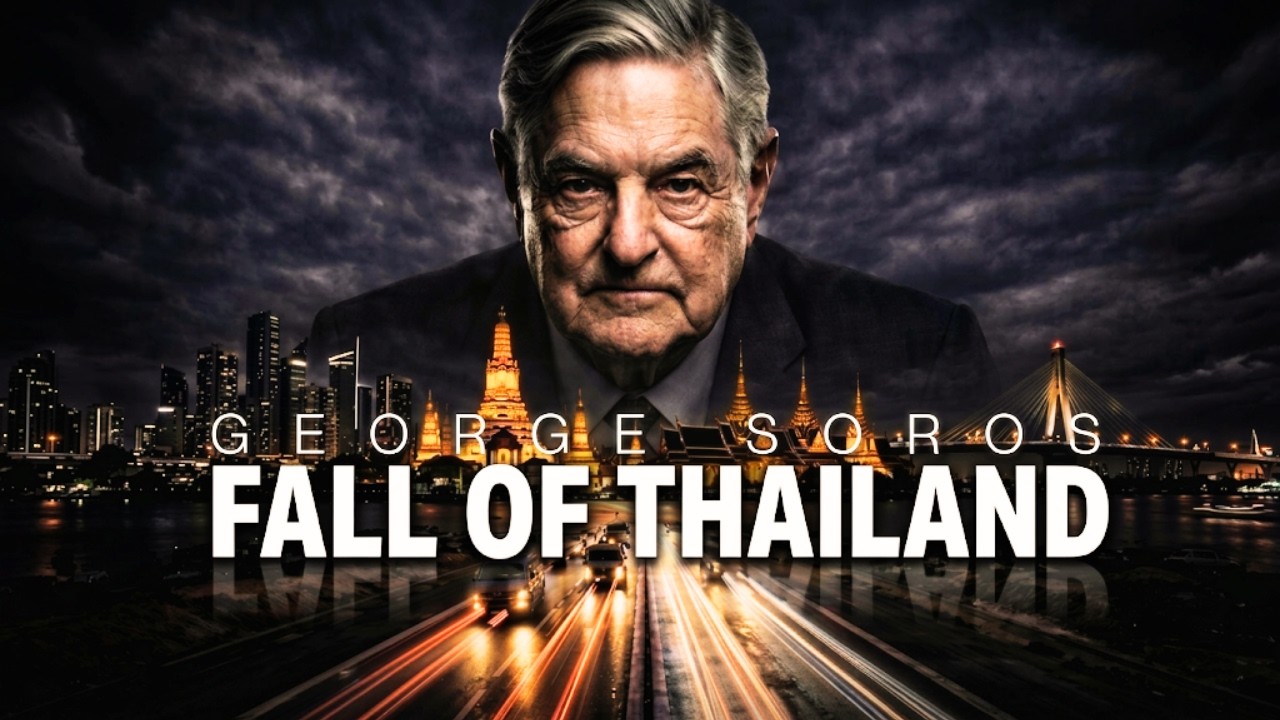
How GEORGE SOROS made $2 BILLION by CRASHING THAILAND's Economy | Economic Case Study
Executive Summary
A Think School economic case study of how George Soros's fund profited from the 1997 Thai baht crisis. The presenter explains Japan's Plaza Accord, why Japanese firms moved to Thailand, Thailand's fixed exchange rate promise, a simplified forward contract example, the crash, and long-term effects, ending with three lessons for India. The caption text covers the whole 15 minute video. The numbers in the worked example are hypothetical illustrations, and claims such as Soros causing the collapse, 2 billion dollars of profit and poverty rising from 35 to 45 percent are the presenter's statements, not independently checked. The presenter's moral framing is opinion. This is not investment or financial advice. Captions are automatic with errors. Topics are untimed; metadata follows YouTube. Think School lists Odoo as a sponsor. Source: https://youtubetotranscript.com/transcript?v=xDSi8-vyZIs
Key Takeaways
The claim
The presenter says George Soros and his friends found a loophole in Thailand's economy and made about 2 billion dollars without building a factory or hiring a worker. Soros is quoted saying he cannot look at the social consequences of what he does.
Why Thailand boomed
After the 1985 Plaza Accord doubled Japan's labour costs in dollar terms, Japanese firms moved production to Malaysia, Indonesia, the Philippines and Thailand. He says Thai income tripled in about 10 years and GDP rose from 38 billion dollars in 1985 to 180 billion in 1996.
The fixed-rate promise
The Bank of Thailand promised to swap 25 baht for 1 dollar. The presenter contrasts this with the RBI, which he says lets the market set the price.
The forward contract example
He uses simplified numbers: a contract to hand over 25 billion baht for 1 billion dollars in six months. Banks hedged by selling baht to the central bank, which drained its dollars. He says it had paid out 23.4 billion and had about 2.8 billion left.
The break and the payoff
On 2 July 1997 Thailand let the baht float and it fell from about 25 to 50 per dollar. In his example, buying baht at the new rate costs 500 million dollars for a 1 billion dollar return.
The damage
He says oil prices doubled, real estate firms failed, poverty rose from about 35 to 45 percent, and the unfinished Sathorn Unique Tower became a symbol. He adds that tourism, high-tech exports and demographics are weak today.
Three lessons for India
He says controlling a free market backfires, cheap labour only goes so far, and nations must get over trauma. He compares Thailand and South Korea and calls India's R&D spending weak. These are his opinions.
The Conversation Breakdown
The claim
⏱ Untimed topicThe presenter says George Soros and his friends found a loophole in Thailand's economy and made about 2 billion dollars without building a factory or hiring a worker. Soros is quoted saying he cannot look at the social consequences of what he does.
Why Thailand boomed
⏱ Untimed topicAfter the 1985 Plaza Accord doubled Japan's labour costs in dollar terms, Japanese firms moved production to Malaysia, Indonesia, the Philippines and Thailand. He says Thai income tripled in about 10 years and GDP rose from 38 billion dollars in 1985 to 180 billion in 1996.
The fixed-rate promise
⏱ Untimed topicThe Bank of Thailand promised to swap 25 baht for 1 dollar. The presenter contrasts this with the RBI, which he says lets the market set the price.
The forward contract example
⏱ Untimed topicHe uses simplified numbers: a contract to hand over 25 billion baht for 1 billion dollars in six months. Banks hedged by selling baht to the central bank, which drained its dollars. He says it had paid out 23.4 billion and had about 2.8 billion left.
The break and the payoff
⏱ Untimed topicOn 2 July 1997 Thailand let the baht float and it fell from about 25 to 50 per dollar. In his example, buying baht at the new rate costs 500 million dollars for a 1 billion dollar return.
The damage
⏱ Untimed topicHe says oil prices doubled, real estate firms failed, poverty rose from about 35 to 45 percent, and the unfinished Sathorn Unique Tower became a symbol. He adds that tourism, high-tech exports and demographics are weak today.
Three lessons for India
⏱ Untimed topicHe says controlling a free market backfires, cheap labour only goes so far, and nations must get over trauma. He compares Thailand and South Korea and calls India's R&D spending weak. These are his opinions.
Core Frameworks & Ideas
Fixed exchange-rate trap - presenter's account
A promise to hold a price invites traders to test it until reserves run out.
Cheap labour ceiling - presenter's lesson
Countries that do not move up to R&D and design stall, as he says Thailand did relative to South Korea.
Trauma shapes policy - presenter's lens
Fear after a crisis can make countries over-save and under-invest in people.
Actionable Next Steps
- ✓Compare how the RBI and the Bank of Thailand each handled their exchange rate.
- ✓Work through the baht forward-contract example with your own hypothetical numbers.
- ✓Look up Thailand's reserves and tourism figures from official sources.
- ✓Check which of your own costs depend on a single fixed price or supplier.
Notable Quotes
“trying to control a free market is like trying to hold a pile of sand with tight palms”
“cheap labor can only get you so far”
“an old man in a young neighborhood”
The One Thing to Remember
A fixed exchange-rate promise is a one-way bet for anyone who can test it, and the country pays when the promise breaks.