


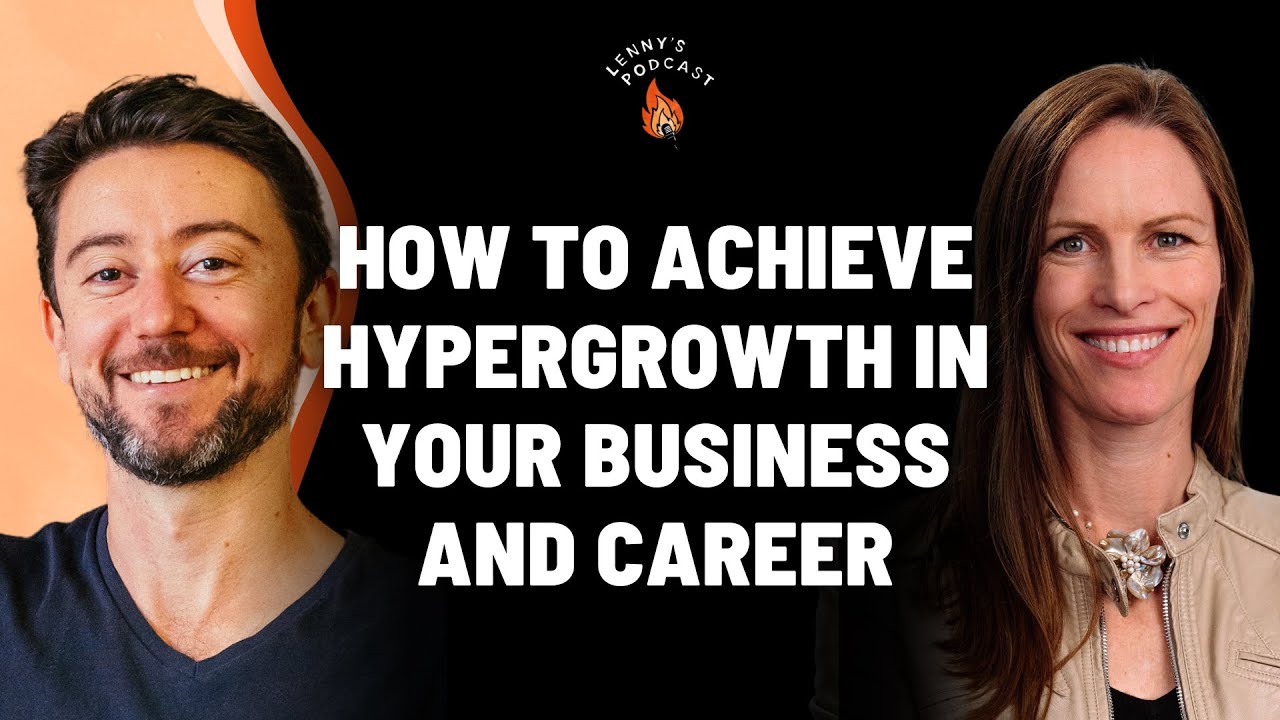
How to achieve hypergrowth in your business and career | Carilu Dietrich (Atlassian)
Executive Summary
Carilu Dietrich joins Lenny Rachitsky on useful thought leadership, community, selective sales alongside product-led growth, coordinated growth levers and landing with one product. Selected coverage omits career tradeoffs, unemployment advice and AI mentions. Company examples are her account, unverified here. Untimed editorial topics are not video chapters.
Key Takeaways
Start with a product people value
Dietrich argues that advertising amplifies the product experience rather than repairing it. A large awareness budget does not automatically create loyal users. Her company examples are retrospective accounts, not independently verified measurements of advertising return.
Support thought leaders and useful content
She describes employees with deep expertise participating in existing communities and sharing ideas. Helpful content can give people a reason to talk about the company. This is a way to encourage word of mouth rather than demand that customers promote a product.
Bring customers and prospects together
Happy customers can explain the product in ways that a sales-heavy event cannot. Dietrich recounts user groups that also helped people learn and build networks. A community should provide its own value instead of becoming only a lead-generation mechanism.
Use sales where the buying process needs it
She describes product-led growth and sales as coexisting. The appropriate mix depends on the product, how quickly people get value and how the buyer purchases. Hiring a sales team too far ahead of real customer resonance can add substantial cost.
Read customer signals before expanding sales
Her examples include sales engaging after product usage has demonstrated interest, and people helping users progress through a complex product. These are interview-era examples, not fixed thresholds. Ask where help is useful rather than copying another company's headcount or trigger.
Make large growth levers a company choice
New products, segments, verticals, geographies and partner channels require coordinated work. Dietrich warns that a department cannot deliver such a shift by itself. Product, marketing, research, support and sales need a shared direction and resources.
Distinguish landing from expansion
She says bundles slowed Atlassian's product-led entry motion and that the team returned to quick value from one product before adding others. She sees bundling differently in a sales-led motion. This is her experience, not a universal rule against bundles; selected coverage omits career tradeoffs, unemployment advice and AI mentions.
The Conversation Breakdown
Start with a product people value
⏱ Untimed topicDietrich argues that advertising amplifies the product experience rather than repairing it. A large awareness budget does not automatically create loyal users. Her company examples are retrospective accounts, not independently verified measurements of advertising return.
Support thought leaders and useful content
⏱ Untimed topicShe describes employees with deep expertise participating in existing communities and sharing ideas. Helpful content can give people a reason to talk about the company. This is a way to encourage word of mouth rather than demand that customers promote a product.
Bring customers and prospects together
⏱ Untimed topicHappy customers can explain the product in ways that a sales-heavy event cannot. Dietrich recounts user groups that also helped people learn and build networks. A community should provide its own value instead of becoming only a lead-generation mechanism.
Use sales where the buying process needs it
⏱ Untimed topicShe describes product-led growth and sales as coexisting. The appropriate mix depends on the product, how quickly people get value and how the buyer purchases. Hiring a sales team too far ahead of real customer resonance can add substantial cost.
Read customer signals before expanding sales
⏱ Untimed topicHer examples include sales engaging after product usage has demonstrated interest, and people helping users progress through a complex product. These are interview-era examples, not fixed thresholds. Ask where help is useful rather than copying another company's headcount or trigger.
Make large growth levers a company choice
⏱ Untimed topicNew products, segments, verticals, geographies and partner channels require coordinated work. Dietrich warns that a department cannot deliver such a shift by itself. Product, marketing, research, support and sales need a shared direction and resources.
Distinguish landing from expansion
⏱ Untimed topicShe says bundles slowed Atlassian's product-led entry motion and that the team returned to quick value from one product before adding others. She sees bundling differently in a sales-led motion. This is her experience, not a universal rule against bundles; selected coverage omits career tradeoffs, unemployment advice and AI mentions.
Core Frameworks & Ideas
People, content, community
Support expertise and customer connections that give word of mouth something useful to spread.
PLG with selective sales
Match human help to product complexity, buying behavior and evidence of interest.
Company-wide growth levers
Coordinate product, audience, geography or channel changes across the business.
Actionable Next Steps
- ✓Give a knowledgeable employee a useful platform for teaching.
- ✓Ask where customers need human help to get value or buy.
- ✓Choose a growth lever and map the cross-company work it requires.
- ✓Test a simple single-product entry before assuming a bundle is the best landing offer.
Notable Quotes
“So no one sells your product better than your own happy customers.”
“Net new prospecting is a really expensive way to get new customers.”
“The big growth levers are pretty consistent across companies.”
The One Thing to Remember
Make growth a company strategy built on customer value, not an isolated marketing assignment.