


Executive Summary
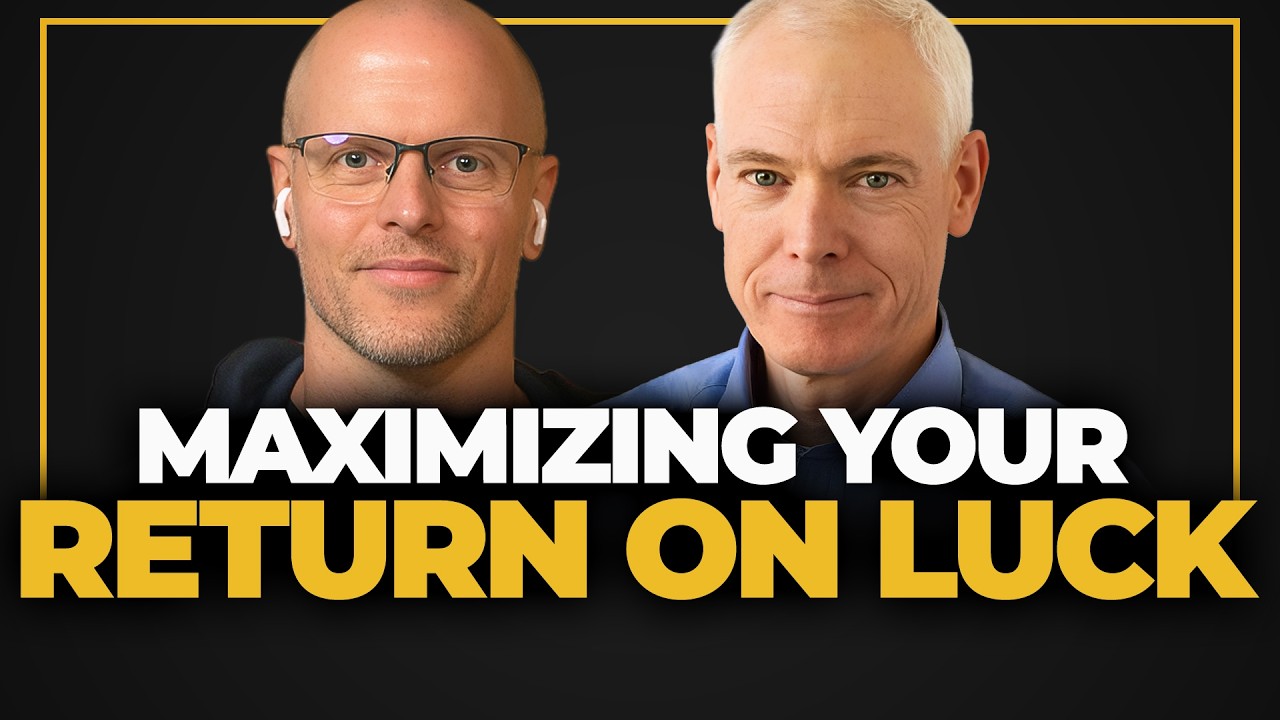
Collins describes finding and trusting work that fits, with uncertainty sometimes lasting well beyond an obvious turning point. He distinguishes effort from being pulled into a project and defines luck through events, people and historical timing. His concepts are lenses from his work and life, not universal formulas or guarantees. Chapter times are taken from the video rather than the differently timed audio notes.
Key Takeaways
Fit is broader than one predetermined calling
Collins says the range of activities a person might be encoded to do is vast and discovering one can involve randomness. Encodings are his language for natural fit, not a genetic test or a guarantee of talent. The concept allows exploration rather than insisting that every person has exactly one discoverable life assignment.
Trusting a discovered fit matters in his account
Asked to divide points between finding encodings and trusting them, he places most on trust. The illustration emphasizes not letting other people’s expectations automatically displace meaningful work. The number is his judgment, not a measured optimum or a reason to ignore feedback about skill, consequences or practical limits.
Rare opportunities still need a reason
Collins argues that once-in-a-lifetime describes how often something occurs, not whether it fits one’s work or life. He recounts learning to say no to opportunities that consumed his time. The lens is to evaluate an offer’s purpose and cost, not to reject unfamiliar possibilities or assume every commitment outside one’s current project is a mistake.
Fog is an uncertainty phase, not a verdict on a life
He describes periods of confusion and disorientation in the lives he studied, sometimes after large cliff events. The account can separate uncertainty from an immediate conclusion of failure. It is not a clinical description or reassurance that every difficulty resolves on its own; the examples do not prove one universal trajectory.
Being compelled is different from exercising discipline
Collins reflects that some of his apparent discipline came from loving a project so much he wanted to keep working. He distinguishes that pull from forcing himself to act. His early-morning routine is personal, not advice to shorten sleep, overwork or use exhaustion as proof that one has found the right activity.
Luck has several forms in his framework
He distinguishes what luck, an event; who luck, an influential person; and zeit luck, alignment with a historical moment. He separates an event one did not cause from the response to it. These are his definitions and interpretations, not a way to calculate a person’s deserved success or a claim that every hardship is an opportunity.
Some moments may call for a different response
Collins uses NATALIE, Not All Time In Life Is Equal, for moments that can deserve unequal attention. He connects recognizing them with getting a return on luck. The concept is not an instruction to risk everything or a promise that exceptional commitment produces success; the value and limits of a response still need judgment.
The Conversation Breakdown
Encodings and trust
⏱ 49:11Collins explains his language for fit and then discusses trusting what one discovers. The official video chapter start is used, rather than the differently aligned audio chapter list.
Core Frameworks & Ideas
Encodings and trust
Collins’s language for noticing fit and deciding how much confidence to place in it.
What, who and zeit luck
Distinguish events, people and historical timing from the response one chooses.
NATALIE moments
Not All Time In Life Is Equal, his lens for recognizing moments that may deserve different attention.
Actionable Next Steps
- ✓Describe an activity that draws your effort and the evidence of fit.
- ✓Evaluate an opportunity by its purpose and cost, not only its rarity.
- ✓Separate an event you did not cause from the response you can choose.
- ✓Name the specific uncertainty in a project instead of treating all of life as one unresolved question.
Notable Quotes
“just because something's a once in a lifetime opportunity is merely a fact, it's not a reason.”
“I'm going to put 70 points on trust.”
“that's not discipline. You're just compelled. It's almost a form of compulsion, which isn't discipline.”
The One Thing to Remember
The rarity of an opportunity is a fact, not by itself a reason to accept it.