


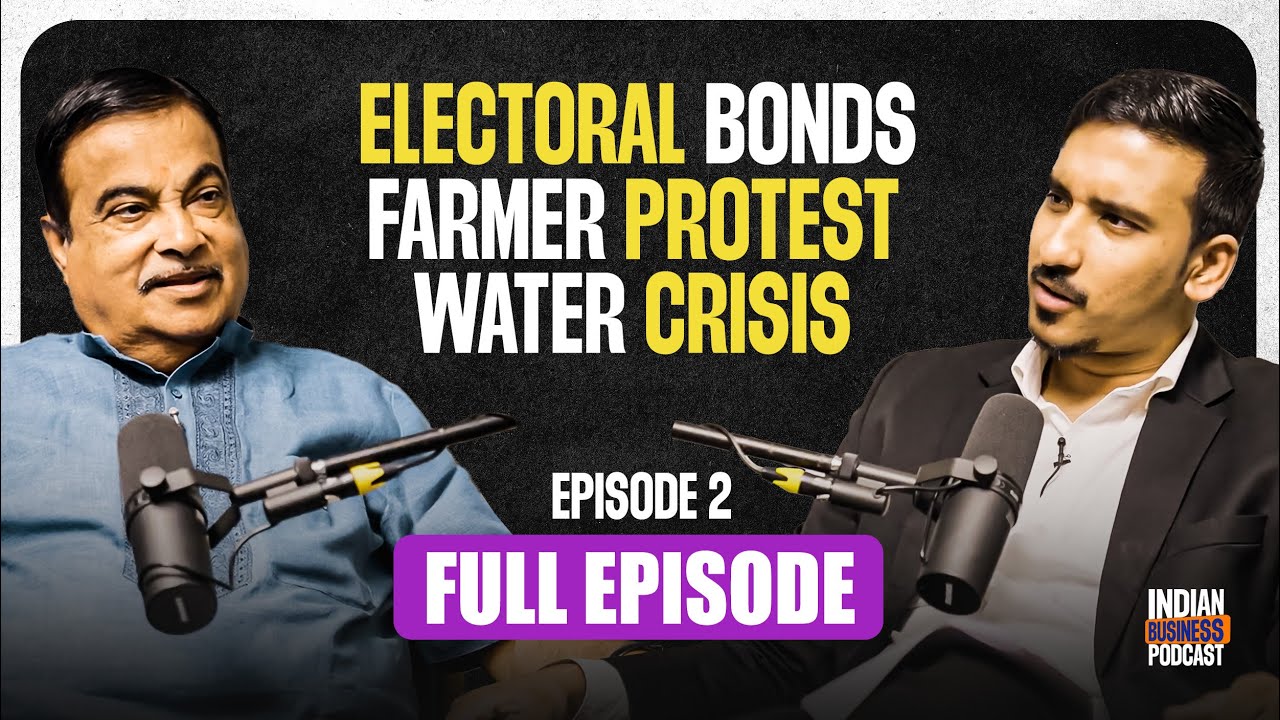
Nitin Gadkari breaks his Silence on Electoral Bonds, Farmer protest & his Vision for India: IBP Ep 2
with Nitin Gadkari
Executive Summary
Nitin Gadkari, Union Minister for Road Transport and Highways, walks through his journey from an RSS swayamsevak in Nagpur to the 'Highway Man of India': the values training he credits for his working style, his cross-party affection for Balasaheb Thackeray, and Chhatrapati Shivaji Maharaj as his leadership ideal. He explains how he unstalled 406 projects worth Rs 3.85 lakh crore after 2014, why he terminated Rs 40,000 crore of unworkable projects, and how fair land compensation turned acquisition from conflict into demand. He lays out NHAI's money math across toll, monetization and the EPC-hybrid annuity-BOT ladder, Nagpur's waste-to-wealth makeover, the blocked transshipment ports, and his bets on EVs, ethanol and bio-aviation fuel, before giving his positions on MSP, electoral bonds and a poor-centric economic model. All views and claims are the speakers' own.
Key Takeaways
Skills are built by practice, values and organisation
Gadkari traces his rise from Nagpur to Union minister not to personal brilliance - he explicitly disclaims it - but to RSS training: the organisation accepts people with their flaws, reduces the flaws and grows the strengths. His student-wing and RSS lessons became, in his words, his personality's strength.
Politics can hold differences without enmity
Across party lines, Balasaheb Thackeray called him 'mera Nitin' and refused a flyover photo until Gadkari arrived. As opposition leader Gadkari says he also welcomed and supported good government decisions. His rule: matbhed and matbhinnata are fine, dushmani is not.
Ownership is checking the equipment two hours early
His live example: the interview crew set up microphones, lights and recording and never tested them. Ownership, he says, is arriving two hours early and personally verifying every dependency - negligence in small things signals negligence in big ones.
Stalled projects were a coordination failure - and coordination fixed them
When he became minister, 406 projects worth Rs 3.85 lakh crore were stuck on land, utility shifting, railway clearances and bank NPAs. He called contractors and bankers together, solved what was genuine and restarted the rest, saving banks Rs 3 lakh crore of NPA, and terminated Rs 40,000 crore of work that could not be saved.
Fair compensation flipped land acquisition from conflict to demand
The 2014 Land Acquisition Act he piloted pays two to three times the ready-reckoner rate, above market price. Bharatmala's cost rose from Rs 3.5 lakh crore to Rs 8.5-9 lakh crore, but farmers now ask the government to take their land because compensation beats the market and their remaining plot appreciates.
Every project must stand on its own economics
Gadkari rejects the claim that NHAI's interest burden outruns toll growth: toll income is Rs 45,000 crore a year and heading to Rs 1,30,000 crore, a Rs 1,200 crore asset monetized for 15 years brings Rs 2,000 crore, and the EPC, hybrid-annuity and BOT ladder matches each project to a viable funding model.
The farmer becomes the energy provider
From stubble and rice straw to ethanol, bio-bitumen and sustainable aviation fuel - a Panipat plant turns rice straw into 1 lakh litres of ethanol a day plus 150 tonnes of bio-bitumen and 76,000 tonnes of SAF - Gadkari's vision moves the farmer from annadata to urjadata, with bamboo ethanol in the Northeast and 20% blending in fuel exports to Bangladesh.
The Conversation Breakdown
RSS, sanskar and the making of the 'Highway Man'
⏱ Untimed topicGadkari recounts building the Worli-Bandra Sea Link, 55 flyovers and the Mumbai-Pune expressway in Maharashtra before becoming party president and Union minister. He credits RSS character-building - accepting people with their flaws and growing their strengths - and explains 'apoornank': nobody is 100% perfect, and becoming a better person means growing your virtues and shrinking your flaws.
Thackeray, opposition years and Shivaji Maharaj's ideal
⏱ Untimed topicHe recalls Balasaheb Thackeray's open-hearted affection across party lines - 'mera Nitin', the flyover photo he refused to take without him - and his own rule that politics should hold disagreement without enmity. He describes Chhatrapati Shivaji Maharaj, in Ramdas Swami's portrait, as the complete ideal: warrior, administrator, ideal son and father, whose army respected farmers' fields - the 'Shivshahi' or Ramrajya he says his politics aims at.
Unstalling 406 projects: ownership as a working method
⏱ Untimed topicAs minister in 2014 he found 406 projects worth Rs 3.85 lakh crore stalled on land, clearances and NPAs. His method: call contractors and bankers in, understand each problem, fix what is genuine, restart the work, terminate what cannot be saved. He frames positivity, transparency and understanding others' problems as leadership essentials, with the microphone-check story as his definition of ownership.
Bharatmala, 36 expressways and Mumbai's road mismatch
⏱ Untimed topicHe maps the Bharatmala programme, the Atal Tunnel (3.5 hours to 8 minutes), the Zojila and Z-Morh tunnels and 36 greenfield expressways cutting Delhi-Dehradun to 2 hours and Delhi-Meerut to 45 minutes, and claims India's highway network now rivals or exceeds America's. On Mumbai's internal congestion he cites Atal Setu, the JNPT-Khopoli link and the coastal road, the limits of a city ringed by sea, and the need to decentralize toward a third Mumbai in Raigad - while noting that protest and litigation culture is the price democracy pays and must work through.
NHAI's money math: toll, monetization, EPC, HAM and BOT
⏱ Untimed topicGadkari disputes an Economic Times graph on NHAI interest costs, citing Rs 45,000 crore annual toll income rising to Rs 1,30,000 crore and lifelong toll streams backing 15-year monetization. He explains the three models - EPC (government funds, then toll), hybrid annuity (40% government, 60% private) and BOT (100% private, build-operate-transfer) - with his first BOT road on the Mumbai-Nasik route, the 'daughter's marriage conditions' story about over-strict tender policy, and the Mathura 90 MLD sewage plant whose treated water earns Rs 20 crore a year from Indian Oil.
Waste to wealth, Nagpur's makeover and the transshipment fight
⏱ Untimed topicFrom treated sewage sold for Rs 300 crore to waste-segregated CNG for city buses, plastic and tyre powder in bitumen and plastic-to-crude, his line is that nothing and no one is waste. He lists Nagpur's 24x7 slum water supply, pothole-free concrete roads 'guaranteed for two generations', its education and aviation hubs and 68,000 jobs. On ports he lays out Sagarmala as a capacity-and-efficiency programme run on a landlord model: the government acquires land and builds the breakwater with its own money, then hands cranes and operations to private players through BOT public-private partnership, with new ports and four-, six- and eight-lane connectivity roads alongside. On the missing transshipment port he cites a Sivakasi case study: 95% of India's firecrackers come from Sivakasi, and without a domestic hub they ship through Colombo, where he says Chinese vessels reject the cargo to shut out competitors - capturing even 30% of that market, he argues, would triple India's firecracker industry. He also describes the Vizhinjam port saga, empty containers routing through Colombo under Chinese influence, and the Andaman transshipment hub blocked by environment litigation.
EVs, ethanol, MSP and the economic model for India
⏱ Untimed topicHe predicts EV-petrol price parity within 6-8 months of the recording, cites Jammu's lithium find and alternatives like aluminium-ion and aluminium-air, and 400 electric-scooter startups making about half of two-wheeler production; on supply chains he notes lithium comes from China and cobalt from Congo, with recycling as his answer. On ethanol he is bullish about E20, estimating India's requirement at about 10.16 billion litres from corn, wheat, rice and sugarcane - three of them water-guzzling crops - which leads to his water arguments: a national water grid, the Rs 2,500 crore concrete Indira canal carrying water to nine Rajasthan districts, 19 of 24 inter-state water disputes settled in his tenure, and recycled water for industry. On farm economics he argues for productivity and lower input costs (nano urea, drone spraying) over legal MSP, noting MSP already exceeds market prices, and pushes value addition: ethanol from bamboo, bio-bitumen and aviation fuel from stubble. On the vision for India he argues both socialism and capitalism have failed and India needs a poor-centric, employment-generating, tourism- and manufacturing-led model, with direct benefit transfers cleaning up corruption.
Core Frameworks & Ideas
Apoornank: nobody is the complete edition
Gadkari's framework from the RSS: every person is a partial edition - 60%, 70%, 80% - of virtues and flaws. Personal growth and institution-building both mean accepting people as raw material, reducing flaws and growing strengths, rather than hunting for a 100% perfect person who does not exist.
The EPC-HAM-BOT funding ladder
Match the project to the money: EPC uses government funds and recovers through toll; hybrid annuity splits 40% government grant with 60% private capital; BOT hands build-operate-transfer to private money entirely. He applied the same installment logic to a Mathura sewage plant: Rs 100 of work done for Rs 40 of public money, repaid by selling treated water.
40-40-20 land pooling
Instead of buying land outright: take the owner's land, develop 40% of it with roads, water and power and return it to the owner, keep 40% for government use, and spend 20% on infrastructure. The owner's returned land jumps many multiples in value - he cites Ratan Tata endorsing this model and says it turns acquisition losers into partners.
The potential-facilities-employment-wealth chain
His economy formula: identify a region's inherent potential (for Nagpur: tigers, oranges, central location), build the facilities that exploit it, convert facilities into employment, and convert employment into wealth - applied equally to tourism circuits, logistics parks and manufacturing.
Actionable Next Steps
- ✓Run Gadkari's ownership check before your next important deliverable: arrive early and personally test every dependency - equipment, data, people - instead of assuming someone else did.
- ✓Take one stalled project in your work, list its three real blockers (money, approvals, coordination), and bring the people behind each blocker into one conversation.
- ✓Apply the apoornank test to yourself this week: write down two virtues to grow and two flaws to shrink, rather than chasing a perfect version of yourself.
- ✓Find one 'waste' stream in your home or business - food scraps, packaging, idle capacity - and research one route that converts it into value.
- ✓Before opposing a colleague's idea by default, do what Gadkari says he did in opposition: state what is genuinely good in it first, then disagree with reasons.
Notable Quotes
“In politics there can be differences of opinion and there can be divergence, but there should never be enmity. (translated from Hindi)”
“Nothing is waste, and no person is waste. (translated from Hindi)”
“Running away after seeing a problem is not the solution; overcoming the problem and moving ahead is the solution. (translated from Hindi)”
“None among us is 100% perfect. We are all incomplete editions. (translated from Hindi)”
“Now the farmer will not remain only the food-giver, he will become the energy-giver. (translated from Hindi)”
“Taking action is very easy; calling someone useless and discarding them is very easy. (translated from Hindi)”
The One Thing to Remember
Gadkari's working formula in one line: accept the problem, reduce it, overcome it and keep moving - ownership plus a problem-solving attitude matter more than any obstacle.