


OpenAI's Genius Comeback : How Altman Turned a $27B Loss Into an EMPIRE?
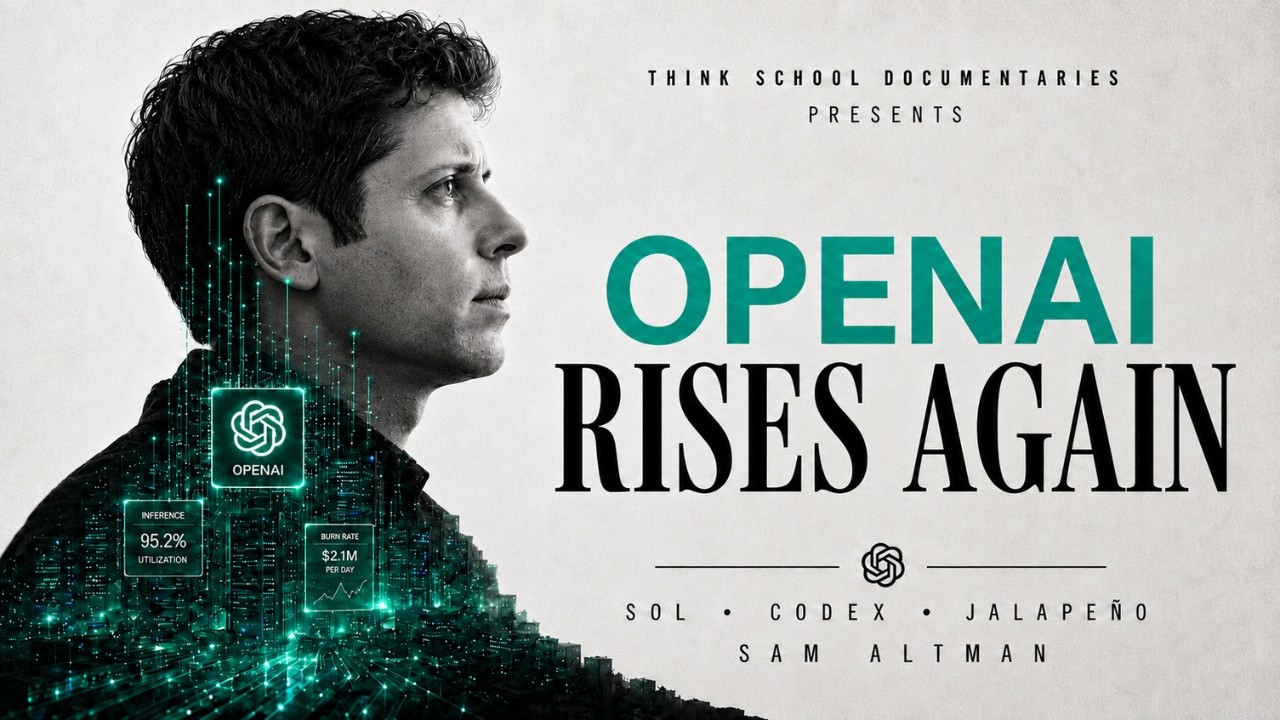
Executive Summary
For three years, OpenAI ran what Think School calls the most confusing business on Earth: the more it grew, the more it bled, because every ChatGPT answer is an inference cost and its best customers are its least profitable ones. The video breaks down the two traps - competition collapsing token prices a thousand-fold in three years, and the landlord problem of renting Nvidia chips and Microsoft data centers at a 75% gross margin to the landlords - and then the four comeback moves of the last 90 days: GPT-5.6 matching Claude Fable 5 at about a third of the cost, Codex exploding 500%, the GPT Work super app, and Halapino, a custom Broadcom-designed inference chip claimed to cut cost per token by about 50%. The catch is Jevons paradox: cheaper intelligence means more usage, not savings. FULL COVERAGE: the captions appear to cover the entire episode. All figures and product claims are as stated by the channel, not independently verified. Sponsor: none stated in the episode. Nothing here is investment advice.
Key Takeaways
A $33 billion loss on $25 billion of revenue
OpenAI is on track to lose $33 billion in 2026 even though revenue grew 92% to a $25 billion run rate - and Sam Altman has said they lose money even on $200 Pro subscribers.
Inference is the whole problem
Training happens once, but inference happens every time someone places an order - multiplied by 900 million people, OpenAI will burn about $14 billion on inference in 2026 alone.
The best customers lose the most money
Analysts estimate a heavy user firing 100 queries a day burns more than $30 of compute a month while paying $19.99 - so OpenAI loses about $10 on her every month, and the more she loves the product, the more it loses.
Two traps: prices racing down and the landlord cost
GPT-3-level intelligence fell from $60 per million tokens in November 2021 to 6 cents by late 2024, so OpenAI cannot raise prices; and of Jensen Huang's five layers - energy, chips, infrastructure, models, applications - OpenAI owned only the models, renting the rest from Nvidia (75% gross margin) and Microsoft.
GPT-5.6 matched Claude at a third of the cost
Launched July 9, 2026, Soul and Terra beat Claude Fable 5 on the coding index; Soul does a task for about $1.86 versus Fable 5's $3.15, and Luna for about $0.07 - and Anthropic responded by extending Fable's availability in subscriber plans instead of pulling it.
Codex makes the cost problem bigger
Codex writes code, ships websites and runs multi-step jobs; its active users exploded 500% and it stays included on every ChatGPT plan - but one Codex task can cost what a hundred ChatGPT questions cost.
Halapino could halve the inference bill
OpenAI's first custom inference-only chip, designed with Broadcom, is claimed by Broadcom's CEO to deliver roughly 50% lower cost per token at performance on par with Nvidia's best Blackwell chips - but Jevons paradox means cheaper AI drives insanely more usage, not savings.
The Conversation Breakdown
Why OpenAI loses money on premium subscribers
⏱ Untimed topicThe Tanisha example: a $19.99 Plus subscriber firing 100 queries a day can burn over $30 of compute a month, so OpenAI loses about $10 a month on its most loyal users.
Training cost versus inference cost
⏱ Untimed topicThe chef analogy: training is the one-time cost of culinary school; inference is the stove firing for every order - and 900 million people place billions of orders a week.
The thousand-fold collapse in token prices
⏱ Untimed topicGPT-3-level intelligence went from $60 per million tokens in November 2021 to 6 cents by late 2024, while Google made Gemini free and Anthropic cut prices - so raising prices just moves users to a competitor in 30 seconds.
The five-layer cake and the landlord trap
⏱ Untimed topicEnergy, chips, infrastructure, models, applications: OpenAI owned only the model layer, paying Nvidia's 75% gross margin on chips and renting Microsoft's data centers - a restaurant that owns neither kitchen nor building and cannot raise menu prices.
GPT-5.6, Soul, Terra and Luna
⏱ Untimed topicThe July 9, 2026 launch matched or beat Claude Fable 5 on the coding and agenting indices at roughly half the time and cost, forcing Anthropic to keep Fable inside subscriber plans.
Codex and GPT Work
⏱ Untimed topicCodex is framed as an autopilot for the mind that lets a billion people build software, and GPT Work folds email, docs, files and Codex into one screen - while multiplying the inference cost per user.
Halapino and Jevons paradox
⏱ Untimed topicThe custom Broadcom-designed inference chip could halve the $14 billion inference bill - Soul creates demand, Codex blows up usage, Halapino halves the cost of every answer - but Jevons paradox means cheaper intelligence gets used more, pushing the threshold again.
Core Frameworks & Ideas
Training vs Inference (the Chef Analogy)
Training is the one-time cost of sending a chef to culinary school; inference is the stove firing up for every single order. At 900 million users placing billions of orders a week, inference - not training - is what bankrupts an AI company.
The Five-Layer Cake
Jensen Huang's stack: energy, chips, infrastructure, models, applications. A player that owns only the model layer rents everything else - Nvidia's chips at 75% gross margin, Microsoft's data centers, somebody else's electricity - and carries a landlord cost that caps its margins.
Jevons Paradox
When you make something 10x cheaper, people do not use less of it, they use insanely more of it. Cheaper tokens will not save OpenAI money; they expand usage, so the cost threshold has to keep falling.
Actionable Next Steps
- ✓If you build on AI APIs, plan for token prices to keep falling and design products that profit from more usage rather than rationing it.
- ✓Compare models on cost per completed task, not per token - $1.86 versus $3.15 versus $0.07 for the same task reframes the choice entirely.
- ✓Budget agent-style tools like Codex as a step-change in cost: one agent task can run to a hundred times a chat query.
- ✓Track whether custom silicon like Halapino actually ships at the claimed 50% lower cost per token - it determines which AI companies reach profitability.
Notable Quotes
“in a normal company, your best customers are your most profitable customers, but in OpenAI's world, their best customers are their least profitable customers.”
“So, OpenAI is a restaurant that does not own the kitchen, does not own the ovens, and does not own the building. And more importantly, it cannot even raise its menu prices.”
“When you make something 10x cheaper, people don't use less of it, they use insanely more of it. This is called Jevons paradox”
The One Thing to Remember
OpenAI loses money because inference never sleeps - so its entire comeback is one bet: make every single answer radically cheaper, from the model to the chip.