


Strange Fall of Oracle | How a $300 Billion AI Deal Changed Everything?
Executive Summary
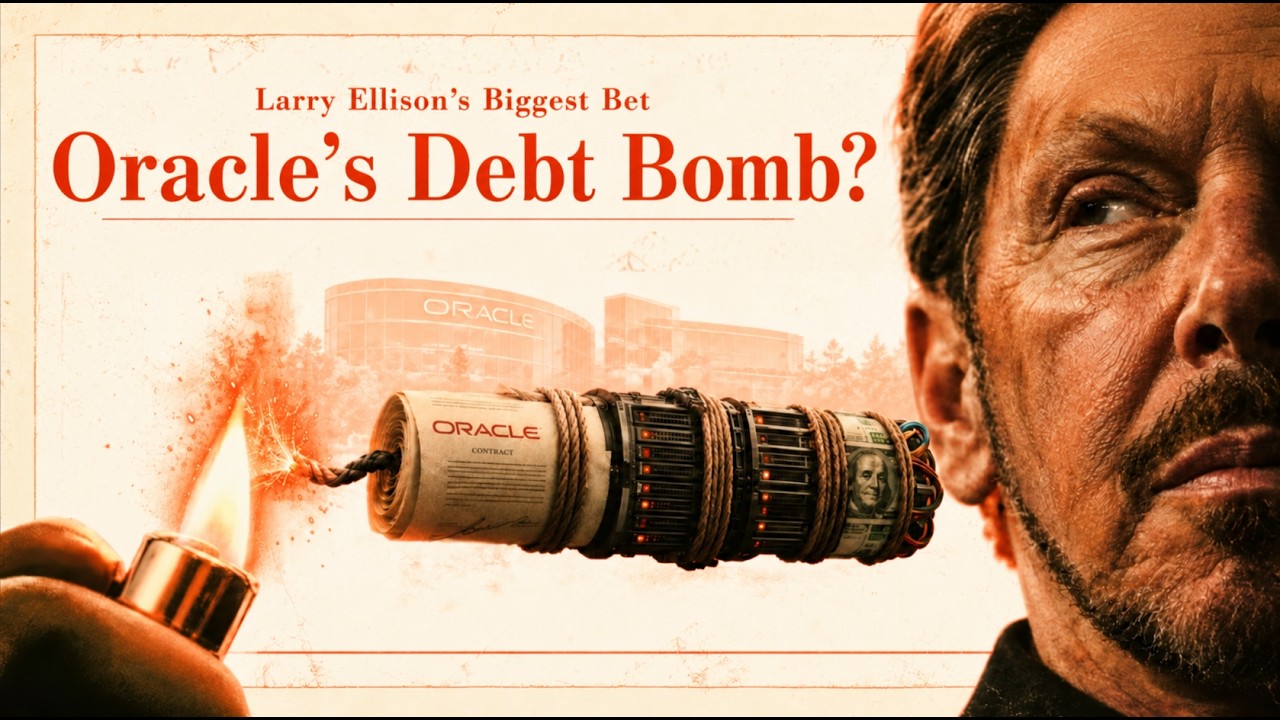
Think School explains how Oracle went from the hottest stock of 2025 to a 56 percent fall from its peak. The video traces Oracle's original model of selling database software while customers owned the machines, how Amazon Web Services inverted that model by renting computing by the hour, and how the September 2025 announcement of a roughly $300 billion, five-year computing deal with OpenAI inflated Oracle's remaining performance obligations to $455 billion and briefly made Larry Ellison the world's richest man. It then shows why investors turned skeptical: the deal flips Oracle into an asset-heavy build-now-rent-later business funded by borrowing, OpenAI's promise of about $60 billion a year is many times its own revenue at the time, and a stress test shows interest costs climbing toward half of profits while credit default swap prices signal four times the earlier default nervousness. FULL COVERAGE: the captions appear to cover the entire episode. All figures are as stated by the channel, not independently verified. Sponsor: none stated in the episode (the outro promotes the channel's own job application form). Nothing here is financial advice.
Key Takeaways
Oracle got rich selling software, never machines
For three decades Oracle's rule was simple: let customers buy the servers, the air-conditioned rooms and the engineers, while Oracle sold the SQL database software - a business with gross margins near 70 percent.
AWS inverted the model and ate the future
From 2006, Amazon rented computing by the hour like electricity, letting a two-person startup match a corporation's computing power; Airbnb, Slack and Pinterest grew on it, and Bezos kept AWS financials secret for nine years while Ellison mocked the cloud until 2016.
One contract added $100 billion to Ellison's fortune in a day
In September 2025 Oracle reported $455 billion in remaining performance obligations against about $180 billion expected, driven by OpenAI's roughly $300 billion five-year commitment, and the stock jumped 36 percent in a single day.
Both companies are stretched beyond their size
OpenAI promised about $60 billion a year to Oracle from 2027 while its own revenue at the time was about $12 billion a year, and Oracle's operating cash flow was about $21.5 billion a year.
The deal flips Oracle into an asset-heavy business
Renting computing power needs land, buildings, power and Nvidia chips at roughly 30 to 40 percent gross margins; Oracle spent $84 billion in 15 months while generating $55 billion in cash, and borrowed the difference.
The J-curve hides three ways to never profit
If the customer starts paying a year late, interest keeps running; if rent falls from $30 to $20, break-even stretches from three years to five; and if chips go obsolete in four years, they must be replaced before any real profit appears.
The market now prices real default fear
In the video's stress test, profits could fall from $27 billion to $20 billion while interest climbs to $9.5 billion a year, and Oracle's credit default swaps moved from about $5,000 to about $20,000 per $1 million insured - a fourfold jump in perceived risk.
The Conversation Breakdown
Oracle got rich selling software, never machines
⏱ Untimed topicFor three decades Oracle's rule was simple: let customers buy the servers, the air-conditioned rooms and the engineers, while Oracle sold the SQL database software - a business with gross margins near 70 percent.
AWS inverted the model and ate the future
⏱ Untimed topicFrom 2006, Amazon rented computing by the hour like electricity, letting a two-person startup match a corporation's computing power; Airbnb, Slack and Pinterest grew on it, and Bezos kept AWS financials secret for nine years while Ellison mocked the cloud until 2016.
One contract added $100 billion to Ellison's fortune in a day
⏱ Untimed topicIn September 2025 Oracle reported $455 billion in remaining performance obligations against about $180 billion expected, driven by OpenAI's roughly $300 billion five-year commitment, and the stock jumped 36 percent in a single day.
Both companies are stretched beyond their size
⏱ Untimed topicOpenAI promised about $60 billion a year to Oracle from 2027 while its own revenue at the time was about $12 billion a year, and Oracle's operating cash flow was about $21.5 billion a year.
The deal flips Oracle into an asset-heavy business
⏱ Untimed topicRenting computing power needs land, buildings, power and Nvidia chips at roughly 30 to 40 percent gross margins; Oracle spent $84 billion in 15 months while generating $55 billion in cash, and borrowed the difference.
The J-curve hides three ways to never profit
⏱ Untimed topicIf the customer starts paying a year late, interest keeps running; if rent falls from $30 to $20, break-even stretches from three years to five; and if chips go obsolete in four years, they must be replaced before any real profit appears.
The market now prices real default fear
⏱ Untimed topicIn the video's stress test, profits could fall from $27 billion to $20 billion while interest climbs to $9.5 billion a year, and Oracle's credit default swaps moved from about $5,000 to about $20,000 per $1 million insured - a fourfold jump in perceived risk.
Core Frameworks & Ideas
Remaining performance obligations
Signed but not yet earned revenue - the order book. Markets pay for expected future earnings, so a giant RPO can move a stock before a single dollar arrives.
The J-curve of build-now-rent-later
Deep losses in the early years of an asset-heavy build before rent arrives, with the depth set by payment delays, rent levels and asset obsolescence.
The asymmetry of debt
Interest bills only go up because they are fixed, while profits can fall - which is why leverage turns a slowdown into a solvency question.
Actionable Next Steps
- ✓When a company touts a mega contract, check the counterparty's revenue against what it has promised to pay before treating the order book as safe.
- ✓Compare gross margins before and after a business-model flip; software-level margins do not survive an asset-heavy pivot.
- ✓Watch a borrower's credit default swap spread as a real-time gauge of how lenders price default risk.
- ✓Apply the three J-curve questions to any infrastructure bet: what if payment is late, prices drop, or the asset goes obsolete first.
Notable Quotes
“Let the customers own the machines and Oracle will only sell software.”
“the stock market doesn't pay for what a company earned yesterday.”
“once you borrow money, the bill is fixed. Only the profits can fall.”
The One Thing to Remember
A signed contract is not cash: when a customer's promise is several times its own revenue, a record order book can be a measure of bubble risk rather than safety.