


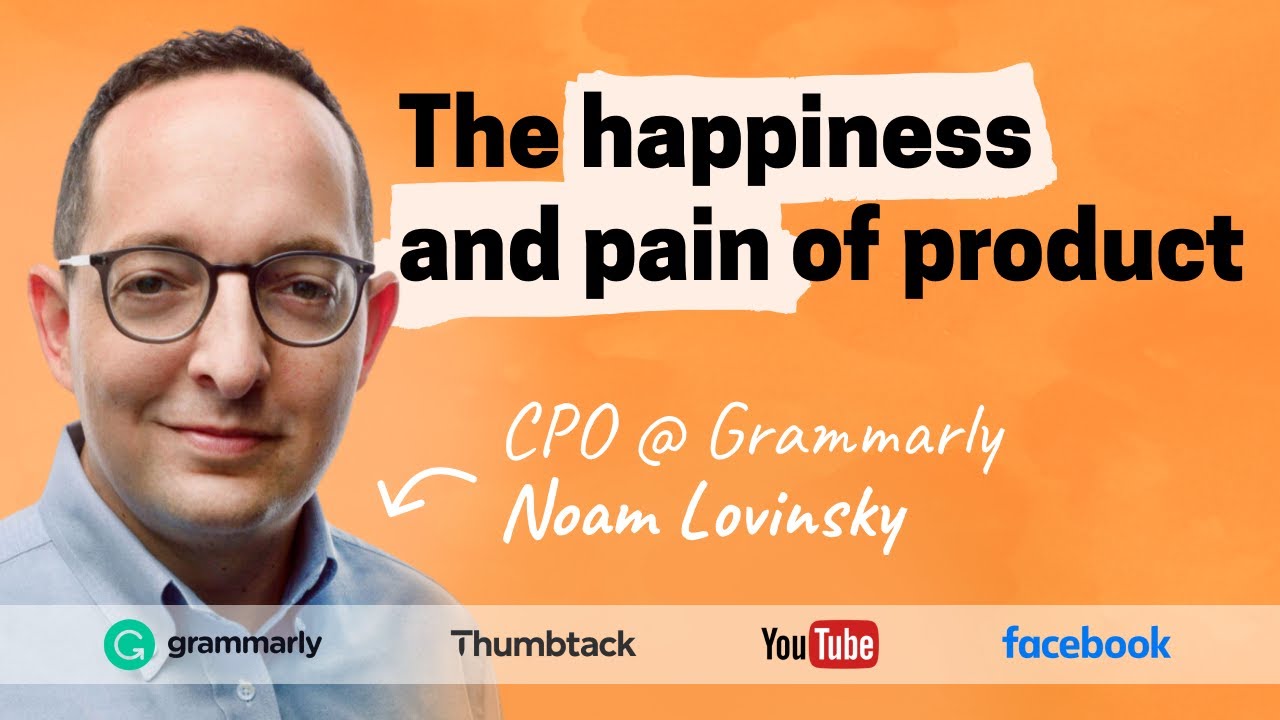
The happiness and pain of product management | Noam Lovinsky (Grammarly, FB, Thumbtack, YT)
Executive Summary
Noam Lovinsky discusses company-aligned decisions, conflict principles, marketplace friction, shared strategy and a distinct operating model for early discovery. Selected third-party transcript coverage excludes sponsor reads, personal wellbeing discussion, AI passages and numerical company results. Company examples are his accounts, unverified here. Untimed editorial topics are not video chapters.
Key Takeaways
Align local decisions with the company goal
Lovinsky says he tries to understand the broader strategy and direct the work he can influence toward it. A team's immediate goal may not be the whole business goal. That broader frame helps explain why a project should change rather than defending it simply because it belongs to the team.
Use principles for conflicting needs
Customer, marketplace supplier and business interests do not always point to the same choice. He describes making the priority order explicit at Thumbtack. The example is his account of one marketplace, not a universal instruction to rank stakeholders the same way.
Look for friction in the core loop
Lovinsky's Thumbtack story focuses on customers waiting and providers paying before being seen. He says those frictions affected both sides of the marketplace. The useful diagnostic is the whole loop, rather than assuming growth-channel changes alone solve the experience.
Invite the leadership team into product strategy
He argues that product strategy cannot belong only to the person with product in their title. Finance, people, sales and engineering leaders need to understand and contribute. Their own choices shape whether the company can act on the strategy.
Make strategy accessible across functions
The product team has a responsibility to explain what the direction means for other parts of the business. Lovinsky wants each leader to feel their contribution is visible in it. A strategy document that other functions cannot engage with is not enough.
Give early discovery room to stay small
He describes how a large organization can struggle to start with a narrow group and work directly with customers. Early discovery may need a different operating model from a scaled product. The lesson is to preserve the ability to learn from small signals before distribution expands.
Match incentives to the stage of work
Lovinsky warns that an established performance cycle can create the wrong incentives for a zero-to-one team. The people, timeframe and evaluation method should fit discovery work. He treats this as a design choice for the operating model, not merely an exception to process.
The Conversation Breakdown
Align local decisions with the company goal
⏱ Untimed topicLovinsky says he tries to understand the broader strategy and direct the work he can influence toward it. A team's immediate goal may not be the whole business goal. That broader frame helps explain why a project should change rather than defending it simply because it belongs to the team.
Use principles for conflicting needs
⏱ Untimed topicCustomer, marketplace supplier and business interests do not always point to the same choice. He describes making the priority order explicit at Thumbtack. The example is his account of one marketplace, not a universal instruction to rank stakeholders the same way.
Look for friction in the core loop
⏱ Untimed topicLovinsky's Thumbtack story focuses on customers waiting and providers paying before being seen. He says those frictions affected both sides of the marketplace. The useful diagnostic is the whole loop, rather than assuming growth-channel changes alone solve the experience.
Invite the leadership team into product strategy
⏱ Untimed topicHe argues that product strategy cannot belong only to the person with product in their title. Finance, people, sales and engineering leaders need to understand and contribute. Their own choices shape whether the company can act on the strategy.
Make strategy accessible across functions
⏱ Untimed topicThe product team has a responsibility to explain what the direction means for other parts of the business. Lovinsky wants each leader to feel their contribution is visible in it. A strategy document that other functions cannot engage with is not enough.
Give early discovery room to stay small
⏱ Untimed topicHe describes how a large organization can struggle to start with a narrow group and work directly with customers. Early discovery may need a different operating model from a scaled product. The lesson is to preserve the ability to learn from small signals before distribution expands.
Match incentives to the stage of work
⏱ Untimed topicLovinsky warns that an established performance cycle can create the wrong incentives for a zero-to-one team. The people, timeframe and evaluation method should fit discovery work. He treats this as a design choice for the operating model, not merely an exception to process.
Core Frameworks & Ideas
Guiding conflict principles
Make the priority among competing needs explicit before individual decisions become disputes.
Shared strategy discussion
Explain the direction so leaders across functions can understand and contribute to it.
Stage-fit operating model
Give early discovery the audience size, access and incentives appropriate to learning.
Actionable Next Steps
- ✓Write down a principle for a recurring stakeholder conflict.
- ✓Map friction on both sides of a product's core loop.
- ✓Ask how each leadership function contributes to the strategy.
- ✓Check whether an early-discovery team is evaluated on an appropriate timeframe.
Notable Quotes
“And I think figuring out some principles that help guide those sorts of conflicts can be really, really helpful.”
“I think that one important lesson from that is, no one can be a bystander on product strategy.”
“But I think the number one thing I would think about would be the incentive system and the adverse selection that that can cause.”
The One Thing to Remember
Make product strategy a shared leadership responsibility and match the operating model to the stage of work.