


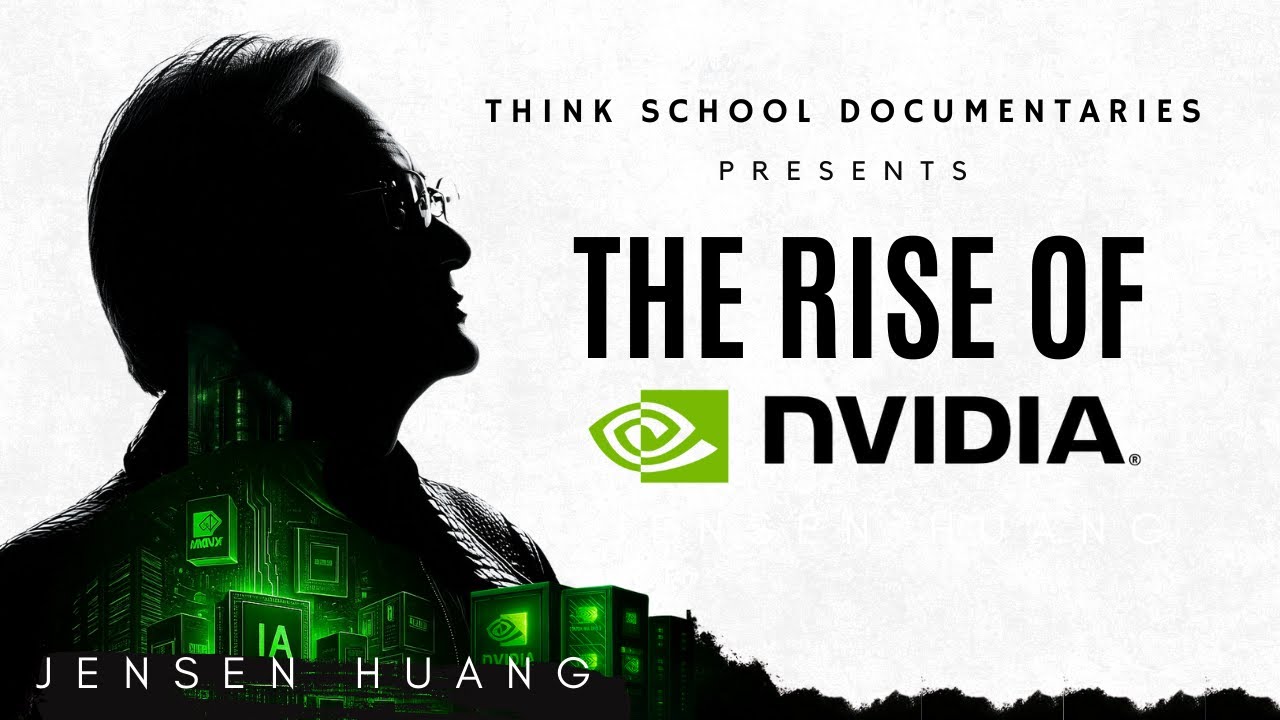
The INSANE Rise of NVIDIA: From Bankruptcy to $4 Trillion? | Business case study @NVIDIA
Executive Summary
A Think School business case study in which the presenter tells the story of NVIDIA, from a gaming-chip startup about 30 days from running out of cash to a company he says is worth over 4 trillion dollars. He covers the failed NV1 chip and Microsoft's DirectX, the untested RIVA 128 chip, the 1999 GeForce 256 GPU, the CUDA software platform launched in 2006, and the 2012 AlexNet moment that he says made GPUs central to modern AI. Sponsor: Odoo, an all-in-one business software platform, thanked mid-video for supporting the show. PARTIAL COVERAGE: this note is based on the opening, the sponsor segment, the NV1 and DirectX section, the RIVA 128 section, the CUDA and AlexNet section, the closing and the description, and may not cover every point in the roughly 27 minute video. The company history, figures and opinions are the presenter's own and are not independently checked. Nothing here is financial or investment advice.
Key Takeaways
The opening hook
The presenter says NVIDIA once had only 30 days of cash left and asks how it became a 4 trillion dollar company.
What a chip does
He explains chips as the invisible brain of every digital device, doing millions of calculations every second.
Betting on games
The presenter says that in the mid-1990s games were seen as toys, yet the founders saw that gaming's demand for speed could lead to chips for anything.
The NV1 failure
He says NVIDIA's NV1 chip failed because it ignored Microsoft's DirectX triangle standard, and that 249,000 of 250,000 units came back.
The untested RIVA 128
The presenter says the founder simulated the next chip fully in software, sent it to manufacturing untested, waited eight weeks, and it worked.
GPU and CUDA
He says the 1999 GeForce 256 was the first GPU, and that CUDA in 2006 let developers use GPUs for general work.
AlexNet in 2012
The presenter says the AlexNet image-recognition result on NVIDIA GPUs proved AI could learn from data and made CUDA the key ingredient.
The Conversation Breakdown
The opening hook
⏱ Untimed topicThe presenter says NVIDIA once had only 30 days of cash left and asks how it became a 4 trillion dollar company.
What a chip does
⏱ Untimed topicHe explains chips as the invisible brain of every digital device, doing millions of calculations every second.
Betting on games
⏱ Untimed topicThe presenter says that in the mid-1990s games were seen as toys, yet the founders saw that gaming's demand for speed could lead to chips for anything.
The NV1 failure
⏱ Untimed topicHe says NVIDIA's NV1 chip failed because it ignored Microsoft's DirectX triangle standard, and that 249,000 of 250,000 units came back.
The untested RIVA 128
⏱ Untimed topicThe presenter says the founder simulated the next chip fully in software, sent it to manufacturing untested, waited eight weeks, and it worked.
GPU and CUDA
⏱ Untimed topicHe says the 1999 GeForce 256 was the first GPU, and that CUDA in 2006 let developers use GPUs for general work.
AlexNet in 2012
⏱ Untimed topicThe presenter says the AlexNet image-recognition result on NVIDIA GPUs proved AI could learn from data and made CUDA the key ingredient.
Core Frameworks & Ideas
The non-obvious insight - the presenter's idea
Look for a belief about your industry that almost nobody else shares and test it.
Survive, then bet early - the presenter's reading of NVIDIA
Use a rescue product to stay alive while investing in a platform that is years ahead.
Own the platform, not just the product - the presenter's point on CUDA
Software and ecosystem can matter as much as the hardware itself.
Actionable Next Steps
- ✓Write down one non-obvious belief about your own field and what evidence would test it.
- ✓Check the presenter's figures and dates against company filings and reliable histories.
- ✓Study how a platform standard such as DirectX can shape what a product can succeed.
- ✓Treat the video's market value claims as the presenter's own and do not use them as financial advice.
Notable Quotes
“Microsoft had locked the doors and Nvidia had built the wrong key.”
“So CUDA was ready but the world wasn't ready for CUDA.”
“a great entrepreneur is defined by the most nonobvious insight he has about the industry that no one else believes in.”
The One Thing to Remember
The presenter argues that NVIDIA survived near-bankruptcy and became a giant because its founder acted on non-obvious insights about gaming chips, parallel computing and CUDA, years before the market caught up.