


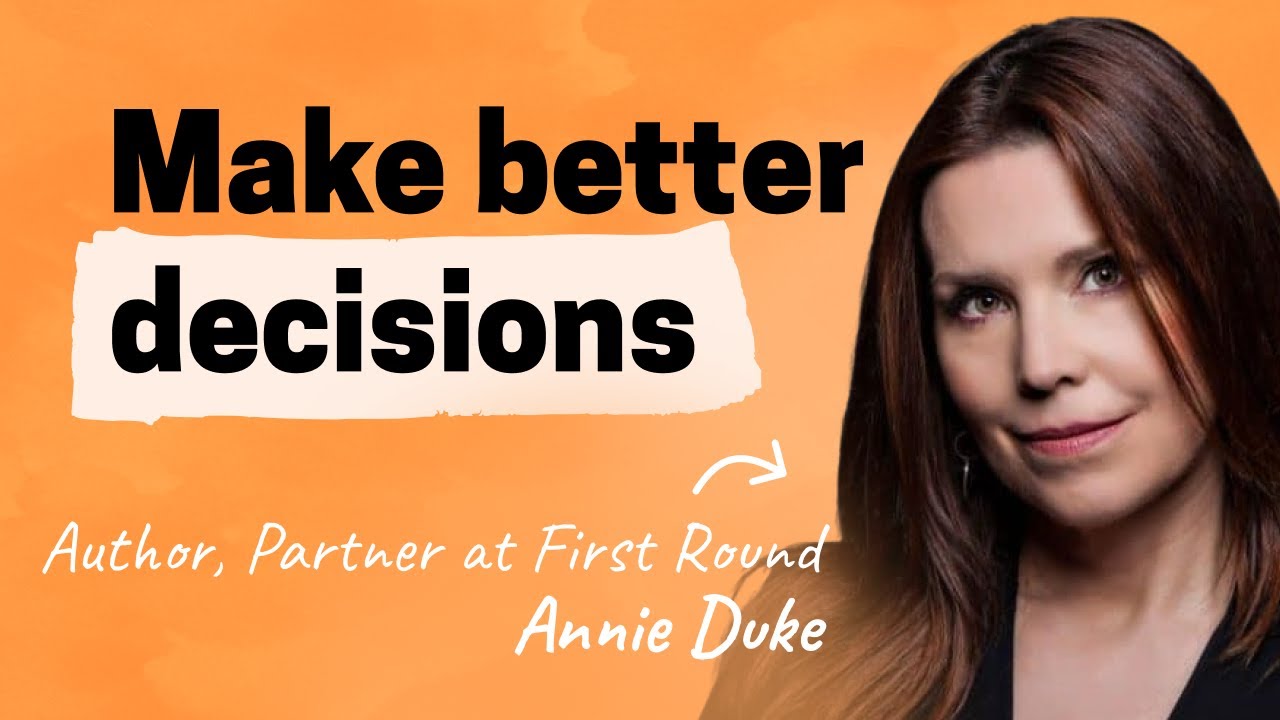
This will make you a better decision maker | Annie Duke (Thinking In Bets, former pro poker player)
Executive Summary
Annie Duke joins Lenny Rachitsky to discuss structured judgment, independent input, discovery versus discussion, forecast ranges and curious meetings. This selected decision-process discussion excludes parenting and First Round client examples, and does not report the later quitting sections. Research and company claims are her account, unverified here. Untimed topics are editorial, not video chapters.
Key Takeaways
Make judgment criteria explicit
Duke discusses turning implicit preferences into a rubric and a structured process before using intuition. Writing the criteria makes them easier to inspect and compare. Her reported hiring improvement is not independently checked here, so the practical point is structure rather than a promised increase in accuracy.
Collect opinions independently first
She recommends getting ideas or judgments before people hear the group's answers. Independent, asynchronous input preserves differences that discussion can otherwise hide. Send a clear question and collect private responses, then share the set for a conversation.
Separate discovery, discussion and decision
Her three-part distinction asks what a meeting is actually for. Discovery can happen independently beforehand; discussion examines the differences; a decision uses that input. A group meeting does not have to perform all three jobs at once.
Ask for a rationale alongside the answer
Duke gives examples of ranked priorities and forecasts with a written explanation. A number alone does not reveal the assumptions behind it. Use short rationales to learn why two people see the same project differently rather than treating disagreement as a problem to erase.
Show the range of forecasts
For a timeline, she recommends a point estimate plus lower and upper bounds. Independent estimates can expose uncertainty that a confident first speaker would otherwise anchor. These are judgments to examine, not commitments or guarantees.
Be curious rather than coercive
She argues that a discussion should convey information and explore models, not make everyone agree. Interruptions and declarations that someone is wrong can shut down useful input. Ask for clarification and understand the reasoning before deciding what to do.
Hearing people is different from giving them their choice
In her account, people can accept a decision they would not have picked when they see the real spread of views and feel heard. Listening does not require pretending everyone agrees. Explain the decision and the trade-offs without claiming consensus that is not there.
The Conversation Breakdown
Make judgment criteria explicit
⏱ Untimed topicDuke discusses turning implicit preferences into a rubric and a structured process before using intuition. Writing the criteria makes them easier to inspect and compare. Her reported hiring improvement is not independently checked here, so the practical point is structure rather than a promised increase in accuracy.
Collect opinions independently first
⏱ Untimed topicShe recommends getting ideas or judgments before people hear the group's answers. Independent, asynchronous input preserves differences that discussion can otherwise hide. Send a clear question and collect private responses, then share the set for a conversation.
Separate discovery, discussion and decision
⏱ Untimed topicHer three-part distinction asks what a meeting is actually for. Discovery can happen independently beforehand; discussion examines the differences; a decision uses that input. A group meeting does not have to perform all three jobs at once.
Ask for a rationale alongside the answer
⏱ Untimed topicDuke gives examples of ranked priorities and forecasts with a written explanation. A number alone does not reveal the assumptions behind it. Use short rationales to learn why two people see the same project differently rather than treating disagreement as a problem to erase.
Show the range of forecasts
⏱ Untimed topicFor a timeline, she recommends a point estimate plus lower and upper bounds. Independent estimates can expose uncertainty that a confident first speaker would otherwise anchor. These are judgments to examine, not commitments or guarantees.
Be curious rather than coercive
⏱ Untimed topicShe argues that a discussion should convey information and explore models, not make everyone agree. Interruptions and declarations that someone is wrong can shut down useful input. Ask for clarification and understand the reasoning before deciding what to do.
Hearing people is different from giving them their choice
⏱ Untimed topicIn her account, people can accept a decision they would not have picked when they see the real spread of views and feel heard. Listening does not require pretending everyone agrees. Explain the decision and the trade-offs without claiming consensus that is not there.
Core Frameworks & Ideas
Discover, discuss, decide
Collect judgments independently, discuss the differences and then use the agreed decision process.
Decision rubric
Write criteria and collect structured judgments before relying on intuition.
Point, low, high
Ask for a central forecast and bounds with a rationale to expose uncertainty.
Actionable Next Steps
- ✓Before the next meeting, ask each person for a private written answer and rationale.
- ✓Write the criteria for a repeated decision before collecting opinions.
- ✓Ask for a point estimate and low/high bounds on a project timeline.
- ✓When people disagree, ask what assumption produces the difference.
Notable Quotes
“The best way to get somebody's opinion is independently of other people's opinions, independently asynchronously.”
“So the way that I put is I want people to stop talking to each other so much.”
“Interrupting someone is silencing them.”
The One Thing to Remember
Get independent judgments before discussion so the meeting can reveal disagreement rather than suppress it.