


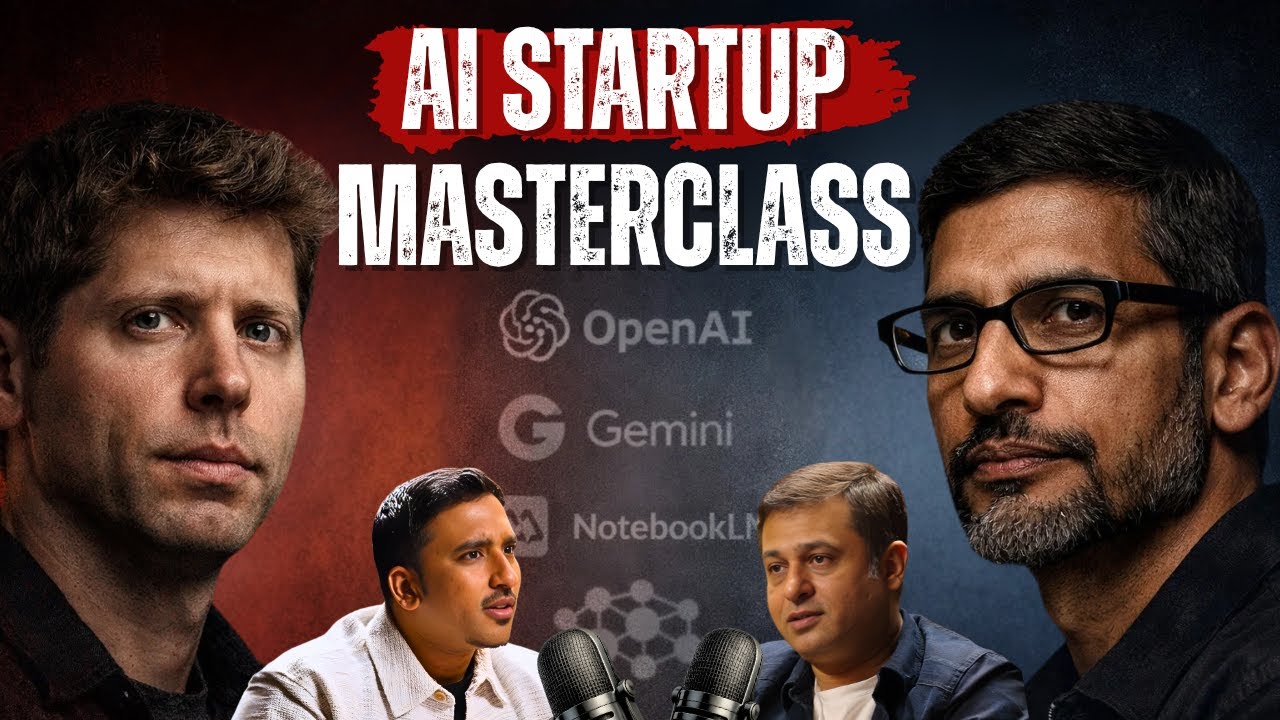
Top VC Reveals How to Win the AI Game? | OpenAI's Billion-Dollar Losses ft. Manav Garg | IBP 48
Executive Summary
AI spend splits 70/20/10 across compute, model training, and the application layer where Indian startups play. Garg's case: vibe coding has collapsed app development from $50-100K and months to under $10K and under an hour, which he frames as market expansion rather than a developer threat. The bigger disruption is structural - search and browse, which he says is 95% of commerce time, collapses into personal agents, so companies like Zomato and PolicyBazaar must rethink their existence while delivery infrastructure stays the real moat. His GTM playbook: broad-but-adjacent influencer marketing with $10-20K a month for six months and no scripts, invest in brand before performance marketing, and demand 50%+ word-of-mouth growth. Together Fund writes $500K-$10M seed checks to purpose-driven founders solving hard problems, and prefers a whiteboarding session over a slide deck.
Key Takeaways
AI's $100 splits 70/20/10, and India plays in the $10 layer
Garg breaks down where AI money goes: roughly $70 of every $100 goes to compute infrastructure (Nvidia chips, data centers, energy), $20 to model training (the OpenAI and Anthropic layer), and $10 to the application layer. Indian startups, he says, mostly build in that application layer - which is why understanding the economics underneath matters for pricing and margins.
Vibe coding compresses app development from $50-100K to under $10K
Through his portfolio company Emergent ($15M ARR in 90 days, per Garg), he describes non-technical users building apps of up to ~300K lines of code: work that cost $50-100K plus 20% annual maintenance and took months now costs $1-10K and under an hour. He calls this market expansion, not a developer threat - YC's average founder age dropped from 30 to 26 and 80% are engineers.
Search and browse will collapse into agents
Garg's claim: search and browse make up 95% of commerce time, with only 5% in checkout, and that 95% collapses into a personal agent that knows you and orders for you. PolicyBazaar-style comparison shopping and Zomato-style discovery lose their interface; the fight becomes who owns the customer - company agents like Amazon's Rufus versus a user's own agent.
Infrastructure, not the interface, is the durable moat
Using Zomato, Swiggy, and Blinkit as examples, Garg argues the predictable delivery promise (a 10-minute order arriving in 9-11 minutes) is a supply chain that survives the search-browse collapse. When agents do the ordering, customer access migrates to whoever runs the user's agent, but the physical fulfillment layer stays valuable.
Design for 2027, not for today's workflow
Asked to reimagine insurance, Garg warns against automating the current call-center workflow (a chatbot doing what Ditto does today) and instead designs for a two-to-three-year-out world: a personal agent holding your health and financial data negotiates directly with insurer agents, which requires payment and authorization rails for agents that don't exist yet. He calls this agentic commerce, not agentic shopping.
The GTM ladder: broad influencers, then brand, then performance
His playbook: influencer marketing first, but broader than your niche - a finance product can use education or fashion creators in adjacent Venn-diagram circles. Budget $10-20K a month for six months ($100-200K total), never hand creators a script because algorithms detect repeated ads, and let content stay organic. Invest in brand (positioning, communication, logo, identity - he praises Lovable's) before performance marketing.
Together Fund backs 'Olympic champions' with a lead-time test
The fund has invested in 40 companies with checks from $500K to $10M at seed. The filter: purpose-driven founders (their internal phrase is Olympic champions), a hard problem measured by how long a similar team would need to replicate the work (Think School's 4.77M-subscriber distribution is a three-year lead; Emergent's 3M apps generate hard-to-copy data), and a market that is either a large existing revenue pool or a new habit-forming one. Pitch via whiteboarding session, not a slide deck - the fund gets about 2,000 plans a year and meets roughly 200.
The Conversation Breakdown
Cold open and why this episode needs no tech background
⏱ Untimed topicA montage teases the big claims - Sam Altman's bubble admission, who owns the customer in an agent world, and India's AI market - before the host promises the episode stays friendly to non-technical viewers. Manav Garg is introduced as the founder of Together Fund, the firm behind Emergent, the Indian startup that reportedly hit $15M ARR in 90 days.
Where the AI money goes: the 70/20/10 stack
⏱ Untimed topicGarg lays out the economics: $70 of every $100 to compute and infrastructure, $20 to model training, $10 to applications. Google is his example of the only true full-stack company (chips, foundation models, infra, and products), which he says is why it looks slow but is positioned to win. This framing sets up why OpenAI's reported $5B loss is concentrated in the 70% infrastructure layer, including data center deals and an AMD stake.
Emergent, vibe coding, and the collapse of app development costs
⏱ Untimed topicThe Emergent case study: apps that cost $50-100K plus maintenance and took months now cost $1-10K and under an hour, with the platform handling about 300K lines of code. Garg argues this expands the market rather than threatening developers - YC's average founder age fell from 30 to 26, 80% of them engineers - and his advice to 21-year-olds is to build, ship, use social distribution, and let companies form organically.
Reimagining insurance and the coming agent economy
⏱ Untimed topicThe host asks Garg to rethink insurance from scratch. Garg rejects automating today's workflow and instead imagines a personal agent holding your health and financial profile negotiating directly with insurer agents - agentic commerce, which he says needs payment and authorization rails for agents that don't exist yet. Search and browse (95% of commerce time) collapses; PolicyBazaar, Zomato, and Swiggy must rethink their existence while physical delivery infrastructure stays the moat and everyone fights over who owns the customer.
The GTM playbook: influencers, brand, performance, word of mouth
⏱ Untimed topicA granular go-to-market sequence: start with influencer marketing that reaches adjacent niches (a finance product through education or fashion creators), budget $10-20K a month for six months, and never script creators because algorithms punish repeated ad-like content. Then invest in brand - positioning, communication, logo, identity, with Lovable as the model - before layering performance marketing. By four to six months, word of mouth should drive 50%+ of growth; after that, product improvement feeds the organic flywheel. Gamma and Cursor are his proof points, and he urges founders not to ignore India, OpenAI's second-largest market.
How Together Fund decides, and how to pitch it
⏱ Untimed topicGarg explains the fund's model: 40 companies, about $110M deployed, seed checks of $500K-$10M. They look for purpose-driven founders ('Olympic champions'), hard problems measured by replication lead time (distribution and proprietary data are the hard-to-copy assets), and markets that are either large existing pools or new habit-forming ones. The investor's role is a coach - 'we work for you instead of you working for us.' Skip the slide deck: he wants a whiteboarding brainstorm, and picks meetings from about 2,000 annual plans by thesis fit. Current interests: SDLC automation, voice as infrastructure, memory, security and AI safety, agentic commerce, edtech, and AI doctors for India's rural healthcare gap. His general framework: pick any old industry with a large incumbent - legal, HR, CRM (Salesforce's 26% share), ERP (SAP) - and build the parallel AI company.
Wrap-up: the full conversation in one summary
⏱ Untimed topicThe host recaps the episode with Garg correcting two points - the planning horizon is two to three years, not ten, and vibe coding serves technical and non-technical users alike. The core arc: find a hard problem by reverse-engineering the near future, separate the real pain point from symptoms the way a doctor connects five symptoms to one cause (customers would never have asked for Blinkit), understand the negative-gross-margin economics of AI, and run the influencer-to-brand-to-organic GTM ladder.
Core Frameworks & Ideas
The 70/20/10 AI stack
Every $100 of AI spend: $70 to compute infrastructure (chips, data centers, energy), $20 to model training, $10 to the application layer. Use it to locate where a business sits, why LLM costs fall as infrastructure gets cheaper, and why full-stack players like Google can squeeze everyone else.
The lead-time test for hard problems
Ask: if software becomes a commodity, how long would a team with similar skills take to recreate what you built? A three-year YouTube distribution lead and a platform generating proprietary data from millions of apps pass the test; a thin wrapper fails it. Garg uses this to define what counts as a hard problem worth funding.
The organic-growth GTM ladder
Sequence marketing as rungs: broad adjacent-niche influencer marketing ($10-20K/month for 6 months, no scripts), then brand identity for message consistency, then performance marketing - while tracking that unpaid word of mouth reaches 50%+ of growth by months four to six, and reinvesting what efficient organic acquisition saves into product improvement.
Design for the agent world, not today's workflow
When reimagining a business, don't automate the current process (a chatbot replacing today's insurance calls). Picture the world two to three years out - personal agents transacting with business agents - and build for that, including the missing rails like agent payment and authorization infrastructure.
Actionable Next Steps
- ✓Students and young engineers: build something, put it out, and push it through your social network - Garg's point is that distribution lets you iterate on real user love, and companies are found organically rather than designed on paper.
- ✓Founders: run the lead-time test on your idea - write down how long a comparable team would need to replicate your edge, and if the answer is weeks, find the distribution or data advantage that stretches it.
- ✓Marketers: before scaling spend, audit your funnel for the 50% word-of-mouth threshold; if paid channels dominate after six months, redirect budget from acquisition into product improvement.
- ✓Pitching VCs: replace the slide deck with a prepared point of view on how your industry changes in two to three years, and be ready to whiteboard it - Garg says imagination doesn't come through in slides.
Notable Quotes
“we work for you instead of you working for us.”
“Search and browse take 95% of time.”
“when you have more time at your hand, you have more time to entertain yourself.”
“don't ignore Indian market.”
The One Thing to Remember
Judge your idea with Garg's lead-time test: if software becomes a commodity, how long would a similar team need to recreate what you built? Distribution, proprietary data, and infrastructure you control are the answers that hold up - and design the product for the world two to three years out, not for today's workflow.