


What the Headlines Don't Tell You! | What the 528-Page DRHP Reveals About Jio IPO
Executive Summary
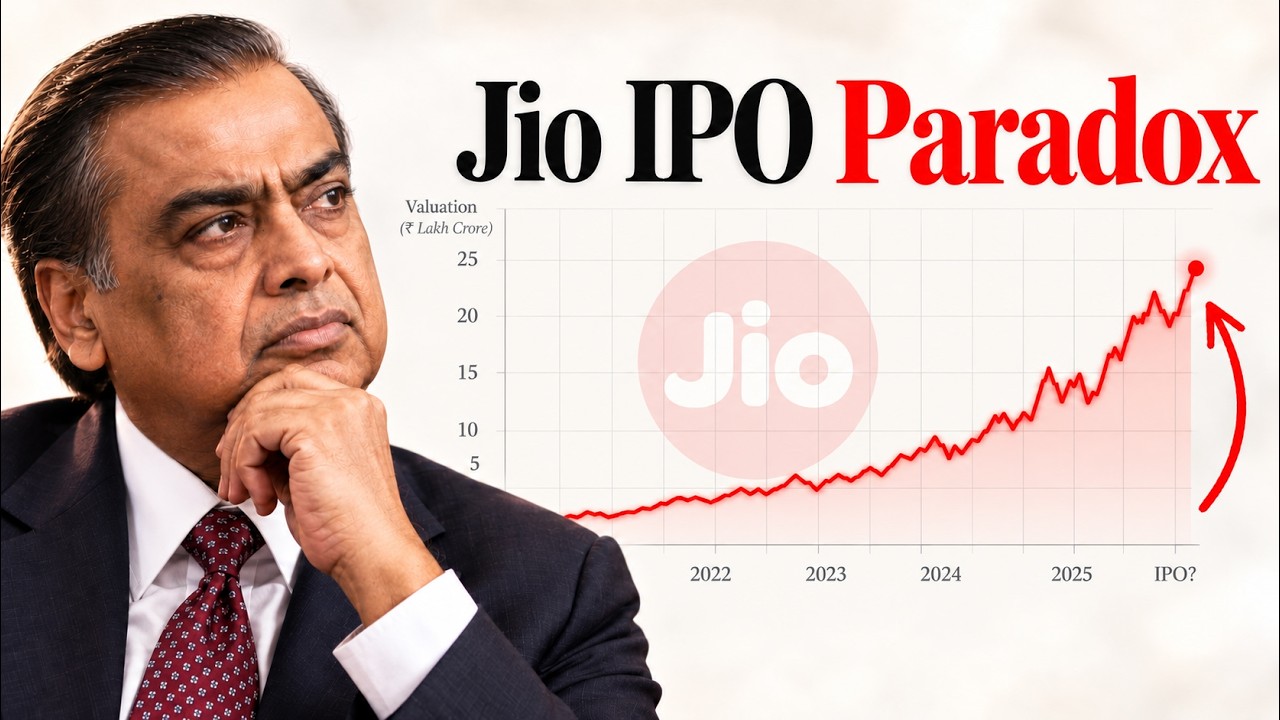
Think School reads Jio's 528-page draft IPO prospectus beyond the headlines. The video lays out Jio's headline numbers of 1.46 lakh crores in revenue, about 30,000 crores in profit and 524 million customers, then explains the business as one equation - revenue equals users times average revenue per user - across a six-level pyramid from 2G India to enterprises. It surfaces three things it says the headlines are missing: an outstanding spectrum obligation of 1.04 lakh crores that costs about 40 percent of profits a year until 2038, a deferred tax pile of 55,611 crores that kept the actual tax paid at 118 crores against a 10,300 crore paper bill, and a real free cash flow of about 20,300 crores that needs roughly 18 rupees more per user per month to hold steady. It closes with four growth engines - recharge prices, home broadband, small business digitization and AI distribution - and three risks: price-sensitive customers, the next capex cycle and satellite internet. FULL COVERAGE: the captions appear to cover the entire episode. All figures are as read from the DRHP by the channel, not independently verified, and the channel states it is not a SEBI registered adviser. Sponsor: none stated in the episode. Nothing here is investment advice.
Key Takeaways
The headline numbers are real and huge
Jio's FY26 report card shows 1.46 lakh crores in revenue, up 14.5 percent, about 30,000 crores in profit, an EBITDA margin of 51.9 percent and 524 million customers - roughly a third of India.
The whole business is one equation
Revenue equals users times average revenue per user, so Jio can only add payers or raise what each pays, which it runs through a six-level pyramid from offline 2G India to enterprise clients.
The pyramid starts with a 799 rupee phone
For the 263.5 million Indians still on basic 2G phones, the Jio Bharat phone works only with a Jio SIM, and its 123 rupee 20-day recharge undercuts Airtel's cheapest plan by about 60 percent - a blue ocean with no reputed 4G phone under 1,000 rupees.
Most of the money sits in the middle
77 percent of Jio's revenue comes from prepaid recharges, Jio holds 49.95 percent of India's wireless broadband market against Airtel's 35.13 percent, and free services like MyJio sent about 72 million visits to JioMart last year.
The spectrum bill is 1.04 lakh crores
Jio will pay about 11,650 crores a year to the government until 2038 - roughly 40 percent of current profits - which lifts total obligations from a reported 0.36 times EBITDA to about 1.7 times.
The tax bill is postponed, not avoided
Accelerated depreciation on towers, fiber and airwaves created a 55,611 crore deferred tax pile, so Jio paid 118 crores against a 10,300 crore paper tax; the remaining savings runway is expected to run out around FY29, after which about 11,000 crores a year goes to the government.
Holding free cash flow needs 18 rupees more per user
Free cash flow is about 20,300 crores after capex, EMIs, rent and interest; keeping it there needs ARPU up about 18 rupees a month - last year's rise was 8 rupees - through recharge hikes, AirFiber homes, small business services and AI distribution.
The Conversation Breakdown
The headline numbers are real and huge
⏱ Untimed topicJio's FY26 report card shows 1.46 lakh crores in revenue, up 14.5 percent, about 30,000 crores in profit, an EBITDA margin of 51.9 percent and 524 million customers - roughly a third of India.
The whole business is one equation
⏱ Untimed topicRevenue equals users times average revenue per user, so Jio can only add payers or raise what each pays, which it runs through a six-level pyramid from offline 2G India to enterprise clients.
The pyramid starts with a 799 rupee phone
⏱ Untimed topicFor the 263.5 million Indians still on basic 2G phones, the Jio Bharat phone works only with a Jio SIM, and its 123 rupee 20-day recharge undercuts Airtel's cheapest plan by about 60 percent - a blue ocean with no reputed 4G phone under 1,000 rupees.
Most of the money sits in the middle
⏱ Untimed topic77 percent of Jio's revenue comes from prepaid recharges, Jio holds 49.95 percent of India's wireless broadband market against Airtel's 35.13 percent, and free services like MyJio sent about 72 million visits to JioMart last year.
The spectrum bill is 1.04 lakh crores
⏱ Untimed topicJio will pay about 11,650 crores a year to the government until 2038 - roughly 40 percent of current profits - which lifts total obligations from a reported 0.36 times EBITDA to about 1.7 times.
The tax bill is postponed, not avoided
⏱ Untimed topicAccelerated depreciation on towers, fiber and airwaves created a 55,611 crore deferred tax pile, so Jio paid 118 crores against a 10,300 crore paper tax; the remaining savings runway is expected to run out around FY29, after which about 11,000 crores a year goes to the government.
Holding free cash flow needs 18 rupees more per user
⏱ Untimed topicFree cash flow is about 20,300 crores after capex, EMIs, rent and interest; keeping it there needs ARPU up about 18 rupees a month - last year's rise was 8 rupees - through recharge hikes, AirFiber homes, small business services and AI distribution.
Core Frameworks & Ideas
The pyramid funnel
Each Jio product exists to push a user one level up - Jio Bharat recruits 2G users, free apps monetize attention, recharge bundles carry OTT perks, and home and enterprise layers upsell.
Depreciation as a timing tool
Accelerated depreciation does not cut total tax, it moves cash into the growth years; the bill arrives in the post-growth phase.
Profit versus free cash flow
After new towers, airwaves, EMIs, rent and interest, Jio's 30,000 crore profit leaves about 20,300 crores of free cash - the number that actually funds the future.
Actionable Next Steps
- ✓When an IPO prospectus touts profit, find the free cash flow line and the deferred tax note before comparing valuations.
- ✓Add spectrum and lease obligations to the stated net debt when judging a telecom's leverage.
- ✓After each tariff hike, watch ARPU against churn - Jio added only 6.4 million net customers after the 2024 hike against 42.5 million the year before.
- ✓Read the DRHP risk section for regulator risk such as tariff ceilings before treating any telecom as a stable compounder.
Notable Quotes
“Revenue equal to users into average revenue per user.”
“the profit of 30,049 crores is real but it is not free cash flow.”
“I am not a SEBI registered financial adviser and you should not listen to me.”
The One Thing to Remember
Headline profit is not free cash flow: Jio's spotless report card hides 1.04 lakh crores of spectrum dues and a deferred tax bill that starts biting around FY29.