


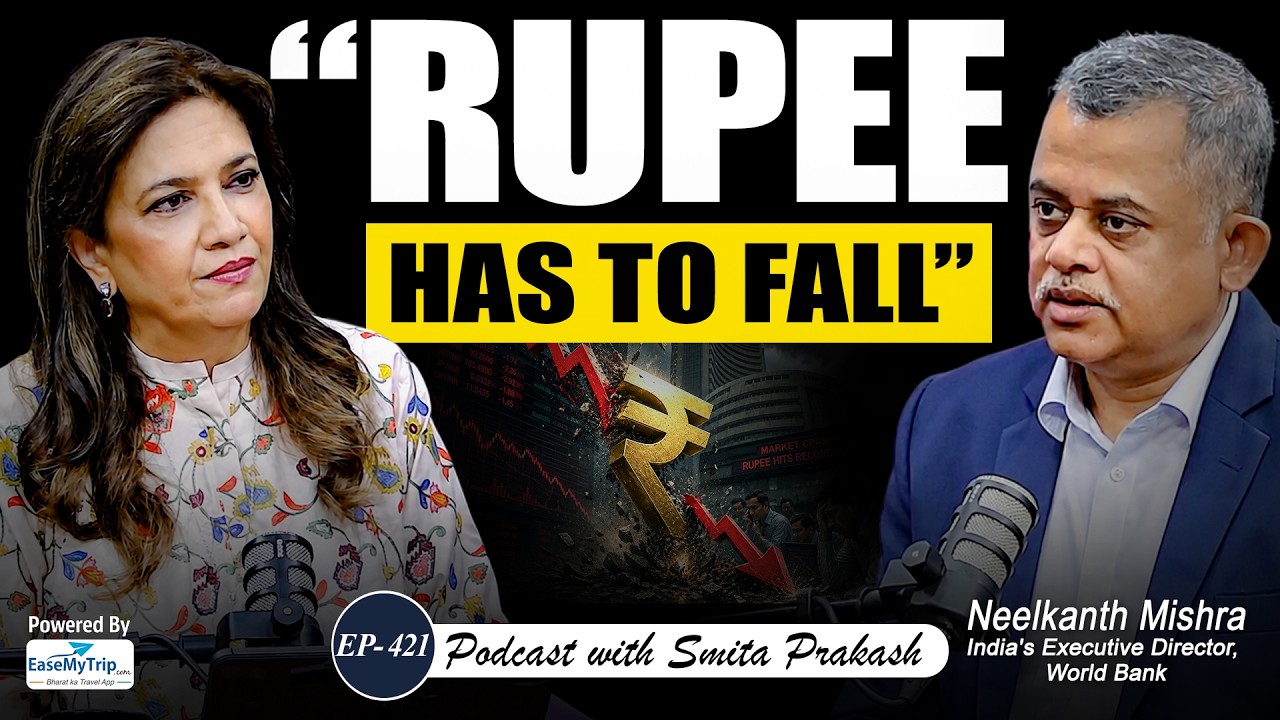
Where is India's Economy Heading Amid West Asia Crisis? | Economist Neelkanth Mishra | EP-421
Executive Summary
Mishra argues for addressing energy exposure, housing and infrastructure while lowering the cost of essential services. He sees state-level reforms as important and distinguishes a temporary price jump from persistent inflation in his rate discussion. These are his historical assessments and proposals from June 2026; figures, forecasts and policy descriptions are not verified current facts.
Key Takeaways
Energy exposure is a problem he thinks can be reduced
Mishra argues that India has options across different energy sources and that changing the mix could reduce vulnerability. He uses comparisons with China to make the case. His estimates and optimism are not proof that independence is assured or that environmental, technical and economic trade-offs have disappeared.
He puts state-level reforms in the foreground
He says important reforms can happen at the state level and receive less national attention. His examples involve land, electricity and building permissions. These are descriptions from the interview, not verified current legal terms or instructions that a company can rely on without checking the relevant official source.
Housing demand needs supporting infrastructure
Mishra sees housing, offices and infrastructure as sources of domestic demand. He argues that access and location matter alongside the price of a home. His survey figures and comparisons remain unverified; the supported idea is to examine the conditions that make housing useful rather than only its advertised cost.
Unit cost shapes who can use a service
He uses branch banking and digital services to illustrate how a lower cost per interaction could broaden access. The numerical example is his illustration, not a measured universal result. It encourages examining service economics without assuming that a lower unit cost alone solves quality, trust or access barriers.
AI applications are possibilities in his account
He suggests that AI may help address education and health service costs. These are proposed areas for work, not proof of successful outcomes or current availability. The discussion does not support choosing medical treatment, replacing teachers or clinicians, or assuming every digital intervention creates useful value.
He favors solving practical problems over only discussing scale
Mishra links wealth and income creation to solving unresolved problems in energy, housing and services. His growth outlook is an opinion rather than a guaranteed forecast. The useful lens is to ask what a proposed improvement changes for a user, not to treat aggregate optimism as proof a specific project succeeds.
A price jump differs from persistent inflation in his lens
In discussing interest rates, he distinguishes a pass-through or step increase from sticky inflation and opposes a hike in that context. This is his monetary-policy reasoning as of the interview. It is not a complete official rate-setting rule, a current forecast or advice to trade securities based on a predicted decision.
The Conversation Breakdown
Policy priorities and access
⏱ 1:07:57Mishra discusses reforms, housing and the cost of services as priorities for growth. He favors attention to state-level decisions and practical constraints. The examples are his historical account, not verified current permissions, costs or program availability.
Core Frameworks & Ideas
Unit-cost and access lens
Investigate how the cost of delivering a service affects access while considering quality and other barriers.
State-level reform lens
Look beyond national headlines to specific local rules, verifying them at the relevant official source.
Temporary versus persistent inflation
Distinguish a one-time price adjustment from a continuing pattern when examining a monetary-policy argument.
Actionable Next Steps
- ✓Identify a practical barrier between a useful service and its users.
- ✓Check current official state rules before relying on an older policy example.
- ✓Separate a speaker's growth forecast from evidence of an actual result.
- ✓Examine whether a price change is temporary or persistent before adopting a policy argument.
Notable Quotes
“You have so much sunlight. You have so much wind, you have so much hydro, you have so much coal.”
“We need to be bold enough to do those next-gen reforms.”
“Most of these reforms need to happen at the state level.”
The One Thing to Remember
Ask which practical constraints prevent a useful service from reaching more people.