


Who Wins the Global Race Now? ft. Balaji Srinivasan
Executive Summary
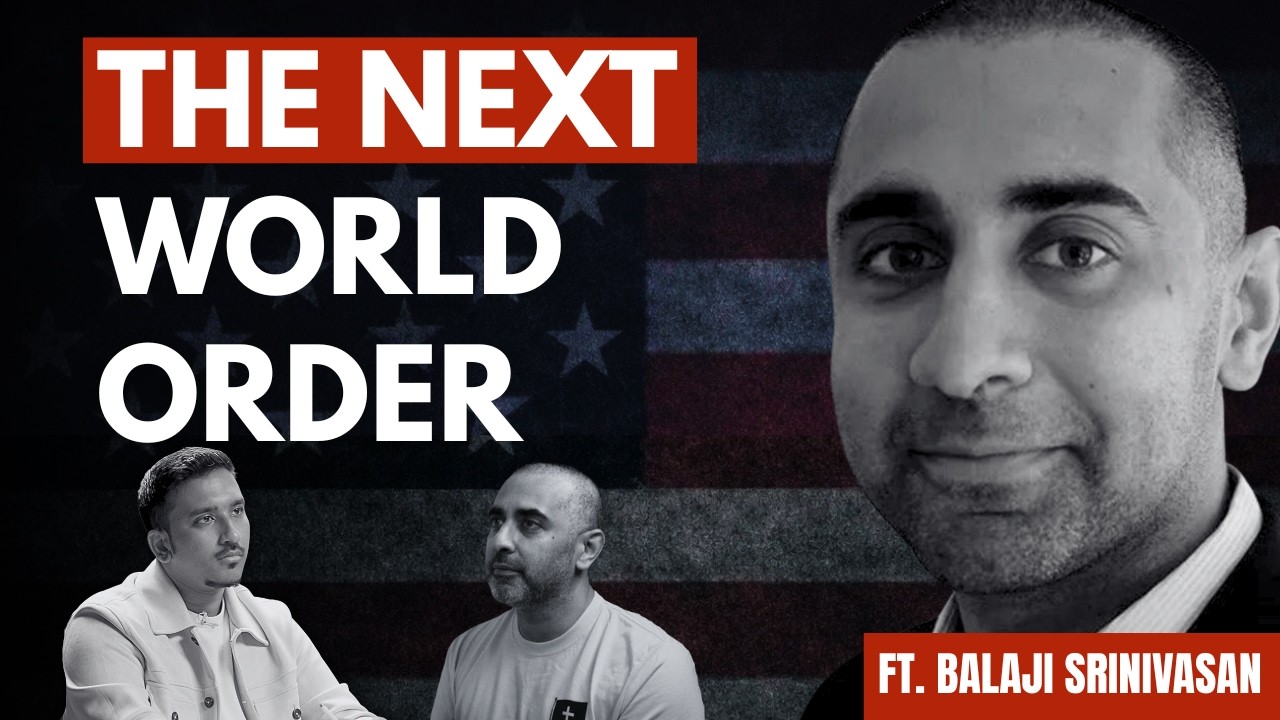
Think School host Ganesh Prasad interviews Balaji Srinivasan, author of The Network State, about his view that American global dominance is fading and that the next phase favours Asia, especially China and India. Balaji gives a history from 1991 to now, argues the US retreat from the world is involuntary, discusses the dollar, oil and sanctions, and says India should be bullish but not compete with China militarily. The caption text appears to cover the whole 49 minute conversation. Everything here about geopolitics, currencies, wars, empires lasting 250 years and predictions is Balaji's or the host's opinion or claim, presented as their views, and is speculative and not independently checked. This is political and economic commentary, not investment or financial advice. Captions are automatic with errors. Topics are untimed; metadata follows YouTube. Source: https://youtubetotranscript.com/transcript?v=6dIdS6slVWE
Key Takeaways
The host's question
The host asks how America can fall when it still controls technology, the military and the dollar, even after printing 3.3 trillion dollars since 2020, and what that means for individuals and India. He also cites a claim that empires last about 250 years.
Balaji's history of the American empire
Balaji says the US was on balance a force for good from 1945 to 1991 and peaked after the Soviet collapse, with Gulf War I and a decade he calls a vacation from history. He says no empire had such complete dominance, including diplomatic reach across 193 countries.
Why he thinks the pullback is not voluntary
He disagrees with a commentator who thinks China will collapse, and agrees the US will retreat from guarding sea lanes. But he argues the retreat is forced, not chosen, because a power would not pull back if it did not have to.
The dollar, oil and sanctions
He says oil trade in dollars worked like a tax on the world, and that sanctions such as freezing assets push countries to alternatives like the yuan or crypto. He describes these as signs of insecurity. These are his claims.
A multipolar world
He says China is everything physical and the internet is everything digital, the two forces after America. He cites purchasing-power-parity rankings with China first, US second, India third and Russia fourth, and says a non-Western majority of the world economy is the natural state.
Why he is bullish on India
He says India should not square off militarily against China and lacks a Russian martial culture, but plays what he calls the best away game through the diaspora. He compares India to California in reverse.
Risks and the host's concern
The host worries that the billion people at the bottom may not prosper as much as those at the top. They also discuss Iran damaging US bases and say the Gulf States, Ukraine and Taiwan are treated as pawns. These are their stated views and not verified.
The Conversation Breakdown
The host's question
⏱ Untimed topicThe host asks how America can fall when it still controls technology, the military and the dollar, even after printing 3.3 trillion dollars since 2020, and what that means for individuals and India. He also cites a claim that empires last about 250 years.
Balaji's history of the American empire
⏱ Untimed topicBalaji says the US was on balance a force for good from 1945 to 1991 and peaked after the Soviet collapse, with Gulf War I and a decade he calls a vacation from history. He says no empire had such complete dominance, including diplomatic reach across 193 countries.
Why he thinks the pullback is not voluntary
⏱ Untimed topicHe disagrees with a commentator who thinks China will collapse, and agrees the US will retreat from guarding sea lanes. But he argues the retreat is forced, not chosen, because a power would not pull back if it did not have to.
The dollar, oil and sanctions
⏱ Untimed topicHe says oil trade in dollars worked like a tax on the world, and that sanctions such as freezing assets push countries to alternatives like the yuan or crypto. He describes these as signs of insecurity. These are his claims.
A multipolar world
⏱ Untimed topicHe says China is everything physical and the internet is everything digital, the two forces after America. He cites purchasing-power-parity rankings with China first, US second, India third and Russia fourth, and says a non-Western majority of the world economy is the natural state.
Why he is bullish on India
⏱ Untimed topicHe says India should not square off militarily against China and lacks a Russian martial culture, but plays what he calls the best away game through the diaspora. He compares India to California in reverse.
Risks and the host's concern
⏱ Untimed topicThe host worries that the billion people at the bottom may not prosper as much as those at the top. They also discuss Iran damaging US bases and say the Gulf States, Ukraine and Taiwan are treated as pawns. These are their stated views and not verified.
Core Frameworks & Ideas
Cycle of empires - Balaji and host's framing
Empires rise and fall on roughly 250-year spans, though the host's source and the claim are unverified.
Home game and away game - Balaji's image
China plays the world's best home game; Indians play a very strong away game through the diaspora.
Dollar as a tax - Balaji's argument
Dollar oil trade and sanctions create demand for the dollar and push others toward alternatives.
Actionable Next Steps
- ✓Treat any prediction in this conversation as one person's view and compare it to other sources.
- ✓Read about the history of the 1991 liberalisation and the Gulf War to check the timeline.
- ✓Look up the purchasing-power rankings cited, from the World Bank.
- ✓Write down how a shift in the dollar would affect your own savings or business and discuss with a qualified adviser.
Notable Quotes
“India is like California in reverse”
“Indians play a very strong away game”
“America had a vacation from history”
The One Thing to Remember
Balaji's thesis: the American era is ending and the next century belongs to Asia, where India's best move is a strong away game.