


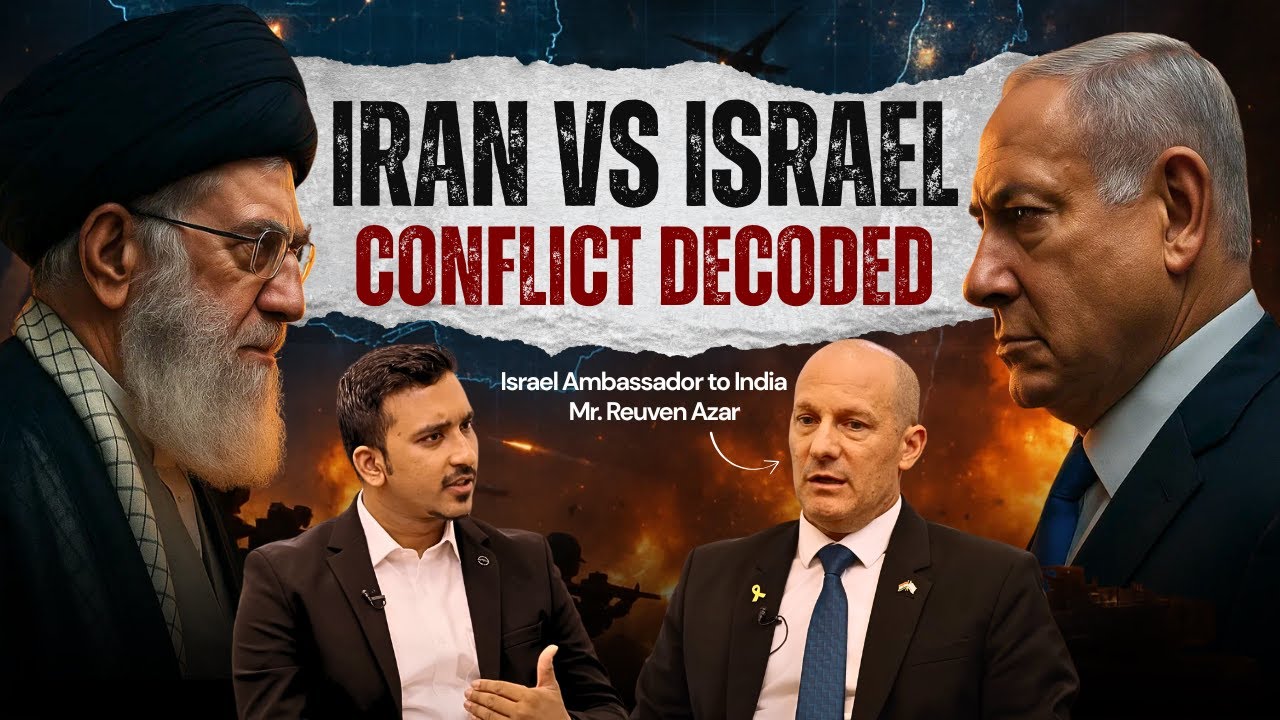
Why Israel Attacks Syria, Fears Iran's Bomb & Faces Global Pressure : Israeli Ambassador Explains
Executive Summary
Ganesh Prasad interviews Israel's Ambassador to India in August 2025, weeks after the Israel-Iran escalation. The ambassador's account, in his own framing: Israel's military operation destroyed Iran's nuclear facilities and ballistic-missile production after diplomacy failed; Iran's 'three-dimensional plan' was proxy armies (Hezbollah's 150,000 rockets, militias in Iraq and Syria, Houthis, Hamas), a military nuclear program, and a missile factory producing 300 a month. On October 7 he cites 1,200 murdered and 254 hostages, with about 200 returned and roughly 50 left, about 20 alive. On Syria: Assad fell because Israel defeated Hezbollah; the new regime is led by a former jihadist whose forces, he says, massacred Druze in Sweida, so Israel bars radical elements south of Damascus. On Gaza aid: he says Hamas seizes and resells humanitarian aid, the new GHF delivers about a million meals a day, and he accuses UNRWA of employing Hamas operatives. The economic thread: Israel's GDP per capita is about $55,000, driven by innovation (7,500 startups, about 100 unicorns, 500 foreign companies doing R&D), defense exports, and offshore gas; the ambassador credits solidarity, conscription that screens talent into security programs, and a flat culture of challenging authority - 'in Israel, we export innovation' - and pitches four pillars for India-Israel ties: defense, food and water, infrastructure, and innovation, with a bilateral trade agreement under negotiation.
Key Takeaways
The ambassador's founding narrative: an old civilization with a young country
He traces Jewish continuity to ancient literacy - children in school for 2,300 years - as the mechanism that preserved identity through exile after the Roman defeat, with sovereignty regained in 1948 after 50-plus years of settlement and struggle, peace with Egypt and Jordan, and now a wave of radicalism he calls genocidal in intent.
His theory of radicalization is social, not economic
Asked what radicals gain, he rejects the poverty explanation - the 9/11 attackers were educated and well-off - and argues radical movements offer rapid ascent up the social ladder in tribal societies where a small-tribe member has no path to respect. The goal is to change the political order and recreate seventh-century caliphates, and the movements fight each other as much as outsiders.
Iran, in his telling: a 30-year one-sided war through proxies
After the 1979 revolution, a small radical faction eliminated rival opposition and took permanent control. Iran then built proxy armies - Hezbollah with over 150,000 rockets, militias in Iraq and Syria, the Houthis, Hamas and Palestinian Islamic Jihad - plus a nuclear program and a missile factory making 300 a month. He says almost every attack on Israel for 30 years had an Iranian connection, and the June 2025 preemptive strike took out nuclear facilities and missile production after 'diplomacy completely failed.'
October 7 and the hostage math as he presents it
He calls it Israel's worst intelligence and operational failure: Hamas murdered 1,200 people including over 800 civilians and took 254 hostages after Israel's 2005 Gaza withdrawal and 18 years of deterrence failures. About 200 hostages returned through mixed negotiation and military pressure; roughly 50 remain, about 20 alive, with a 60-day-ceasefire deal under discussion at recording time.
Why Iran didn't close Hormuz: deterrence after exposure
His answer: Israel's strike neutralized Iran's air defenses and hit military leadership, so Tehran understood escalation risked regime survival, including possible US entry. He also notes the oil market barely moved - a roughly $10 spike that faded - thanks to alternative supply, mainly US production.
Syria after Assad, in his framing: a jihadist-led regime to handle with caution
Assad collapsed because his real prop, Hezbollah, collapsed. The new leadership comes from Hayat Tahrir al-Sham; the ambassador accuses its forces of atrocities against Druze in Sweida and says Israel's policy is non-intervention plus one hard line - no radical elements south of Damascus - with engagement attempted through Azerbaijani mediation.
The startup-nation explanation: urgency plus flat hierarchy
Israel's economy rests on innovation (7,500 startups, ~100 unicorns), defense exports and offshore gas, reaching about $55,000 GDP per capita. His cultural explanation: conscription screens the whole population into security work, the army builds solidarity ('the consequences of a defeat is that we won't exist'), and a hierarchy-free culture of challenging authority - the very name Israel means fighting an angel - keeps creativity high. India, he notes, can do what Israel can't: scale innovation across a huge domestic market.
The Conversation Breakdown
Cold open and sponsor
⏱ Untimed topicA montage of the hard questions - aid-center attacks, Syria strikes, Iran's nuclear bid, the Hormuz threat - followed by an Odoo ad read (all-in-one ERP, 45 apps, first application free) before the ambassador is welcomed to the Indian Business Podcast.
The story of Israel and the roots of radicalism
⏱ Untimed topicThe ambassador's founding narrative (literacy and memory preserving identity through exile, sovereignty in 1948), then his theory of radicalization: not poverty but social ascent in tribal societies, the Muslim Brotherhood lineage, and the post-2011 state collapses that let radical forces fill the vacuum - with Egypt, Jordan and Gulf states now partners against it.
Iran: revolution, proxies and the preemptive strike
⏱ Untimed topicHow the 1979 revolution's radical faction took permanent control; the proxy architecture from Hezbollah to the Houthis; the claimed three-dimensional plan (proxies, nuclear program, 300-missiles-a-month production); the Rafsanjani 'one bomb state' line; and why Israel struck preemptively after concluding diplomacy had failed.
October 7, the war aims and the hostage negotiations
⏱ Untimed topicThe ambassador's account: an intelligence and operational failure after the 2005 Gaza withdrawal, 1,200 murdered and 254 taken, war aims of returning hostages and ensuring Hamas cannot rearm or govern, about 200 hostages back and 50 remaining with a 60-day-ceasefire proposal on the table, and why he says 'forever' is the wrong frame for eliminating Hamas.
Hormuz, geopolitical pressure and narrative wars
⏱ Untimed topicWhy Iran didn't close the strait (deterrence after its air defenses fell, plus US-backed alternative oil supply); pressure in a multipolar world versus the tight Cold War system; his claim that many countries quietly celebrated the strike; and the narrative contest - tiny Israel versus Al Jazeera and TRT budgets - where he concedes Israel invests in hard power over soft.
Syria and Gaza: the two active fronts
⏱ Untimed topicAssad's fall after Hezbollah's defeat, the new jihadist-rooted regime, the Sweida atrocities he attributes to it, and Israel's no-radicals-south-of-Damascus red line; then Gaza aid: his claims that Hamas sequesters and resells aid, that the GHF now delivers about a million meals daily, and his accusations against UNRWA, including alleged staff participation on October 7.
Why Israel is powerful: solidarity, conscription and the innovation export
⏱ Untimed topicThe closing thread: solidarity and 'no choice' as national fuel, conscription as a talent screen into security R&D, the flat challenge-authority culture behind creativity, why Israeli startups sell early to US giants ('in Israel, we export innovation') while India can scale at home, and the four-pillar India-Israel partnership - defense, food and water, infrastructure, innovation - with a trade agreement in negotiation and a hinted multi-billion-dollar Indian acquisition of an Israeli company.
Core Frameworks & Ideas
Existential stakes as an institution-builder
The ambassador's causal chain: when defeat means non-existence, a society builds solidarity, mandatory service and urgency into its institutions - and those institutions later produce outsized defense and innovation results. Threat becomes capability through culture, not despite it.
The proxy-plus-program threat model
His account of Iran's approach: deniable proxy armies for daily pressure, a missile industrial base for volume, and a nuclear program for the existential option - three dimensions that must be read together, which is how Israel justified striking the production base rather than the proxies alone.
Small country, export the innovation
A minuscule domestic market forces Israeli startups to prove concepts locally, raise in the US, and sell to global acquirers early. The contrasting lesson for India: a huge home market lets startups scale without a global breakthrough - the two ecosystems are complementary, which is the logic of the R&D partnership he pitches.
Actionable Next Steps
- ✓Treat every claim in this interview as one government's position at a specific moment (August 2025) - casualty figures, aid-delivery numbers and organizational accusations included - and check independent sources before citing them.
- ✓Founders: note the structural difference the ambassador draws - Israel exports innovation early, India can scale it domestically - and let your market size, not fashion, decide whether you build for local scale or early global exit.
- ✓Students of geopolitics: use his multipolar-versus-bipolar observation as a lens - in a multipolar world fewer mechanisms restrain regional conflicts, so expect more of them to run longer.
- ✓If India-Israel business ties matter to you, watch the bilateral trade agreement he says is under negotiation and the four cooperation pillars (defense, food and water, infrastructure, innovation) as the concrete areas where doors are opening.
Notable Quotes
“war is always a failure of diplomacy”
“if they would have the nuclear capability to destroy us, they would use it”
“we have no choice but to lean on ourselves”
“Israel, we export innovation.”
The One Thing to Remember
The ambassador's explanation for Israel's outsized power in one idea: a country that believes defeat means non-existence builds solidarity and urgency into its institutions - conscription, flat hierarchy, a culture of questioning - and that is what converts constant threat into defense and innovation leadership.