


Zepto Dirty Secret | What's Wrong in Zepto's IPO numbers? (and whats Genius)
Executive Summary
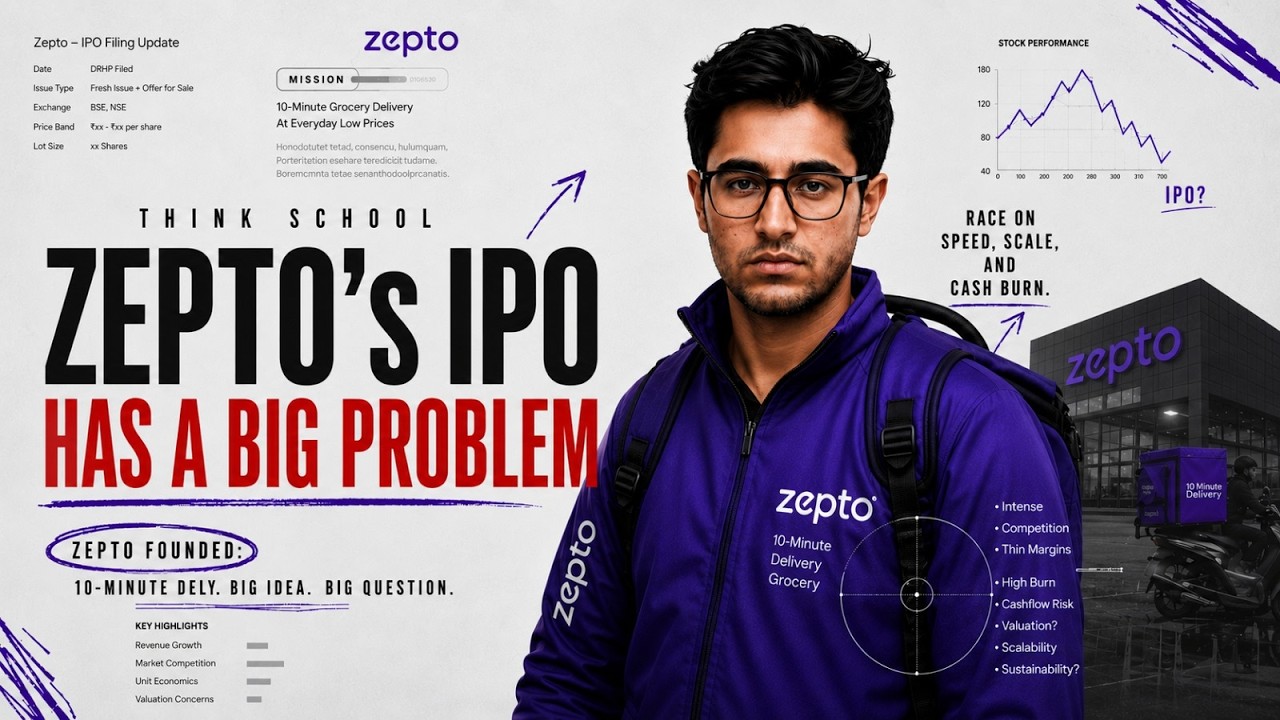
A Think School case study on Zepto's planned IPO, in which the narrator weighs the optimists' and skeptics' views on the quick-commerce company's growth, losses and valuation. He walks through order values, revenue per order, how advertising income per order is growing, and why he thinks there is a ceiling on ad income. Sponsor: Scaler School of Business, named in a mid-roll read about an 18-month business and AI program. PARTIAL COVERAGE: this note covers the opening, the sponsor read, the optimist and skeptic cases, the advertising per order section, the brand profit math, and the closing disclaimer, and does not cover every part of the roughly 20 minute video. All figures, valuations and projections are the narrator's own and are not independently checked. This is a summary and not financial or investment advice; the narrator himself says he is not a financial adviser, and the sponsor read is an advertisement.
Key Takeaways
Optimists' case
The narrator says optimists point to revenue of 22,624 crore, 640 million orders a year, 1,636 crore of ad income and a $7 billion valuation round.
Skeptics' case
He says skeptics note a loss of 5,950 crore in FY26 and an average order value of 388 rupees against 525 for Blinkit and 504 for Instamart.
Losing on every order
He says that even in its best quarter Zepto lost 59 rupees per order, so they are practically paying people to order.
Valuation versus DMart
He compares DMart's 2,970 crore profit on 68,821 crore revenue at 3.79 times sales with Zepto's loss at 2.7 to 3.9 times sales.
Sponsor: Scaler School of Business
A mid-roll read promotes an 18-month business plus AI program in Bangalore, with scholarships up to 50%. This is the sponsor's pitch.
Ads are the fat part
He says ad income per order rose from 4 rupees in FY24 to 26 in FY26, while groceries are the thin part.
The ceiling on ad income
He says closing the 59 rupee gap by ads alone would need ad revenue of about 85 rupees per order, or 22% of the order value, which he says no retail platform has reached.
The Conversation Breakdown
Optimists' case
⏱ Untimed topicThe narrator says optimists point to revenue of 22,624 crore, 640 million orders a year, 1,636 crore of ad income and a $7 billion valuation round.
Skeptics' case
⏱ Untimed topicHe says skeptics note a loss of 5,950 crore in FY26 and an average order value of 388 rupees against 525 for Blinkit and 504 for Instamart.
Losing on every order
⏱ Untimed topicHe says that even in its best quarter Zepto lost 59 rupees per order, so they are practically paying people to order.
Valuation versus DMart
⏱ Untimed topicHe compares DMart's 2,970 crore profit on 68,821 crore revenue at 3.79 times sales with Zepto's loss at 2.7 to 3.9 times sales.
Sponsor: Scaler School of Business
⏱ Untimed topicA mid-roll read promotes an 18-month business plus AI program in Bangalore, with scholarships up to 50%. This is the sponsor's pitch.
Ads are the fat part
⏱ Untimed topicHe says ad income per order rose from 4 rupees in FY24 to 26 in FY26, while groceries are the thin part.
The ceiling on ad income
⏱ Untimed topicHe says closing the 59 rupee gap by ads alone would need ad revenue of about 85 rupees per order, or 22% of the order value, which he says no retail platform has reached.
Core Frameworks & Ideas
Average order value backwards - the narrator's method
Follow revenue and cost per order instead of the headline app growth.
Take per order - his profitability path
Raise what the platform earns per order while cutting cost per order.
CM2 reality for brands - the brand-side math
Most brands earn only a few rupees profit per product after platform margin and costs.
Actionable Next Steps
- ✓Work out revenue and cost per order for your own business.
- ✓Check what share of each sale would have to come from ads or fees to reach profit.
- ✓Read the company's draft offer document yourself before judging any IPO.
- ✓Consult a registered adviser for investment decisions; this is not advice.
Notable Quotes
“they're practically paying money to make you order.”
“the groceries are the thin part and the ads are the fat part”
“I am not a financial adviser and you should never take financial advice from me even if I give it.”
The One Thing to Remember
The narrator argues Zepto's numbers look impressive on growth but weak on per-order profit, and that advertising income alone may not close the gap.