

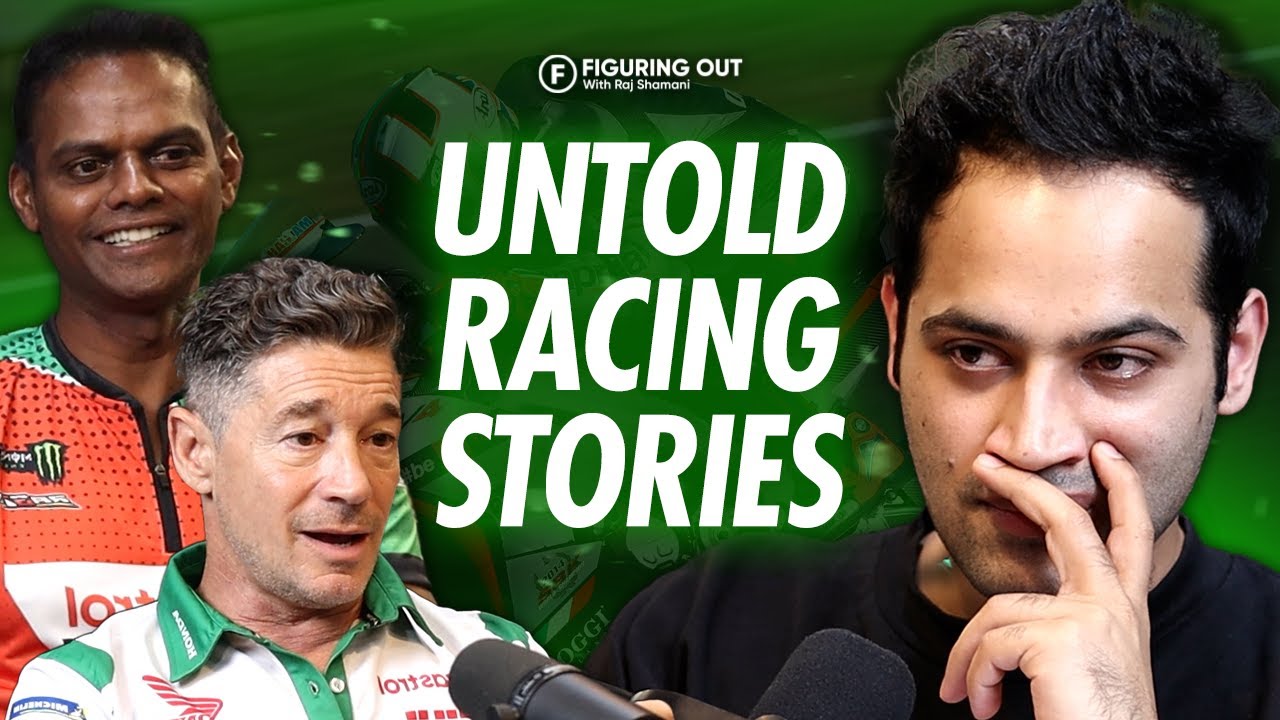
Career, Income & Step By Step Guide To Become A Racer In India | Lucio & Rajini | Raj Shamani |FO166
with Lucio Cecchinello & Rajini Krishnan
Executive Summary
Raj Shamani hosts two champion motorcycle racers - Lucio Cecchinello, former European champion and now LCR Honda MotoGP team principal, and Rajini Krishnan, one of India's pioneering national racers - to break down racing as a career. The economics are stark: starting out costs about 30,000 euro a year in Europe or roughly 5 lakh rupees in India, the first four to five years pay nothing, national-level racing yields an average salary at best, and real money (around 100,000 euro and up) starts only at the world-championship level; a MotoGP team is a 50-million-euro operation with 52 staff for two riders. Both guests stress passion over money: Rajini spent eight to ten years funding racing himself on a 12,000-rupee TVS salary, and Lucio sold his bike to his girlfriend to buy racing gear, then borrowed the bike back. They cover danger (Rajini has had 23 fractures), why India barely notices the sport (no media coverage), and the Castrol Power1 India's Ultimate Moto Star program both are part of. All views and claims are the speakers' own.
Key Takeaways
Racing costs you before it pays you
The entry bill: about 30,000 euro a year minimum in Europe (bike, travel, spares, gear) or roughly 5 lakh rupees a year in India with a rented production bike. Both guests spent their first four to five years earning nothing from racing - Lucio worked as a motorcycle mechanic, Rajini funded everything himself for eight to ten years.
The money starts at the world championship
Their income map: national-level racing pays a medium average salary at best - Rajini's TVS factory salary was about 12,000 rupees a month - while international-level racing, even in smaller categories, can pay around 100,000 euro. At the top, MotoGP rider salaries run from 300,000 euro to 20 million a year.
A MotoGP team is a 50-million-euro enterprise
Lucio's LCR Honda operation: over 50 million euro a year, with four bikes costing about 5 million, carbon brakes and special fuel, and 52 staff for two riders - 20 mechanics, 12 hospitality, 5 in communications and marketing, plus logistics, administration and truck drivers. Riders are paid the most, then the crew chief at around 100,000 euro.
Passion is the only sustainable entry ticket
Both reject racing-for-money: Lucio sold his motorcycle to his girlfriend's family to buy racing gear, then borrowed the bike back for his first race; Rajini put every rupee he earned into racing until nearly 30. Lucio's belief: the spirit of man was always to go higher, deeper and faster.
Danger is routine, and fear is the exit signal
Crashes at 300 km/h can leave no injury while slow crashes break shoulders; Rajini counts 23 fractures and raced with a freshly broken collarbone. His rule: the day crashing scares you, retire from racing and move into management.
India's problem is coverage, not interest
Rajini's diagnosis: Indians love bikes but do not know where racing happens because organizers buy no media coverage - unlike the BCCI, which promotes cricket for months across TV and radio. Live TV and advertising, he argues, would change the sport's scale; MotoGP arriving in India may accelerate it.
Retirement can be a second career, not an end
Leading the 2003 world championship after wins in France, Spain and Italy, Lucio hit a run of engine failures and crashes, read them as signals to stop, and retired that year - then immediately began his second innings as a team manager, which is where his career outgrew his riding years.
The Conversation Breakdown
Two origin stories: Chennai and Bologna
⏱ Untimed topicRajini Krishnan started on his brother's scooter in Chennai at 16, lost his father at 14, worked from 17 and bought an RX100 at 20 - in a pre-Google India, he found racing through a technician friend and funded himself until nearly 30. Lucio Cecchinello grew up near Bologna surrounded by Ferrari, Lamborghini and Ducati culture, worked summers and after school as a mechanic, and financed his first race by selling his bike to his girlfriend and borrowing it back.
From first race to world championship
⏱ Untimed topicLucio's first race at Misano ended with a last-lap crash while running second - and the conviction that he could build a career. A local moto club funded him; he finished second in the Italian championship, second then first in the European championship, raced ten years in the world championship and retired in 2003 with a team already built.
The real cost of becoming a racer
⏱ Untimed topicA beginner's sport-production season costs about 30,000 euro in Europe or roughly 5 lakh rupees in India (rented production bike, gear, tires, spares, travel). At the top end, a MotoGP team runs over 50 million euro a year - 5 million for the bikes alone - with Formula One costing ten times more. The guests' advice: keep the dream alive and start by contacting people already in the paddock.
What a racer actually earns
⏱ Untimed topicThe honest ladder: four to five years of paying to race, national level paying a medium salary (Rajini's TVS years paid about 12,000 rupees a month), and real income only at the international level - around 100,000 euro in smaller world-championship categories, up to 300,000 to 20 million euro for MotoGP riders.
Castrol Power1 India's Ultimate Moto Star
⏱ Untimed topicBoth guests describe their roles in the Castrol Power1 India's Ultimate Moto Star program, built to fund and guide young Indian racers who lack sponsors: Rajini pre-selects the most talented riders in India, and Lucio brings the best of them to Europe to train with MotoGP riders, race in smaller categories and potentially enter a European racing academy.
Danger, fractures and why India doesn't watch
⏱ Untimed topicThe safety reality: 300 km/h crashes, unpredictable injuries, Rajini's 23 fractures and his rule that fear of crashing is the retirement signal. Then the diagnosis of India's indifference: organizers provide no live TV or advertising, so even bike lovers do not know where races happen - the BCCI's promotion machine as the contrast.
Retirement signals, heroes and the second innings
⏱ Untimed topicLucio's exit: leading the 2003 world championship after three straight wins, then a run of engine failures and crashes he read as signals to stop - he retired that year and became a team manager. Heroes: Valentino Rossi, whom Lucio beat to a European title when Rossi debuted, and Marc Marquez, the eight-time world champion.
Core Frameworks & Ideas
The five-year payment window
Racing's career economics as the guests describe them: roughly five years of paying to race (30,000 euro a year in Europe, 5 lakh rupees in India), then national-level wages, and meaningful income only at international level. Plan the funding before the dream.
Creative financing for passion
Lucio's first-race funding: sell the asset (his bike) to finance the consumables (gear, tires, spares), then borrow the asset back from the buyer - his girlfriend. Resourcefulness substitutes for capital at the start.
Fear as the retirement signal
Rajini's risk rule: injuries are random - 300 km/h crashes can be harmless and slow crashes can break bones - so danger alone is not the metric. When fear of crashing arrives, the racing career is over and management begins.
The coverage gap theory
Why niche sports stay niche: not lack of fans but lack of broadcast. The BCCI promotes cricket months in advance across every channel; Indian motorsport organizers buy no coverage, so fans never learn where racing happens.
Actionable Next Steps
- ✓If you want to race in India, budget roughly 5 lakh rupees for your first year and rent a production bike instead of buying.
- ✓Contact a racing team or academy directly - both guests say the paddock is more approachable than it looks from outside.
- ✓If you are funding a passion career, plan for about five years of self-funding and keep a parallel income like Lucio's mechanic work.
- ✓Follow the Castrol Power1 India's Ultimate Moto Star program if you are a young Indian rider looking for a supported entry path.
- ✓Before any high-risk pursuit, define your own exit signal in advance - the guests' rule is the day fear arrives.
Notable Quotes
“I got 23 fractures in my racing career.”
“I sold the motorbike, bought the stuff and then asked the my girlfriend to borrow me the motorbike back.”
“the spirit of man was always to go higher, deeper and faster.”
“God is sending me some signal and then perhaps it's the moment that I need to stop.”
“I beat Valentino.”
“you can make 100,000 euro or something like this.”
“keep their dream alive and then try his best to contact people like Rajni”
The One Thing to Remember
Racing is a passion-first career: expect about five years of paying to race before anyone pays you - and the bill starts at 30,000 euro a year in Europe or 5 lakh rupees in India.