Host: Raj Shamani
Figuring Out with Raj Shamani is a long-form interview podcast featuring entrepreneurs, business leaders, investors, athletes, experts, and influential personalities. Through candid conversations, the show explores entrepreneurship, money, business strategy, personal growth, careers, society, and the decisions behind success. Discover practical lessons, valuable perspectives, and ideas from people with experience across different industries.
Read structured takeaways and actionable insights from Figuring Out with Raj Shamani

Figuring Out with Raj Shamani
Raj Shamani with Gita Gopinath (former IMF Chief Economist, Harvard professor) on how money is created, central banks and inflation, why the US can borrow $38 trillion, dollar dominance and the yuan, tariffs and China's rerouting, the 'great gamble' of AI plus geopolitics, why she expects an AI correction, the IMF's Pakistan lending logic, global debt risk, and her advice to young people on learning in the AI age. FULL COVERAGE: notes span the entire episode (full audio transcribed, ~1:41:07). Sponsor: ASUS ExpertBook (read in intro). All economic claims, statistics and forecasts are the guest's views as of November 2026, attributed to her; nothing here is financial or investment advice.

Figuring Out with Raj Shamani
Raj Shamani with Mel Robbins (best-selling author, The Let Them Theory) on the five-second rule and the knowledge-action gap, why motivation is garbage, her climb out of nearly a million dollars of debt, gratitude and joy as tools for hard chapters, the Let Them theory of control, energy and reciprocity, purpose as what happens in other people, her rules for powerful speaking, and the biggest personal-brand and business mistakes. FULL COVERAGE: notes span the entire episode (full audio transcribed, ~1:43:10). Title sponsor: Porter; styling partner: Levi's (both read in intro). Research and expert references (Dr. K, Kelly McGonigal, Daniel Amen, Angela Duckworth, Seth Godin) are the guest's citations as of November 2026, attributed to her; nothing here is medical, psychological or financial advice.
Figuring Out with Raj Shamani
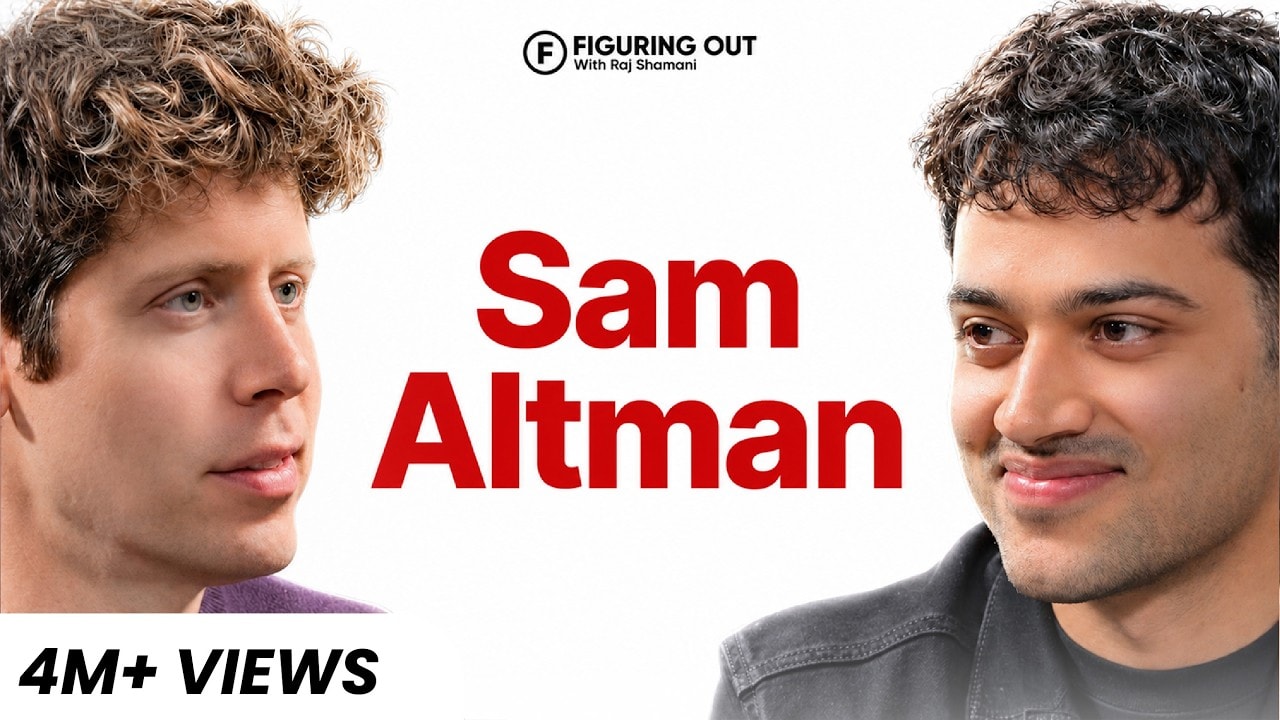
Sam Altman sits with Raj Shamani for a conversation that is less about AI products and more about how his mind works: the bets, the insecurities, the culture, and the costs. FULL COVERAGE: notes span the entire episode (transcript 0:03 to 1:07:42 of 1:08:00). Sponsor: Levi's is named as the episode's styling partner in the intro; the mushroom drink at the end is a host gift moment, not a stated sponsorship. Everything Altman says about markets, user numbers, OpenAI and other people is his claim as spoken on November 3, 2026; nothing here is business, investment or life advice. He says India is OpenAI's biggest market in the world by users, bigger than the US, and links India's optimism about AI to fast-growing economies that need products and services. He walks through the one insight he has reapplied his whole career - scale produces surprising superlinear returns - and how seeing neural networks improve with scale, years before scaling laws existed, led to starting OpenAI in 2015 when it was an extremely low-status thing to do. He takes Raj inside the August 2022 decision to bet the company on compute after GPT-4 finished training, months before the world saw it, and admits he would not have had the conviction if the model had been even a little less smart. He confirms he launched ChatGPT against the mood of his own leadership team, armed with two YC lessons: be embarrassed by your first version, and a small number of people who love the product beats a crowd that merely likes it (the internal prototype's retention was around 5%, but those users loved it). On power, he names two ways this goes wrong - loss of control to far more capable systems, or one actor concentrating too much power - and argues for pluralism: many competing AI efforts. He calls not taking equity in OpenAI a mistake in hindsight because it confused people about his motives, describes the culture that made roughly 700 employees threaten to resign when he was fired, explains why co-founders and colleagues left to build their own efforts (when stakes feel existential, people only trust themselves), and closes with what he wants to build next: AI that discovers new science, and why he is comfortable with his kids growing up in the world he is helping create.

Figuring Out with Raj Shamani
Raj Shamani sits down with Bryson DeChambeau - 2024 US Open champion, YouTube creator and golf-equipment builder - for a two-and-a-half-hour breakdown of the elite-athlete mindset. DeChambeau traces the wiring: a nine-year-old accused of cheating after winning his first tournament, abandonment issues and a fear of not being accepted, role-playing games like The Elder Scrolls that taught him progression, and the 2009 housing crash that pushed a 15-year-old to raise $2,000 door-to-door for tournament fees - including one stranger's $800 'angel check' he later tried to repay. He explains his lifelong hunt for 'distinct advantages': single-length irons he prototyped at 15 by grinding wedge heads to exchange head mass for shaft length, the strokes-gained logic (three yards farther beats six yards offline) behind his 2019 body transformation, speed training at 120 balls a session until his nervous system shook him awake at night, and the curved-face driver that preceded his 58 in 2023. He is candid about the costs: bulking to three times the heart-attack risk before losing 24 lbs in 30 days on a sensitivity-based whole-food diet, a broken hamate from overtraining in the cold, 14 missed cuts in a row in 2017, the lonely morning after winning the US Open, and becoming golf's villain in 2022 - then rebuilding his image by showing who he is on YouTube instead of telling. He closes with the death of his father in November 2022, the final putt at Pinehurst on Father's Day week, and a whiteboard framework for the next year: passion, three daily questions, health-mind-spirit, and outworking everyone. All figures, health claims and views are the speakers' own, not verified by us. FULL COVERAGE: the captions appear to cover the entire episode. Sponsor: a styling partner is named in the intro (auto-captions render it as 'Levice', likely Levi's). Nothing here is medical, investment, legal or financial advice.

Figuring Out with Raj Shamani
Annie Jacobsen - investigative journalist and bestselling author of Nuclear War: A Scenario, Area 51 and Biological War - walks Raj Shamani through how civilization could end in 72 minutes. She explains fission versus fusion ('a thermonuclear bomb is so powerful, it uses an atomic bomb inside of itself as the fuse'), the numbers (about 12,500 nuclear weapons on the planet, 1,700 American ones on ready-for-launch, some airborne 60 seconds after a presidential order), and sole presidential authority: one person can authorize nuclear war without asking Congress, the defense secretary or anyone. She takes us minute by minute through her scenario - the six-minute decision window, launch on warning, the black book, the doomsday plane, the universal unlock code, 44 interceptor missiles with a 40-55% success rate, why US missiles aimed at North Korea must overfly Russia, and how that misunderstanding ends the world. Then the second half: why biological war scares the Pentagon more - 3,600 BSL-3/4 labs worldwide, no inspections because the weapons are illegal, a Soviet defector's confession that the plan was to 'kill everyone in the West and leave the infrastructure intact,' and the classified Devolution Plan to reconstitute the government after everyone dies. FULL COVERAGE: the captions appear to cover the entire episode. All accounts and claims are the guest's own reporting, not independently verified. Sponsor: Porter (title sponsor). Nothing here is professional or safety advice.
Figuring Out with Raj Shamani
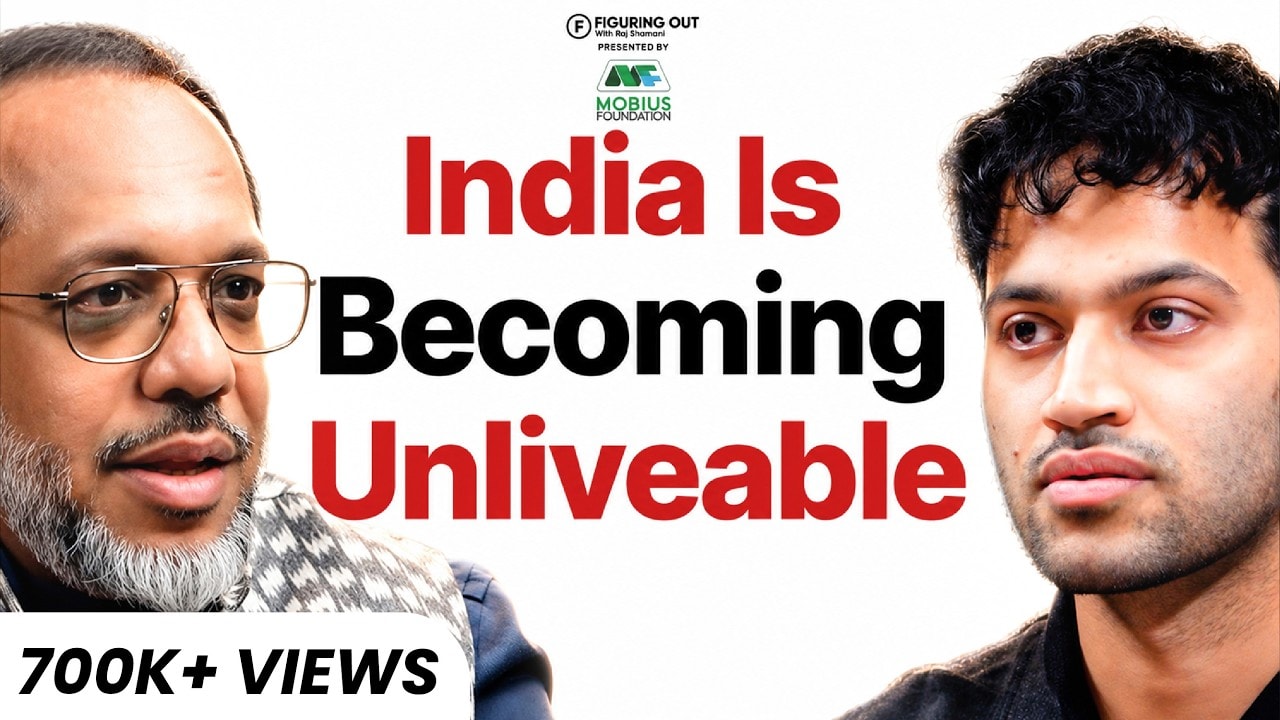
Arunabha Ghosh - founder-CEO of the Council on Energy, Environment and Water (CEEW) and one of India's leading voices on climate and energy - explains to Raj Shamani why 98 of the world's 100 hottest cities are now in India and what that costs. His institute's district-level research: 8 out of 10 Indians live where extreme flood, cyclone or drought risk has jumped; 75% of India's 734 districts are now extreme-weather hotspots; and 40% of districts are swapping trends - flood-prone turning drought-prone and back. The economics: roughly $180 billion in heat-stress losses by 2030 (more than the entire IT industry earns), 30-40 million man-days lost when outdoor labor stops from noon to 4 pm, and an 8x rise in cooling demand by 2040 - the AC trap, where the fix heats the city further. He covers the energy-security shock (90% of India's oil imports, much through the Strait of Hormuz, and a budget built on $65 oil meeting $115-120 reality), who actually emits (power first, then steel/cement/aluminium; cumulatively the US, then Europe, then China), geoengineering's promise and danger, what Medellin, Singapore, Paris and Beijing got right, and three concrete opportunities for young founders - recycling, the bioeconomy and next-generation energy hardware. (This episode is in Hindi; all notes are in English and translated quotes are marked.) FULL COVERAGE: the captions appear to cover the entire episode. All figures and claims are the guest's and his institute's research, not independently verified. Sponsor: none stated in the episode. Nothing here is financial or professional advice.

Figuring Out with Raj Shamani
Robert J. O'Neill, the former SEAL Team 6 operator who says he fired the shots that killed Osama bin Laden, sits down with Raj Shamani in New York for his most detailed account of the Abbottabad raid. He describes the three weeks of training after a CIA analyst - a woman who had worked the target for years, seven days a week - told 28 senior operators 'this is as close as we've ever been'; the handwritten letters to his daughters on a mission he treated as one-way; the stealth helicopter that lost lift and crash-landed in the compound's front yard; the fake door that confirmed bin Laden was inside; walking up the last flight of stairs behind a point man who tackled two people he thought were suicide bombers; and the moment in the bedroom. Then the aftermath: 47 minutes on target, a 90-minute flight counting down to Afghanistan, breakfast sandwiches next to the body while President Obama announced it on TV, and a hard transition to civilian life - no degree, no plan, healthcare ending at midnight - that became a second career as a speaker and author. His closing advice: don't quit today, quit tomorrow. FULL COVERAGE: the captions appear to cover the entire episode. All accounts, figures and claims are the guest's own, not independently verified; his claim to have fired the fatal shots is his own publicly stated account. Sponsor: Porter (title sponsor). Nothing here is professional advice.

Figuring Out with Raj Shamani
Ayyoub El Osrouti, a 27-year-old ultra runner from a Moroccan family in Germany, joins Raj Shamani after running 93 loops - about 623 kilometers - in a Backyard Ultra, a race of 6.7 kilometers every hour on the hour where only the last man standing finishes. He explains why his body, not his mind, ended the race: a swollen right side, an inner thigh inflamed from loop 40 and an Achilles problem from loop 87, and how four years of training taught him the line between discomfort and damage. He describes sleeping about 60 minutes across 93 hours in four-to-five-minute naps between loops, the hallucinations that come when sleep slips, and the David Goggins books and podcasts that turned him from a self-described black sheep who worked in his father's supermarket from age ten into a professional ultra runner coached by world record holder Sam Harvey. He also walks through his full training week of easy runs, intervals at 85 to 90 percent of race pace, long weekend sessions and three gym days. PARTIAL COVERAGE: this summary is built from the first portion of the episode's captions, roughly the first hour of a nearly three-hour conversation. All claims are the guest's own, not independently verified. Sponsor: ASUS ExpertBook. Nothing here is medical or training advice.

Figuring Out with Raj Shamani
Rob Henderson, author and social scientist known for his luxury beliefs idea, joins Raj Shamani in New York for a wide conversation on status, class and money. They cover why people lie in the first minutes of a conversation and how the dark triad of traits peaks in the late teens and early twenties, whether the rich or the poor crave status more, how status symbols moved from luxury goods to cultural capital, why education now drives who marries whom, and why the affluent adopt beliefs that signal status while others pay the cost. Henderson also gives his own 12-month plan to move from low to high status and explains the data on male risk-taking and violence. FULL COVERAGE: the captions appear to cover the entire episode. All claims are Henderson's own views and the research he cites, not independently verified. Sponsor: none stated in the episode description. Nothing here is medical, legal or financial advice.

Figuring Out with Raj Shamani
Organizational psychologist and author Adam Grant sits down with Raj Shamani for a long conversation on how to read people, build trust and choose better friends. Grant explains why we judge people wrongly from first impressions, why deep talk builds closeness faster than small talk, why a first Zoom date can beat a bad in-person one, how personality overlaps even in twins raised apart, why we sometimes trust people we do not like, and why pay-it-forward networks open more doors than trading favors. He also covers the story of Abraham Lincoln's team of rivals, how our assumptions turn small data points into harsh judgments, how to fight loneliness by forming your own group, and why he thinks 'follow your passion' is advice nobody should follow. FULL COVERAGE: the captions appear to cover the entire episode. All claims are Grant's views and the research he cites, not independently verified. Sponsor: Urban Platter. Nothing here is medical, legal or financial advice.

Figuring Out with Raj Shamani
Raj Shamani's Figuring Out episode FO575, sponsored by Porter, in which Raj speaks with Barbara Butcher, a veteran New York death investigator who says she has investigated more than 5,500 deaths over two decades. Butcher explains how she reads a death scene: taking in the whole room before touching the body, using rigor mortis, lividity and body temperature to estimate time of death while insisting there is no precise method, and spotting staged crime scenes, moved bodies and faked suicides. She describes the difference between business and personal killings, recounts cases including a jealous husband, a staged burglary, a faked hanging and the 9/11 recovery work that left her shut down, and closes with the lessons death taught her about gratitude and living fully. FULL COVERAGE: the captions appear to cover the entire episode, and this summary highlights the investigation methods, cases and life lessons discussed. Butcher's accounts are her own recollections and opinions, not independently verified. This episode describes forensic investigation for general interest only; nothing here is medical, legal or safety advice.

Figuring Out with Raj Shamani
Raj Shamani and Karan Gupta discuss how to evaluate an education choice: course fit, faculty, prestige, student outcomes, root causes and adviser incentives. Selected non-policy decision-making passages only, not a full-episode summary. Visa, immigration, licensing, salary, loan, political, AI and mental-health claims omitted; consult current official sources for those subjects. Quotes reproduce YouTube's auto-generated English transcript, which may contain recognition errors. Untimed editorial topics are not video chapters. Source and transcript: https://www.youtube.com/watch?v=ScYnbG_PiL8

Figuring Out with Raj Shamani
Saurabh Mukherjea discusses knowing a core strength, developing leaders, mentoring and gaining perspective through varied work. Selected leadership passages only, not a full-episode summary or investment advice. Crisis forecasts, stocks, gold, portfolios, inflation, debt, political, AI, health and extreme-work claims omitted. Company examples are the guest's account, not current policies. Quotes reproduce Wave's third-party machine transcript; recognition errors and audio-video edit differences are possible. Untimed topics are not video chapters. Original video: https://www.youtube.com/watch?v=61_ouz8Rr4s Transcript: https://pod.wave.co/podcast/raj-shamanis-figuring-out-ae16fa52-2d44-4d97-9190-2a80ee902de7/top-investors-warning-global-crisis-coming-for-your-wealth-saurabh-mukherjea-fo573-raj-shamani

Figuring Out with Raj Shamani
Raj Shamani asks neuroscientist Nikolay Kukushkin how learning changes the brain, why memories can be unreliable, and how sleep, attention and repetition shape memory. The discussion includes memory palaces and the difference between rumination and useful reflection. General educational information, not medical advice or a replacement for mental-health care.

Figuring Out with Raj Shamani
Scott Galloway joins Raj Shamani to discuss the middle class, opportunity, isolation, comparison, luck and risk-taking. He challenges the idea that success is purely individual and asks how young people can build relationships and take useful risks. Economic claims and personal strategies are his views, not investment advice or clinical treatment.

Figuring Out with Raj Shamani
David Bickford, the former legal director of both MI5 and MI6 - the man whose signature a real James Bond would have needed - sits down with Raj Shamani for a rare inside account of how British intelligence actually works. He explains why integrity tops the recruitment list for people paid to lie, why blackmailing an informant is fatal, and why MI5 officers cannot arrest anyone. He walks through the oversight machine he helped build: judicial warrants instead of ministers, a parliamentary committee with its own investigators, and a complaints route for any citizen who thinks they are being followed. Then the stories: writing the Turks and Caicos tax laws that accidentally built a money-laundering hub, then being sent back to dismantle it with an FBI sting that took down government ministers; forcing open the Caymans' secret bank accounts through a mutual legal assistance agreement; catching a Czech spy mid-transmission with his one-time pad after blocking his drains; and trapping a traitor selling submarine stealth tiles with a fake Russian embassy officer. His diagnosis of Britain: a democracy that muddles through, no written constitution, seven prime ministers in ten years, civil servants who treat risk as gambling - while America decentralized innovation and won. FULL COVERAGE: the captions appear to cover the entire episode. All accounts and claims are the guest's own, not independently verified. Sponsor: TapTap Send. Nothing here is legal or professional advice.

Figuring Out with Raj Shamani
Sumant Sinha on renewable electricity costs, storage, grids and the solar manufacturing chain. Edited partial transcript coverage; political, geopolitical and AI-demand passages omitted. Figures, forecasts and company claims are his account, unverified here. Not investment advice. Untimed editorial topics are not video chapters.
Figuring Out with Raj Shamani
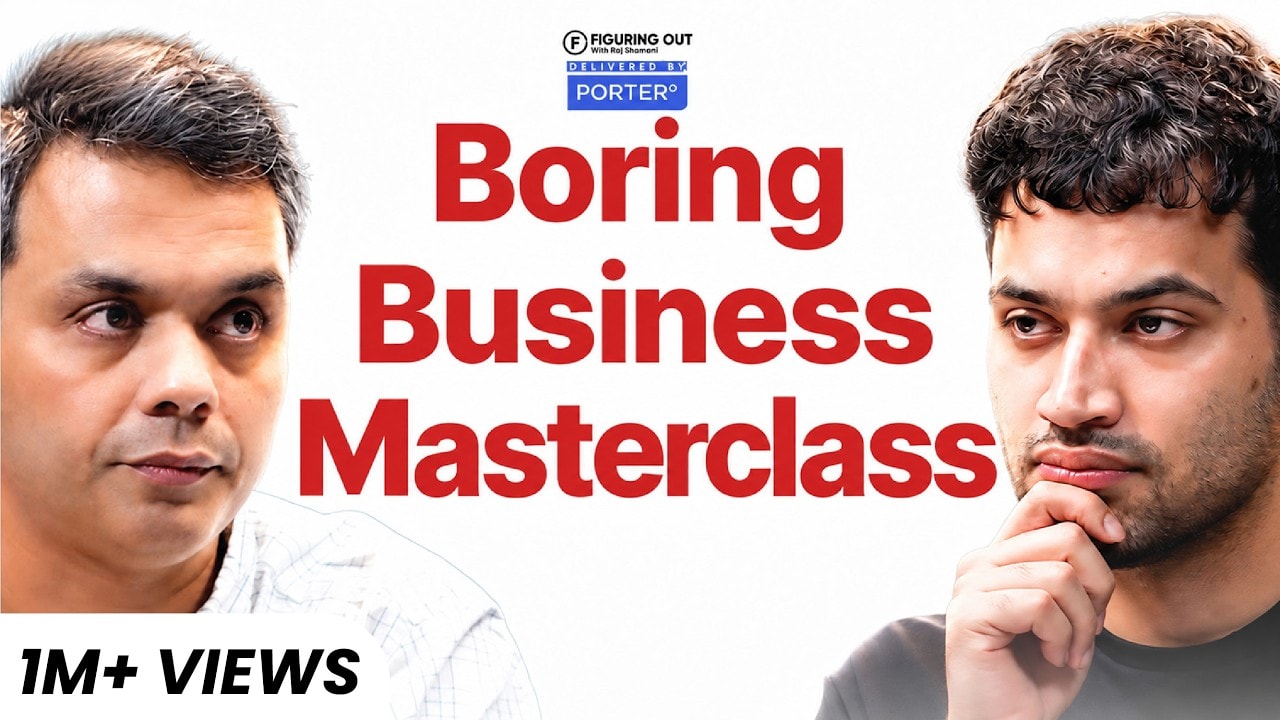
Asish Mohapatra discusses underserved customers, testing ideas, building trust and listening before selling. Selected practical passages only, not a full-episode summary. Financial, regulatory, political, AI, bribery, dismissal and extreme-work claims omitted. Business anecdotes are the guest's account, not independently verified facts. Quotes reproduce Wave's third-party machine transcript; recognition errors and audio-video edit differences are possible. Untimed topics are not video chapters. Original video: https://www.youtube.com/watch?v=GhZgfEfz8og Transcript: https://pod.wave.co/podcast/raj-shamanis-figuring-out-ae16fa52-2d44-4d97-9190-2a80ee902de7/how-to-100x-your-money-in-boring-businesses-spot-hidden-opportunities-asish-mohapatra-fo567-raj-sham
Figuring Out with Raj Shamani
JR Airlines founder Abhinav Tripathi explains the business of private jets and helicopters to Raj Shamani: brokers, charter pricing, ownership costs, utilization, maintenance and customer pressure. Original English notes based on the full available Hindi auto-caption page. Short quotes are translated caption excerpts, not audio-verified English quotations. Source: https://youtubetotranscript.com/transcript?v=pbLFmU1p-7A. Fleet counts, prices, taxes, safety statements and regulatory claims are the guest's account at recording, not current verified rules or aviation advice. Check qualified operators and official authorities before acting.

Figuring Out with Raj Shamani
Raj Shamani asks author Robert Greene how presence, restraint and absence shape influence. Greene discusses the psychology of attraction, the difference between loving a fantasy and knowing a real person, and the years of effort behind his books. These notes describe his ideas about power and human behavior, not universal rules or a license to manipulate others.
Figuring Out with Raj Shamani
Sasha Mirchandani discusses founder follow-through, complementary skills, customer understanding, clear pitches and learning from failure. Selected founder communication and execution passages only, not a full-episode summary or investment advice. Returns, valuations, ownership, portfolio allocation and financial claims omitted. Quotes reproduce YouTube's auto-generated English transcript and may contain recognition errors. Untimed editorial topics are not video chapters. Source and transcript: https://www.youtube.com/watch?v=0XStJayUrUY
Figuring Out with Raj Shamani
Selected workplace coverage: careful hiring, training, visible performance and professional authority. Edited partial third-party transcript, not full-episode coverage. Political, mental-health, lie-detection and interrogation material excluded. Personal accounts and study claims are hers, unverified here. Untimed editorial topics are not video chapters.
Figuring Out with Raj Shamani
David Sinclair joins Raj Shamani to discuss aging, the epigenome, exercise, body composition and daily habits. He presents his longevity theories and personal routines, including ideas that remain debated or preliminary. This is a summary of his views, not medical advice; animal findings and proposed treatments should not be read as proven human age reversal.

Figuring Out with Raj Shamani
Smriti Mandhana talks with Raj Shamani about practice goals, protecting training time, reviewing performance and leading a cricket team. She describes a shift from chasing a runs total to improving a specific skill and arriving prepared. These notes cover selected preparation and leadership passages from roughly the first 50,000 characters of the public machine transcript, not the full 109-minute episode. The ending is not covered. Medical, mental-health, meditation and manifestation advice are omitted. Captions contain recognition errors; quotes reproduce the available transcript rather than independently checked audio. Personal routines and match recollections are her account, not universal rules. Source: https://youtubetotranscript.com/transcript?v=46P1rL0rzPE . Topic labels are untimed.

Figuring Out with Raj Shamani
Major Rishabh Singh Sambial - former Para Special Forces officer (4 Para SF) and former ADC, aide-de-camp, to the President of India - tells Raj Shamani what life looks like one step away from the head of state. He explains why nobody may touch the President's feet or shake her hand ('you don't know the intentions of the individual'), why the smallest thing he obsesses over is the glass she drinks from, and how a full one-kilometer area is sanitized before she arrives. He breaks down the ADC selection funnel: 20-30 officers shortlisted, five brought to Delhi for fourteen days of daily interviews, one vacancy; the 11-12 page checklist he had to memorize; and the pressure interviews designed to expose your weak subject - his was geopolitics. He contrasts President and Prime Minister security (police versus the SPG), explains why Para SF never does VIP protection, walks through every element of the ADC uniform from the maroon beret to the right-shoulder aiguillette, and relives the 90-day Para SF probation: the 72-hour stress phase with no food, water or sleep, and the diving tank where instructors push you under until you nearly give up. He closes with his four pillars of the military mindset, why he is retiring for his parents, the ADC rule against marrying while serving, and one piece of advice nobody should follow: be practical. FULL COVERAGE: the captions appear to cover the entire episode. All accounts and claims are the guest's own, not independently verified. Sponsor: Porter (title sponsor). Nothing here is professional or security advice.

Figuring Out with Raj Shamani
Raj Shamani asks cognitive neuroscientist Dr Sahar Yousef about focus, habit change, cravings, chronotypes, recovery and digital habits. She links practical behavior changes with the emotions that drive them, while discussing her own struggles and the cost of ambition. Educational summary, not medical advice. Persistent addiction or burnout deserves qualified professional care.
Figuring Out with Raj Shamani
Sauvik Banerjjee discusses execution, accountable teams, dated commitments, clear product notes and respectful disagreement with leaders. Selected workplace coverage; AI demo, later AI discussion and personal-loss passages omitted. Auto-captions have recognition errors and no speaker labels; attribution follows the question-and-answer context. Advice and company examples are his views, not universal rules or verified current policies. Untimed topics are not video chapters. Source: https://www.youtube.com/watch?v=XwawXRaNfzM

Figuring Out with Raj Shamani
Andrew Huberman joins Raj Shamani to discuss stress regulation, morning routines, attention and the need for recovery. He connects mental strength with being able to shift between focused effort and rest without turning routines into another source of anxiety. Health claims and techniques are his educational views, not personal medical advice.

Figuring Out with Raj Shamani
Gaurav Mehta tells Raj Shamani how coin collecting led to Jaipur Watch Company, and how manufacturing obstacles and retailer rejection shaped its early years. He discusses resourceful suppliers, cash pressure, alternative retail channels and watch design. This summary focuses on the founder story supported by the third-party transcript; personal and business claims remain his account.

Figuring Out with Raj Shamani
Sanjiv Goenka discusses finding business problems, filtering ideas, a path to profits, changing a team's belief and adapting a family business over time. Selected business passages only. Clinical-product claims, politics, legal disputes, personal loss and unrelated passages omitted. YouTube auto-captions have no speaker labels and recognition errors; attribution follows the question-and-answer context. Financial and company claims are his account, not investment advice. Untimed topics are not video chapters. Source: https://www.youtube.com/watch?v=JWPrgCbUwC8

Figuring Out with Raj Shamani
Frank-Steffen Walliser talks with Raj Shamani about car design, clay prototypes, sensory details, door acoustics and brand heritage. The Bentley executive offers a commercial and personal perspective on craftsmanship and emotion, not an independent product comparison or verified safety assessment.

Figuring Out with Raj Shamani
Aimen Dean - the Bahraini who joined the Bosnian jihad at 16, swore personal allegiance to Osama bin Laden at 19, trained in bomb making under al-Qaeda's legendary Abu Khabab, and then spent eight years spying on al-Qaeda for MI6 - tells Raj Shamani the whole story. He describes meeting bin Laden on August 4, 1996 ('he looked like a refugee... a hermit'), the handshake oath ('I give you my allegiance to listen to you, obey you, and never disobey you'), and the bomb camp where the first rule was 'in the art of bomb making the first mistake is your last mistake.' He explains how the 1998 Nairobi embassy bombing - 224 dead, 5,000 wounded by nails packed into the device - shattered his faith in the cause, how a 700-year-old fatwa about Mongol siege towers was being misused to justify killing civilians, and how he walked out via Doha into the hands of three recruiting intelligence agencies, choosing MI6. He covers the honey-and-Himalayan-salt business cover that ran for 33 months, the 2003 New York subway cyanide plot he helped foil, the 2006 Time magazine article that blew his cover in the middle of a Paris boat tour, and his framework for radicalization: victimhood, then empowerment, then action - and why it spreads 'like a virus' wherever laws are not enforced. FULL COVERAGE: the captions appear to cover the entire episode. All accounts and claims are the guest's own, not independently verified. Sponsor: Porter (title sponsor). Nothing here is professional advice.

Figuring Out with Raj Shamani
Figuring Out episode FO549, sponsored by Asus ExpertBook, in which Raj Shamani speaks with Mark Bowden, body language expert and advisor to G7 leaders, about how behavior wins trust and credibility. Bowden demonstrates live why the brain rewards predictability, shows Raj his own stress adapters on camera, explains his four boxes of communication style, and breaks down influence and persuasion: accept first, float in the other person's river, then offer binary choices. He defends the genuine fake, recounts coaching a world leader to survive Donald Trump's handshake by approaching fast with a locked arm, and closes on targeting your scarce resource at the audience that matters. PARTIAL COVERAGE: this long conversation is summarized from its caption highlights; the quick-fire segments and full rapid rounds are not covered question by question. These are Bowden's own methods and opinions, not independently verified, and nothing here is professional advice.

Figuring Out with Raj Shamani
Anahat Singh discusses squash practice, reviewing games, tournament trade-offs, preparation and the training environment she saw in Egypt. Selected sports-work coverage only. Injury and playing-through-pain stories, diet, superstition and unrelated personal passages omitted. Auto-captions contain errors and no speaker labels; attribution follows interview context. Ranking and sports-history claims are not independently verified. This is not medical or training-prescription advice. Untimed topics are not video chapters. Source: https://www.youtube.com/watch?v=h-0u0ui8ESQ

Figuring Out with Raj Shamani
Geopolitical analyst Prof. Jiang Xueqin tells Raj Shamani why he believes the world order is a lie - and lays out his framework for how power really works: occultists who imagine the plan, financiers who fund it, and politicians who implement it. He walks through his interpretation of the Epstein mysteries, the three pillars of America's National Defense Strategy (Western Hemisphere control, maritime chokepoints, conflict in Eurasia), why he thinks America cannot be defeated in a war, his domino theory of imperial decline, and why he predicts complete global collapse within 50 years - plus chess vs Go as civilizational strategy, the resource trap, and which nations he thinks rise by 2035. IMPORTANT: the theories, interpretations and predictions in this episode are entirely Prof. Jiang's own - he himself calls parts of his narrative speculation and offers falsifiable predictions to test it. They are presented here as his views, not established fact, and several claims are contested or unverified. FULL COVERAGE: the captions appear to cover the entire episode. Sponsor: ASUS ExpertBook (Flipkart). Nothing here is professional, financial or political advice.
Figuring Out with Raj Shamani
Puneet Nanda discusses retail fulfillment, customer research, brand identity and sourcing. Selected business passages only; health and supplement benefits, clinical advice, personal health history, AI design tools and sponsor material omitted. Rough auto-captions lack speaker labels; quotes retain exact caption wording and attribution follows interview context. His name is confirmed in the official description. Retail rules, sales and company history are his recollections, not current verified vendor policy. Untimed topics are not video chapters. Source: https://www.youtube.com/watch?v=czkPKQ9VIU8

Figuring Out with Raj Shamani
Ian Bremmer explains his G-Zero and geopolitical-recession lens, argues for shared governance and proposes expert-led coordination on AI risks. He discusses Europe and the difference between controlling events and controlling his response. These are his August 2026 interpretations and proposals, not settled geopolitical facts or an existing AI-governance institution.

Figuring Out with Raj Shamani
John Sipher spent 28 years in CIA operations - recruiting spies, running the Russia desk as deputy, serving undercover across Russia, Asia and Pakistan. On Figuring Out, he tells Raj Shamani how the Agency really works (a small spy side, a university-sized analytic side, and 70-80% of clandestine reporting from partner services), why security services like Russia's, China's and Pakistan's behave so differently, why he believes the US is losing the trust that made it powerful, and why he calls China the biggest long-term challenge - a country that doesn't need a war to win. He walks through the full recruitment cycle (spot, assess, develop, recruit, handle, terminate), the big-data 'targeter' revolution, the cops-vs-robbers FBI/CIA culture clash, his profile of Vladimir Putin's Chekist mentality, and the brick from Osama bin Laden's compound behind his desk. All assessments and opinions in this episode - including his sharp criticism of Donald Trump and current US politics - are Sipher's own views as a private citizen and former officer, not official positions. FULL COVERAGE: the captions appear to cover the entire episode. Sponsor: none stated. Nothing here is professional, legal or political advice.
Figuring Out with Raj Shamani
Figuring Out episode FO543 in which Raj Shamani speaks with Sunil Bajpai, chief trust officer of Tanla Platforms and a 30-year Government of India veteran who wrote the anti-spam rules at TRAI, about why fraud calls work on smart people. Walking a board of real cases, Bajpai shows the same elements every time: a friendly authority figure, a problem, urgency, and an irreversible action, from the 7-crore digital arrest of a Padma Bhushan textile owner to the fake emergency that cost a mother her life. He explains the scam industry's supply chain - data procurement for a rupee or two per number, toolkits, voice cloning, distribution by SMS and social media - the sunk-cost psychology that keeps victims paying, and the perverse incentives, from toll-booth telecoms to inaction having no consequence, that let the industry reach about 1 trillion dollars a year. His defense advice is simple: hang up. This episode features the guest's own company and carries no separate sponsor read. PARTIAL COVERAGE: the captions cover most of the conversation, but this summary highlights the scam mechanics and defenses only. These are the guest's figures and views, not independently verified; consult official channels if you receive such a call.

Figuring Out with Raj Shamani
Alok Sama discusses entrepreneurial setbacks, selection bias in success stories, business-model discipline and the dangers of growing beyond what the economics support. Selected business coverage; AI, political and unrelated personal passages omitted. Auto-captions contain errors and no speaker labels; attribution follows interview context. Company histories and financial comparisons are his recollection, not independently verified facts or investment advice. Untimed topics are not video chapters. Source: https://www.youtube.com/watch?v=5UTkieEX-bA
Figuring Out with Raj Shamani
Mohandas Pai and Raj Shamani discuss his career, financial curiosity, workplace respect, reporting discipline and views on government. These notes focus on the source-read career and leadership passages rather than analyzing every tax or political claim in the full episode. His recollections and policy views are attributed, not current tax guidance.

Figuring Out with Raj Shamani
Kiran Mazumdar-Shaw discusses explaining a new business, customer demand, credibility, reusing existing capabilities and learning from mistakes. Selected founder-work passages only; medical efficacy and pricing, politics and unrelated personal passages omitted. Auto-captions contain errors and no speaker labels; attribution follows the interview context. Company and historical claims are her account, not verified current facts, medical or investment advice. Untimed topics are not video chapters. Source: https://www.youtube.com/watch?v=PXMyK7JxGOk

Figuring Out with Raj Shamani
Group Captain Shubhanshu Shukla - test pilot, fighter pilot and the first Indian to reach the International Space Station - explains rocket science to Raj Shamani like he is talking to a kid: why orbit is really a continuous free fall, what 0 to 28,500 km/h in eight and a half minutes does to a human body, and how a docking at 28,000 km/h is choreographed down to centimeters per second. He describes what microgravity does to blood, hearts, height, balance, taste and tears; life aboard the ISS (98% recycled water, floating sleep, shared Indian food from DFRL); the night flyover of India that left him with tears pooling in his eyes; and the full road there - a secretly filled 20-rupee NDA form, the academy that broke him down, 2,000 flying hours, a test-pilot course at 30, and a Gaganyaan selection process with 40 blood vials and a 7-day isolation exercise. NOTE: this episode is mostly in Hindi/Hinglish; all notes below are in English and quotes are translated faithfully and marked. All experiences and views are the guest's own. FULL COVERAGE: the captions appear to cover the entire episode. Sponsor: ASUS ExpertBook (Flipkart). Nothing here is medical or professional advice.
Figuring Out with Raj Shamani
Raj Shamani hosts investor and Marcellus Investment Managers co-founder Saurabh Mukherjea, author of the book "Break Point", for a data-heavy diagnosis of why India's middle-class life construct is cracking - and what could replace it. NOTE: This episode is in Hindi; these notes and the quotes are in English, with quotes translated faithfully and marked. FULL COVERAGE: notes span the entire conversation. Sponsor: Porter (packers and movers), named as title sponsor in the intro. All statistics and claims below are Mukherjea's or his cited sources (Azim Premji University research, Naukri.com data, SEBI data, income-tax filing data, NSSO) as presented in the episode - they are his framing, not independently verified, and nothing here is financial, career or investment advice. Mukherjea defines the Indian middle class as households earning roughly Rs 5 lakh to Rs 1 crore a year - about 5-6 crore tax filers of whom only ~2 crore actually pay income tax - and says this small group shoulders ~70% of the income-tax and ~40% of the GST burden while anchoring employment. His core argument: three pillars of middle-class life have broken. Education no longer guarantees a job (Azim Premji University: only ~7 of 100 graduates find work in their graduation year, 2-3 of them white-collar; an entry-level graduate salary of ~Rs 2.5 lakh now trails a big-city construction worker's Rs 5-6 lakh). Saving has been replaced by leverage (household debt-to-income excluding home loans at 32-33% vs a 15-23% global band; 27% of personal loans funding holidays; roughly 1 in 2 middle-class Indians in debt). And real wages have been flat for about a decade while living costs rise 8-9% a year. Naukri data, he says, shows white-collar job creation - 11% a year until 2020 - has been near zero for three years, with IT at -15%. Layered on top: Jio's free data and COVID fused a generation to social media, producing what he calls the "industrialization of aspiration" - borrowing to fund fantasy lifestyles and mass F&O trading that, per SEBI data he cites, pulled ~Rs 4 lakh crore from ~9 million mostly male traders aged 30-40 over four years, half of it flowing to foreign hedge funds. Raj frames the compulsion with Skinner-box economics (random rewards addict fastest) and Mukherjea adds Althusser's ideological state apparatus: a culture that celebrates exam toppers keeps millions chasing JEE/UPSC at ~2% success rates. He contrasts the UK/US (hollowed-out middle classes, 1985-2015, culminating in Brexit and MAGA, per the Autor-Levy-Murnane polarization thesis he cites) with Japan, which escaped. His three fixes: AI-era gig work at global scale, a mindset shift from jobs to work and early entrepreneurship (India already adds ~1 million entrepreneurs a year, backed by ~$40 billion of angel/VC/PE money), and Buffett's internal scorecard over external markers of success. He sees outsized opportunity in AI-powered "Uber for white-collar work" intermediaries, AI media houses, original R&D and IP (China now produces half the world's new biotech drugs; US firms spend $700B/year on R&D vs India's $20B), and AI-driven financial services managing global money. The blockers, per him: red tape (an FSSAI licence to cook Maggi in an office pantry, a legal spittoon requirement, 60-70 licences for a Mumbai 3-star hotel), industrial land priced like Western Europe (Vietnam is 40% cheaper), and 11-12% working-capital costs versus 3% in the US, China and Vietnam. He closes by predicting India's entrepreneurship wave can still pull off what the US did in 1880-1930 and China in 2004-2026 - if those three bottlenecks break.

Figuring Out with Raj Shamani
Srini Sriniwasan, MD of Kotak Alternate Asset Managers, joins Raj Shamani after 30 years of raising and investing billions for global institutions and ultra-rich families in India. He explains how foreign capital evaluates India (why India, what in India, why you), how tax and rupee depreciation shrink returns, why delisting rules make listed companies Hotel California, and why he welcomes crises because India reforms with its back to the wall. He recounts his first 5-crore investor, the 450-crore building deal run on written commitments, and Kotak's 2020 data-center bet on India's digital backbone before the AI hype. He also covers why EPFO and LIC barely touch alternate assets while global pension funds buy Indian toll roads and InvITs, healthcare economics at 20% of US cost, and the ultra-rich playbook: better information sources, pattern recognition, preserving wealth, and why money stops mattering after a point unless vanity takes over. Promotion note: the episode intro directs listeners to a Kotak Alts link; Kotak Alts is the guest's own firm. Sponsor: none stated. Investment views are the guest's personal opinions, not financial advice. Notes based on the publisher's full audio edition. FULL COVERAGE: these notes cover the complete episode from start to finish.

Figuring Out with Raj Shamani
Ashwini Bhide, IAS - Additional Municipal Commissioner of BMC and the MD who delivered Mumbai Metro's Aqua Line - joins Raj Shamani to explain how Mumbai really works. She covers who runs the city (BMC, BEST, MMRC, Railway Board), metro economics (900-1000 crore per kilometer, 300-350 crore per station, JICA soft debt, why private capital cannot build metros), and tunnelling under a living city with unmapped utilities and heritage structures above. She details the flood playbook (24 high-tide events, 6 crore metric tonnes of desilted naala waste, IoT pumps), why traffic's only answer is public transport (Tokyo moves 70-80% by metro), the 100-crore pothole budget and the utility-digging cycle, waste bio-mining and the 2035 waste-to-energy target, and why evacuating C1 buildings is always a legal action, never a heartless one. Sponsor: this episode includes a stated sponsor read for ASUS ExpertBook. Urban-policy views are the guest's professional opinions. Notes based on the publisher's full audio edition. FULL COVERAGE: these notes cover the complete episode from start to finish.
Figuring Out with Raj Shamani
Raj Shamani talks with comedian and writer Hasan Minhaj about what it means to succeed abroad as an Indian, why stand-up in New York shaped him, where his drive comes from, and how his relationship with money and risk changed. Hasan also explains why he would not want his kids to follow his career, why choosing uncertainty can be rational, and what he wants his children to feel about his success. A warm, candid conversation about family, ambition and creative work.

Figuring Out with Raj Shamani
Richard Teng discusses changes in payment infrastructure, fraud awareness, proof of reserve, compliance and building useful products. Selected finance and leadership coverage, not the full conversation; AI trading and geopolitical passages omitted. Teng leads Binance, so product, security and performance claims are promotional and unverified. This is not investment advice, a safety endorsement or a statement of current law. Crypto is volatile. Untimed topics are not video chapters. Transcript: https://singjupost.com/fo529-raj-shamani-w-richard-teng-bitcoin-crypto-de-dollarisation-transcript/

Figuring Out with Raj Shamani
Ranjit Bajaj - former owner of Minerva Punjab FC and one of Indian football's most outspoken insiders - joins Raj Shamani to answer why a country of 1.4 billion cannot produce 11 World Cup players. He covers the missing stadiums and state leagues, federation politics and deflected blame, the match-fixing he says he filmed (FIRs followed), pay-to-play selections, and the 24-lakh astrologer cheque - then contrasts it with his own academy, which won national titles and put nine players in India's 2017 under-17 World Cup squad on 5.5-7.5 lakh per kid per year. He also shares his performance system (myelin, sleep cycles, cryo and hyperbaric recovery) and his mindset code (fear extinction, process over results, learning to lose, never playing it safe). Claims about individuals, federations and specific events are the guest's own assertions. Sponsor: this episode includes a stated sponsor read for Porter (title sponsor). Notes based on the publisher's full audio edition. FULL COVERAGE: these notes cover the complete episode from start to finish.

Figuring Out with Raj Shamani
Raj Shamani talks to Dr. Viju Jacob of Synthite Industries, a Kerala company that is one of the world's largest makers of spice extracts. Dr. Jacob explains how a small pepper-extraction business grew into a group that supplies Nestle and Pepsi, why he advises aiming for the number four spot in an industry instead of number one, how he handled a big export order that nearly went wrong, and why he is moving into supplements and fermentation. Useful for founders in manufacturing and B2B.

Figuring Out with Raj Shamani
Aliia Roza, who describes training in a secret Russian intelligence program, joins Raj Shamani to reveal the psychology of espionage-grade influence: active listening, similarity bridges, seduction as social engineering, historical honey traps, and the red flags that expose manipulation in love and business. Accounts and claims are the guest's own. Sponsor: this episode is brought to you by travel partner Goibibo (stated in the episode). Notes based on the publisher's full audio edition. FULL COVERAGE: these notes cover the complete episode from start to finish.
Figuring Out with Raj Shamani
Ashwin Damera discusses career capital, learning from cases and understanding what people want in a negotiation. Selected career and decision passages only; institutional rankings and promotional claims, health, political context, moral dilemmas and deal valuations omitted. Rough auto-captions have recognition errors and no speaker labels; quotes retain caption wording and attribution follows interview context. The official description confirms his name. Harvard grading remarks are his retrospective account, not current university policy. Untimed topics are not video chapters. Source: https://www.youtube.com/watch?v=YVlWj1LCv54
Figuring Out with Raj Shamani
Abhijit Banerjee discusses increasing returns, inequality measurement, poverty constraints and job concerns with Raj Shamani. He argues for respecting low-income choices and examining resources and opportunities. Empirical program claims and automation predictions remain the speaker’s account, not independently verified effects or personal financial and career advice.
Figuring Out with Raj Shamani
Imtiaz Ali - writer-director of Rockstar, Tamasha, Jab We Met and Highway - joins Raj Shamani for a deep conversation on love, longing and filmmaking. He explains why his characters run away and chase fantasy, why his heroines find the man while the man finds himself, how failing in college rewired him, why Rockstar became a cult after flopping, the unscripted concert shot with a live crowd, and why Jordan's curse is staying alive. He also walks through his oral-first writing process, casting Alia Bhatt and Diljit Dosanjh on 'soul match', and his take on modern dating vocabulary. Creative readings of his films are the guest's own interpretations. Sponsor: this episode includes a stated sponsor read for Porter (title sponsor). Notes based on the publisher's full audio edition. FULL COVERAGE: these notes cover the complete episode from start to finish.

Figuring Out with Raj Shamani
Mokksh Sani, founder of Mumbai's Living Liquidz chain, joins Raj Shamani to break down the liquor business in India - license economics, alcohol taxes, excise regulation, distribution, celebrity brands and the culture shifts reshaping drinking in India. Figures and views shared are the guest's own. Sponsor: none stated in this episode. Notes based on the publisher's full audio edition. Episode is largely in Hindi; notes are in English. FULL COVERAGE: these notes cover the complete episode from start to finish.

Figuring Out with Raj Shamani
A Figuring Out with Raj Shamani conversation with Chris Williamson, host of the Modern Wisdom podcast, about the mindset of champions, vulnerability, status, strategically managing suffering and why outsiders often win. Sponsor: Gobo, a travel partner named at the start. PARTIAL COVERAGE: the episode runs about 144 minutes and the available caption text is cut off, so this summary covers roughly the first third and the opening teaser, with some jumps within it, and not the rest. Williamson's views on attraction and on his drink business are his own and are not summarised here as fact. This is a summary of his views, not medical, psychological or financial advice.
Figuring Out with Raj Shamani
Economic analyst Jayant joins Raj Shamani to unpack India's real crisis - gold imports, the falling rupee, the squeezed middle class, the many-Indias income divide, real estate as an investment asset, and the country's technology dependence. Figures and analysis shared are the guest's own. Sponsor: none stated in this episode. Notes based on the publisher's full audio edition. Episode is largely in Hindi; notes are in English. FULL COVERAGE: these notes cover the complete episode from start to finish.
Figuring Out with Raj Shamani
Sourav Ganguly - former India captain and BCCI president - joins Raj Shamani on leadership, team building and life after cricket. He revisits the 2000 captaincy after the match-fixing scandal, backing Sehwag, Yuvraj, Harbhajan and Dhoni, his most unusual call (Sehwag opening), why he never criticized players publicly, aggression versus anger, the Chappell years and the 2007 T20 World Cup he does not regret missing. He also shares his visualization routine from a Desmond Haynes book chapter, his father's discipline and death, his January 2021 cardiac event, and his advice on money and value. Accounts of selection rooms, matches and conversations are the guest's own recollections. Sponsor: none stated in this episode. Notes based on the publisher's full audio edition. FULL COVERAGE: these notes cover the complete episode from start to finish.
Figuring Out with Raj Shamani
Vishwa Mohan - IIT alumnus, former Amazon engineer and founder building a code-first engineering school - joins Raj Shamani to go inside the IIT race: JEE preparation, placements, big-tech interview loops and layoffs, and the future of engineering in the AI era. He argues the marks obsession is outdated, explains what Amazon, Google and LinkedIn actually test, and shares the code-first education model he is building. Opinions and claims expressed are the guest's own. Sponsor: none stated in this episode. Notes based on the publisher's full audio edition. Episode is largely in Hindi; notes are in English. FULL COVERAGE: these notes cover the complete episode from start to finish.
Figuring Out with Raj Shamani
Kiara Advani joins Raj Shamani for a personal conversation on marriage, motherhood, relationships and Bollywood. She opens up about postpartum and the identity shift of new motherhood, the five-year lull before Kabir Singh, the Lust Stories call from Karan Johar, how she learned to switch between character and home, breaking the people-pleasing pattern with the facts-versus-opinions filter, why she and Sidharth Malhotra kept their relationship private, and how she wants to raise her daughter. Personal experiences and views shared are the guest's own. Sponsor: none stated in this episode. Notes based on the publisher's full audio edition. FULL COVERAGE: these notes cover the complete episode from start to finish.

Figuring Out with Raj Shamani
Sociologist Shekhar joins Raj Shamani to discuss how America and globalization are changing India - its culture, jobs, relationships and identity. He argues prosperity drives service quality and social openness, explains the shift from identity-based to interest-based relationships, and reads America and China through national interest and execution. Views and analysis expressed are the guest's own. Sponsor: none stated in this episode. Notes based on the publisher's full audio edition. Episode is largely in Hindi; notes are in English. FULL COVERAGE: these notes cover the complete episode from start to finish.
Figuring Out with Raj Shamani
Lakshya Sen - India's badminton star and Paris 2024 Olympic semifinalist - joins Raj Shamani on the champion mindset. He covers the arrogance-respect balance every athlete needs, playing the Istora cauldron in Indonesia, his exact match-day system (warm-up heart-rate spikes, breath resets, wind-end strategy), the Paris bronze match he fought at 20-10 down, the two-month blank after the Olympics, the mental trainer who made him visualize losing, the rankings treadmill, and the father who coached him from Almora to the world's top - plus the Arjuna Award court case that reached the Supreme Court. Match accounts and selections described are the guest's own recollections. Sponsor: this episode includes a stated sponsor read for Porter (title sponsor). Notes based on the publisher's full audio edition. FULL COVERAGE: these notes cover the complete episode from start to finish.

Figuring Out with Raj Shamani
Raj Shamani Figuring Out episode, sponsored by travel partner Gobo, the show's five-hundredth special, in which Raj talks with Paul Rosolie, conservationist, author and founder of Jungle Keepers, which protects 136,000 acres of Amazon rainforest, about life inside the world's deadliest jungle. Rosolie's stakes: rainforest covers only 6 percent of Earth's land but holds half of its life, and we are wiping out the belt we cannot live without. His ecology point is ants over humans - remove humans and nothing changes, remove ants and whole ecosystems crash, because they engineer the system. The stories run from being charged by an elephant in India - it threw a stick at his head after he rolled down a twelve-foot bank into a stream - to tracking tigers on foot, to the twenty-three-billion-dollar-a-year illegal wildlife trade behind tiger-penis wine and ivory. His career advice to admirers: never replicate somebody else's path - find a master doing the work at the highest level and study under them, as he did for seven years with the tracker JJ. PARTIAL COVERAGE: this summary highlights the conservation case and key stories; the field anecdotes are not covered. These are Rosolie's own views, figures and experiences, not independently verified.

Figuring Out with Raj Shamani
Suyash Saraf, founder and CEO of Dot & Key Skincare and HyperScale Ventures, joins Raj Shamani to break down how a Kolkata-built skincare brand became one of India's standout beauty businesses: choosing categories with depth, mining marketplace reviews for a differentiated insight, pricing for a value-sensitive India, the ROI of premium packaging, contract-manufacturing quality control, and why layered creator marketing beats celebrity endorsements. Figures, claims and anecdotes are the guest's own. Sponsor: none stated in the episode. Notes based on the publisher's full audio edition. FULL COVERAGE: these notes cover the complete episode from start to finish.

Figuring Out with Raj Shamani
Raj Shamani with real estate lawyer Harsh Parikh on rich vs middle-class thinking about property, the single largest buying mistake (glamour over legal reality), how 2008 and demonetization/GST separated genuine builders from the rest, reading builder intent and skin in the game, red flags (unclear title, government land, IOD disapproval), return math across residential, commercial and the new asset classes (warehousing, data centers, logistics, senior living), negotiation realities (scientifically calculated timelines, no free lunches, written over spoken), post-possession builder liability and penalties, the allotment letter - agreement for sale - conveyance deed chain, and a 10-step under-construction checklist starting with RERA. FULL COVERAGE: notes span the entire episode (full ~61:13 audio transcribed). Sponsor: none stated in the episode. All return figures, legal readings and market assessments are the guest's views as of March 2026; nothing here is legal, financial or investment advice.
Figuring Out with Raj Shamani
Raj Shamani Figuring Out episode, part of the Birla Estates Real Advice series, in which Raj talks with actor and entrepreneur Suniel Shetty, nearly 140 films deep, about Bollywood's realities, loss, and the value of community and home. Shetty's industry read: after 2010, success and failure stopped being about the quality of films and became about marketing and sales, and the consistent blockbuster deliverers are all 55-plus with hundred-film careers. He traces his own pivot from the macho image that typecast him into family comedies, and credits his Tulu community for his protector instinct - migrants who built South Indian restaurants as a super-fast, hygienic, affordable food chain, ran zero-interest chit funds instead of banks, gave each other jobs, and made Mangalore a banking hub through education and mutual support. His most personal passages are about his father: he prayed God would take him before his parents, went numb when his father passed, and still begins and ends every day praying to him - while his weakest point as a father is being unable to handle his children's struggles. PARTIAL COVERAGE: this summary highlights the career and community lessons; the real-estate discussion is not covered. These are Shetty's own views and experiences, not independently verified.
Figuring Out with Raj Shamani
Simon Sinek joins Raj Shamani for FO476 to discuss trust, patience, leadership and comparison. He argues for asking for help, creating care within a team and leaving room for curiosity. His social and leadership views are opinions, not clinical mental-health advice or independently established historical claims.
Figuring Out with Raj Shamani
Snigdha Poonam, a journalist and the author of Scamlands, a book on organized online scams in Asia, joins Raj Shamani to explain how scam networks are built and who runs them. Poonam describes how fake dating apps and romance scams work, including the pay-for-a-VIP-package trick and photos stolen from the internet, how job ads draw women to scam call centers, her reporting on companies in Gurgaon that were raided, the claim that apps behind scams were made by Chinese companies, and how a fake life insurance racket in rural Assam used unregistered deaths and even invented people. She also describes how scam bosses see themselves as startup founders and how the fraud drains money out of India. The episode is mostly in Hindi with English terms. PARTIAL COVERAGE: this summary is built from a sampled reading of the Hindi captions. All claims are Poonam's own reporting and views and are not independently verified. Sponsor: none stated in the episode description. This is general awareness only, not legal or financial advice.
Figuring Out with Raj Shamani
Shiv Shivakumar discusses category focus, hiring for the next stage, cost choices, brand associations and customer relevance. Selected brand and growth coverage; named-company criticism, political and generational commentary and sponsor segments omitted. Auto-captions have recognition errors and no speaker labels; attribution follows interview context. Historical examples and broad business claims are his views, not verified statistics or universal rules. Untimed topics are not video chapters. Source: https://www.youtube.com/watch?v=nrVyl0awWsw
Figuring Out with Raj Shamani
Sunita Williams discusses career exploration, learning from experienced people, teamwork and solving a spacecraft problem one step at a time. These notes cover selected training and mission-work passages from the retrieved transcript, not the full interview. Health, personal-family and unrelated passages omitted. Mission details are her account, not independently verified. Untimed topics are not video chapters. Transcript source: https://singjupost.com/raj-shamani-fo461-w-sunita-williams-on-286-days-in-space-transcript/
Figuring Out with Raj Shamani
A Figuring Out with Raj Shamani conversation with Michael Phelps, the most decorated Olympian of all time, about hating to lose, his coach, how he prepared and trained from childhood, and how adversity in training prepared him for the Olympics. PARTIAL COVERAGE: the episode runs about 132 minutes and the available caption text is cut off, so this summary covers roughly the first 40 percent, up to the daily training routine, and not later topics. Medal counts and training details are Phelps's own account and are unverified. This is a summary of his views, not training or medical advice.
Figuring Out with Raj Shamani
Raj Shamani Figuring Out episode, in Hindi, in which Raj talks with Zomato founder Deepinder Goyal about his childhood, founder mindset, ten-minute delivery, and what he is building next. Goyal describes being bullied all his childhood - short, dark, a stammerer, with other parents telling their kids not to be his friend - and says what pinched most was that people did not listen when he spoke. His hiring bar: the cost of working alongside him is very high, because you have to be obsessive about building something and think of it as life, not a job - startups do not get built on a nine-to-five attitude. On Blinkit he reveals that right after the acquisition he asked his old friend, the founder, to leave, because objective calls matter more than sentiment. On ten-minute delivery he insists no human pressure is created - the countdown timer is shown only to the customer, not the rider, and every delivery earns money on its own. He shares how Swiggy, as a Shark Tank sponsor, had him removed as a judge, and shrugs off competitors like Zepto - we do not think about all this, we do our work. He closes on his new gravity-and-aging research venture, treating it as a science project that could create a category. PARTIAL COVERAGE: this summary highlights the founder-mindset lessons from the four-and-a-half-hour conversation; many segments are not covered. These are Goyal's own views and claims, not independently verified. No sponsor read was named in the episode.
Figuring Out with Raj Shamani
Raj Shamani talks with branding expert and author Harsh Pamnani (Figuring Out, FO450) about the frameworks behind billion-dollar Indian brands. Pamnani shares his simplest naming strategy - combine common usage words into a brand name - and calls Darshan Patel, the man behind Fogg and Move, a genius for his grip on packaging, communication and distribution. He argues that in any market a business must create differentiation and its own category position, and that founders should avoid entering categories where giants already sit, using the example of entering Greek yogurt rather than taking on the established curd leaders. He explains why Amul's single umbrella brand lets the trust earned by butter reflect onto every new category, why he believes sub-brand strategy works best because it keeps the parent brand's equity, and why companies need a clear why statement beyond making money. Turning to creators, he says everyone starts at zero followers and must go through a caterpillar stage of learning and struggle before becoming the butterfly people see, and that creators who stay relevant take care of their health because social media is intensely competitive. All frameworks and brand examples are the speaker's own analysis. No sponsor read appears in this episode.
Figuring Out with Raj Shamani
Raj Shamani talks with Karan Bhangay, founder and CEO of Indulge, a luxury concierge service (Figuring Out, FO447; the episode is presented by Indulge, the guest's own company). Bhangay explains what the richest of the rich actually want: not things, but access - a meeting with Virat Kohli, a seat in Wimbledon's Royal Box, a table at a fully booked ten-seat restaurant. He describes how Indulge profiles each client down to food, music and the 40-50 most important people in their life, runs 24/7 across time zones because 80% of clients are always traveling, and organizes its team into 'kings' who each own about 200 customers like a small startup. He shares the economics (one client paid 8 lakh rupees over two years and used the service only two or three times, yet reads every message), the Veblen effect (the ultra-rich want rare, not expensive), emotional requests his team has fulfilled - from reuniting families to overnight charter paperwork through an embassy - and how the ultra-wealthy behave inside invite-only clubs like the Taj Chambers and YPO. His sharpest observation: entry-level clients complain the most; the top level are disarmingly polite. All views expressed are the speaker's own; nothing here is financial or investment advice.
Figuring Out with Raj Shamani
Raj Shamani Figuring Out episode in which Raj talks with Raj Armani, co-founder of sexual wellness brand Besharam, about how the category actually works in India and worldwide. Armani's buyer data: 65 to 70 percent of purchasers are singles, not couples, and Bangalore is his top city, ahead of Mumbai, with Pune, Hyderabad and Kolkata next. His catalog logic: there are far more products for women than for men because women's products span a wider range of experiences, and global leader Satisfyer reflects that with an 85 percent women's catalog - a German brand selling a million-plus units a year at roughly 200 to 225 million dollars in revenue by hitting the sweet spot of pricing, product quality and packaging. He credits Womanizer's patented suction technology and its one-minute-orgasm guarantee with creating a premium category, while in sex toys, unlike condoms where brands like Manforce and Skore dominate in India, customers do not care about brand at all - yet. PARTIAL COVERAGE: this summary highlights the market and brand lessons; explicit product demonstrations and VR content are not covered. These are Armani's own figures and views, not independently verified. Nothing here is medical advice.
Figuring Out with Raj Shamani
Raj Shamani Figuring Out episode, in Hindi, in which Raj talks with businessman Keshav Inani about the Marwari formula for wealth and the business secrets nobody teaches. His three daily habits for dreamers: manifestation, shamelessly asking - because you always learn something - and basic hard work with discipline, because if you cannot be disciplined you cannot do business. On India's market he is contrarian: India is price-sensitive, so do not give a great product at a high cost - give an average product at low cost and people will buy. He warns that glamour is a businessman's biggest enemy, pointing to how Mukesh Ambani's white shirt and Mark Zuckerberg's uniform exist to kill irrational daily decisions, and names telecom, e-commerce and any consumerism-led market as India's big opportunities, alongside building businesses AI cannot replace. PARTIAL COVERAGE: this summary highlights the money and market lessons; community history and family segments are not covered. These are Inani's own views, not independently verified. This is not financial advice. No sponsor read was named in the episode.
Figuring Out with Raj Shamani
Raj Shamani talks with an IndiaMART business expert (Figuring Out, FO443) about where India's hidden business opportunities actually sit. The guest's opening frame: India is not one common consumer base - every 8-10 crore people are completely different, so a founder must first decide which population to serve. He points to the unglamorous ecosystems that quietly boomed, like e-rickshaws spawning demand for batteries, replacement parts and mobile accessories, and to commodity realities - iron quoted per kilo, fabric per meter - where the product stays the same no matter how it is sold, leaving wide scope for brand-building in completely unbranded categories like CCTV cameras and furniture. He highlights solar and energy storage as sectors with real work left to do, notes that demand in some categories doubles year on year while supply lags, and explains why even culturally specific products like rakhi are mandatory purchases regardless of price. He also shares seller-level observations from IndiaMART's data, including that the sellers with the lowest English proficiency are often the ones whose goods reach everywhere. All market observations are the guest's own. The episode is sponsored by IndiaMART.

Figuring Out with Raj Shamani
Raj Shamani talks with a senior Visa executive (Figuring Out, FO440) about how the credit card system really works in India. The guest contrasts America, whose economy he says benefits from consumers' ability to spend on credit, with India, where he says credit is still seen as a devil - only about 11 crore credit cards serve a 1.4 billion population, leaving huge headroom. He stresses a structural point most users miss: the cardholder is the customer of the bank, not of Visa, and Visa shares spending insights with banks so they can decide which customer gets which card and offer. On security, he describes network-level screening that rejects a transaction instantly when, say, a Mumbai card is suddenly used in Thailand, and explains tokenization as a secure vault: the token cannot be traced back to the person or card. He says India lacks the strong dispute and chargeback mechanisms available in markets like the US, walks through co-branded cards including what he calls India's first dual-airline co-brand, and notes that premium cards carry fees approaching a lakh of rupees. All product details, data practices and market views are described by the guest from Visa's perspective; nothing in the episode is personal financial advice. The episode is sponsored by Visa.
Figuring Out with Raj Shamani
Dr. Vikas Divyakirti, educator, author and founder of Drishti IAS, sits with Raj Shamani for a sweeping conversation on love, marriage, money and fame. He explains why the relationships of people at the very top are almost always broken or single, why cheating is far more common than any data will ever show, and why male loneliness is the bigger epidemic. He opens up about growing up in financial scarcity from 17 to 25 and how it left him unable to spend without vigilance even today, why fatherhood is a cultural rather than natural arrangement, how the contraceptive pill in 1961 quietly rewired marriage, and why his public image as an ideal man is only one side of his personality. A rare, honest look at the biology and sociology underneath modern relationships. (Sponsor: Porter.)
Figuring Out with Raj Shamani
Raj Shamani Figuring Out episode, in Hindi, in which Raj talks with Karan Bhagat, founder and CEO of one of India's top wealth management firms, about what the ninety-nine percent of rich people actually do. His definition of rich in India today: a good house and five crore is very, very rich. The difference between those who stall at one or two crore and those who build five thousand: a certain discipline to their process - doing slightly more every day than the day before. He maps where India's wealth gets made - financial services, consumer, technology services, industrials and defense, pharma and healthcare - and advises a twenty-year-old to pick one space, live with the people who know it, study them and prepare. He also gets into what money does not change: the fears people carry stay the same after the money arrives, and the old-money versus new-money mindset gap. PARTIAL COVERAGE: this summary highlights the wealth and mindset lessons; firm history and product talk are not covered. These are Bhagat's own figures and views, not independently verified. This is not financial advice. No sponsor read was named in the episode.
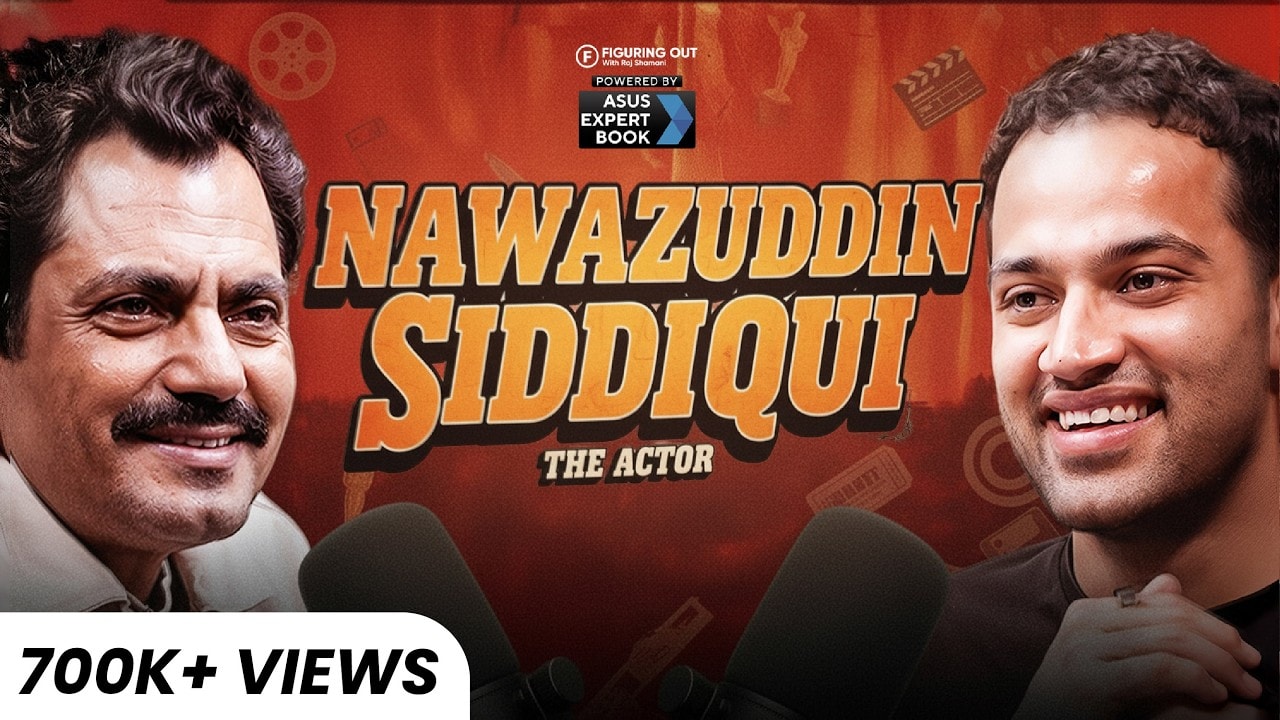
Figuring Out with Raj Shamani
Raj Shamani talks with actor Nawazuddin Siddiqui (Figuring Out, FO429) about rejection, craft and the realities of Bollywood. Nawazuddin describes a village childhood marked by fights and humiliation, a father whose failures left him with deep insecurity, and years of rejection in Mumbai that he says he simply got used to. He argues that lying is routine in the industry - people invent origin stories and, in his view, promotional interviews contain the most lies of all. On craft, he says every new role must be started from zero and that past glory has to be crushed, crediting acting exercises with training him to spot contradiction and dishonesty in performance. He also touches on discrimination over colour and height early in his career, sleeping barely four hours, crying alone at times, and watching only difficult films and great art because, he says, he has no time to waste. All views expressed are the speaker's own recollections and opinions. No sponsor read appears in this episode.

Figuring Out with Raj Shamani
Migration consultant DSquare, founder of DSquare Global, maps the real routes to moving abroad with Raj Shamani: which countries literally sell passports, which make you earn them, and which will never give you one no matter what you pay. He breaks down Caribbean donation programs and why Grenada's E2 treaty with the US makes it the most popular, the true cost of a golden visa, why Singapore has become nearly impossible and the Middle East impossible by design, and how Portugal and Greece residencies give legal access to all of Europe. He also gets practical: how much a waiter in the US actually sends home, why Dubai is one of the safest places on earth, the two only reasons student visas get rejected, and the cheapest legitimate route into the US through an L1 visa. (No sponsor.)
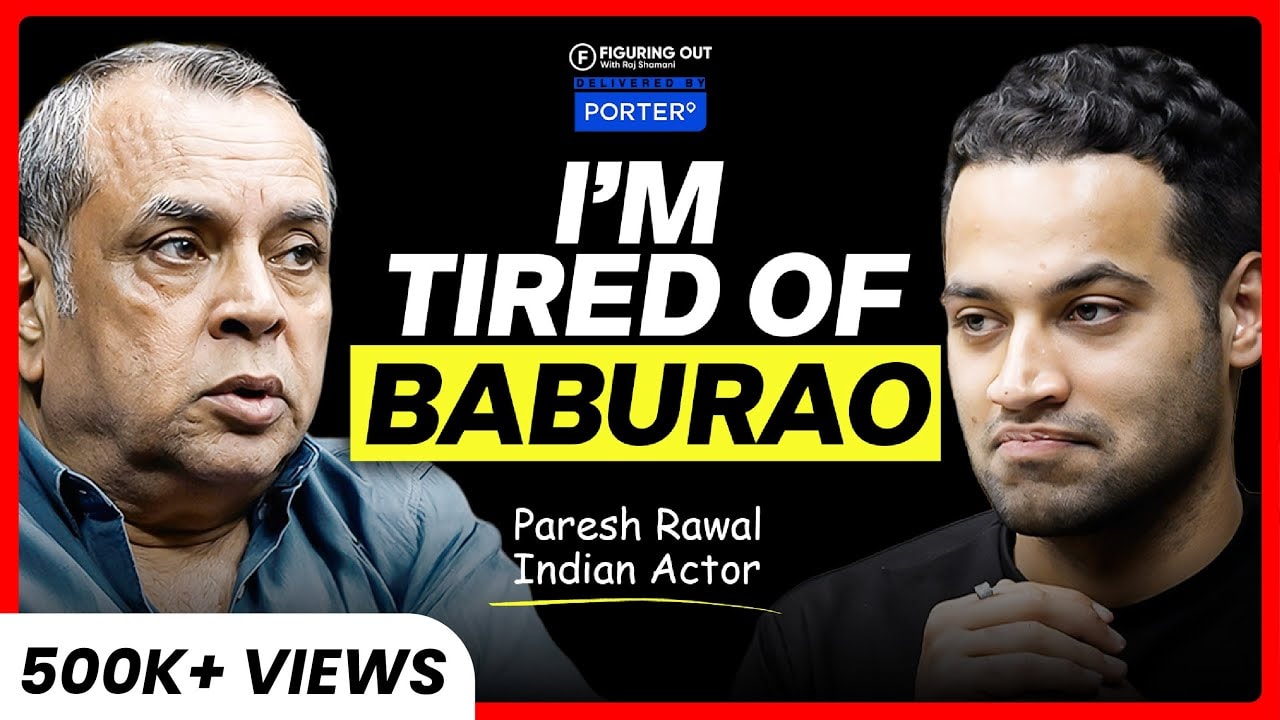
Figuring Out with Raj Shamani
Raj Shamani talks with actor Paresh Rawal (Figuring Out, FO427) about anger, family, marriage and four decades in Bollywood. Rawal admits his anger is violent and recalls breaking a stone over a man's head as a young man. He describes his father as friendly but firm - the kind who never stopped him from risk, only stayed alongside - and says that is the model of fatherhood he believes in. On marriage, he says he decided on the spot that Swaroop would become his wife, yet argues no couple ever fully knows each other: the commitment is to grow together. On the industry, he contends that actors survive while stars come with an expiry date, that several good actors disappeared because they could not network or build multifaceted public personalities, and that social-media armies are no substitute for craft, citing Ranbir Kapoor and Vicky Kaushal as actors who stay relevant on work alone. He also discusses what makes characters like Baburao and Munna Bhai endure. All views expressed are the speaker's own. The episode includes a sponsor read for Porter, the logistics service.
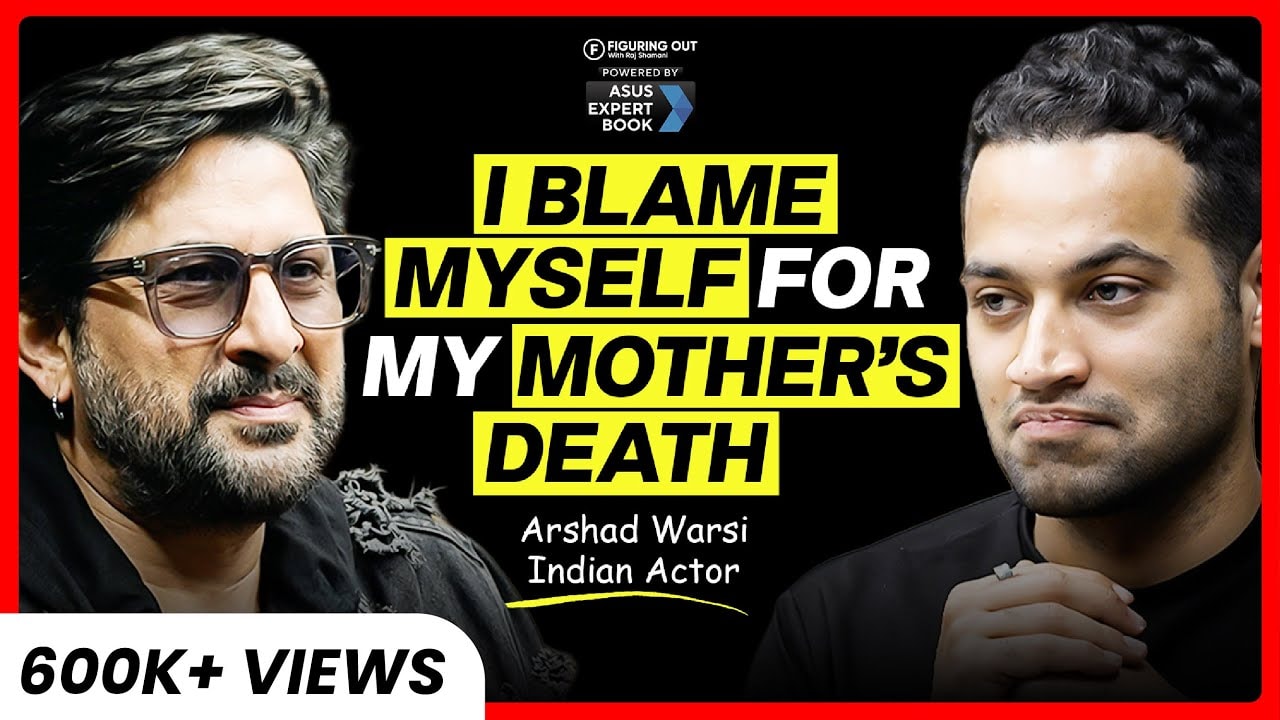
Figuring Out with Raj Shamani
Raj Shamani talks with actor Arshad Warsi (Figuring Out, FO425) about stardom, failure, parents and pain. Warsi says he has never given an audition in his life - and that wherever he did, he was thrown out. He recalls being bullied at school, tells the story of his own son finally hitting back at a bully, and passes on his father's lifelong confidence in him: don't worry about him, he will manage. He describes growing up mature beyond his age after his father lost a lot of money, losing his mother young and crying for everybody only weeks later, and says he would rather die a year early at home with family than live longer in a hospital. On parenting he argues adults overpower children instead of correcting them, because children develop their own brains and opinions. On the industry he praises Shah Rukh Khan's reinvention from lover boy to action hero as requiring real intelligence, and says humility - even if most people have to fake it - is worth faking. All views expressed are the speaker's own. The episode includes a sponsor read for the ASUS ExpertBook laptop line.
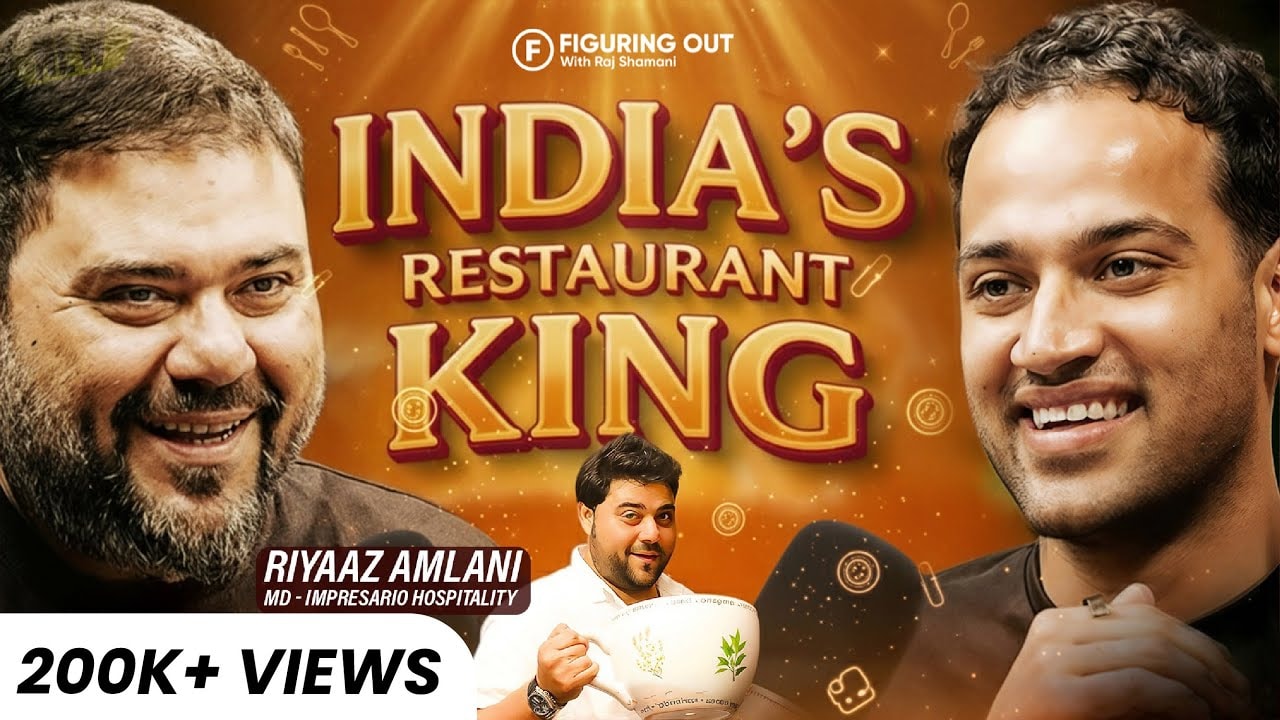
Figuring Out with Raj Shamani
Riyaaz Amlani, described in the episode as the man behind SOCIAL and the owner of more than 80 restaurants in India, joins Raj Shamani to explain how to start and run a food business. He says the episode will cover how to start a restaurant, how much investment it takes and how a long-lasting restaurant brand is built. Amlani shares how the first cafe came from the lack of places to hang out, his rule of thumb that a restaurant should return the invested money within 30 months, the typical cost split of a rupee of sales, why hookah went viral, the three most common mistakes new owners make, and why he expects India's eating-out market to keep growing. He says he runs about an 800 crore rupee restaurant business after 22 years. The episode is mostly in Hindi with English terms. PARTIAL COVERAGE: this summary is built from a sampled reading of the Hindi captions. All figures and views are the guest's own and not independently verified. Sponsor: none stated in the episode description. Nothing here is financial or legal advice, and any mention of alcohol or hookah is reported as discussion only.

Figuring Out with Raj Shamani
Amit Dubey, introduced as a top cyber security expert in India, joins Raj Shamani to explain how everyday digital accounts get compromised. Dubey describes how a simple phone call can lead to an account takeover, how a single OTP can expose a person's whole financial system, what Facebook and Google can track from your phone, how Aadhaar details can be misused, and how SIM and eSIM tricks work in fraud. He shares cases from his own investigations, including how he traced a hack using access logs and device details, why influencer and event invites are used as bait, and how WhatsApp two-step verification protects an account. He also talks about state-level hacking groups and how quantum computing may change future attacks. The episode is mostly in Hindi with English terms. PARTIAL COVERAGE: this summary is built from a sampled reading of the Hindi captions. All claims, figures and cases are the guest's own and not independently verified. Sponsor: ASUS ExpertBook. This is general awareness only, not security, legal or financial advice.
Figuring Out with Raj Shamani
Raj Shamani Figuring Out episode, in Hindi, in which Raj talks with actor Lakshya about the reality of Bollywood, nepotism and what carried him through. Lakshya confirms the politics shown on screen exists off screen too - co-actors have tried to put him down - and credits discipline and hard work as the only things that got him this far. He says he never planned to be an actor and simply became one, speaks warmly about Shah Rukh Khan's family as amazing human beings despite their money and fandom, and calls Aryan Khan a warm young man who could change the world. He opens up about a hard family period that lasted years, how it affected his sister and their relationship, and how suppressed anger eventually finds its way out - while refusing to erase any memory, because without his past he would not be who he is. PARTIAL COVERAGE: this summary highlights the career and character lessons; film anecdotes and rapid-fire segments are not covered. These are Lakshya's own views and experiences, not independently verified. No sponsor read was named in the episode.
Figuring Out with Raj Shamani
Raj Shamani Figuring Out episode, in Hindi, in which Raj talks with Gujarat advocate Utkarsh Dave about how India's criminal justice system actually works from the inside. Dave describes how murder accused with power get their names kept out of FIRs, how witnesses and their families are bought or pressured into compromise, and how an accused who killed 135 people was out on bail in about fourteen months. He walks through the Morbi bridge collapse case he is fighting: the bridge reopened without a proper fitness certificate, a private company ran it on a ticketing model, and his PIL in the Gujarat High Court is pushing for two hundred and fifty crore rupees in compensation for the victims' families, a fight he says will not stop. He explains the delay playbook - a discharge application kept pending for years, then appeals to the High Court and Supreme Court that stall trial for seven to eight years - and argues that money plus political power can bend almost any case, while insisting that India's law itself is not blind. PARTIAL COVERAGE: this summary highlights the justice-system lessons; case anecdotes and personal asides are not covered. These are Dave's own claims and experiences, not independently verified. This is not legal advice. No sponsor read was named in the episode.

Figuring Out with Raj Shamani
Raj Shamani Figuring Out episode, in Hindi, in which Raj talks with the founder of Kimirica about building a luxury hotel toiletries business from India. The insight that started it: hotel toiletries were tiny bottles kept in a bathroom corner, and nobody had thought this could become a real business - yet ninety percent of luxury international and Indian hotel chains were importing them from China. His playbook for winning boardrooms: study the hotel's brand DNA before the meeting and tell them facts about their own property even they do not know. He admits the early credibility problem was so real that he grew his beard partly to be taken seriously, and frames the market as America versus China with India as the alternative supplier. PARTIAL COVERAGE: this summary highlights the business lessons; product and marketing segments are not covered. These are the founder's own figures and views, not independently verified. Sponsor: Outskill World, an AI education platform, named in a mid-roll read about doing a whole team's work solo with AI.
Figuring Out with Raj Shamani
Raj Shamani Figuring Out episode, in Hindi, in which Raj talks with Team India opener Yashasvi Jaiswal about his journey from a tent in Mumbai to opening for India at twenty-three. Jaiswal's family could not give him everything, but his father's love for cricket planted the idea - and the famous stories are true: he lived in a tent and sold pani puri after practice, because no work is too small. He credits childhood visualization techniques with helping him reach Team India, and walks through the dressing-room learning curve - seniors pointing out field placements, the panic of realizing you are about to get out, and reading the ball coming slow. He addresses being misunderstood, saying many people have said many things about him without knowing his story. PARTIAL COVERAGE: this summary highlights the mindset and struggle lessons; match-by-match cricket discussion is not covered. These are Jaiswal's own views and experiences, not independently verified. No sponsor read was named in the episode.

Figuring Out with Raj Shamani
Raj Shamani Figuring Out episode, in Hindi, in which Raj talks with actor Bobby Deol about losing stardom and earning it back. Bobby is blunt about the fall: his films stopped working, work stopped coming, roles meant for him were snatched away by other actors, and alcohol was his only support system at that point. He traces part of it to never having seen hardship early - growing up in a family where every member was already a star - and describes the five or six years when his heart was broken and people made fun of him even at parties. The comeback, back-to-back hits after years of silence and rejection, gets equal time: what self-doubt and embarrassment taught him, and the qualities he says nobody has like his father. PARTIAL COVERAGE: this summary highlights the fall-and-comeback lessons; film anecdotes and family segments are not covered. These are Bobby's own views and experiences, not independently verified. No sponsor read was named in the episode.

Figuring Out with Raj Shamani
Raj Shamani Figuring Out episode, in Hindi, in which Raj talks with Indian fast bowler Ishant Sharma about India-Pakistan cricket, Virat Kohli, Jasprit Bumrah and his own fiery years. On Pakistan, Ishant says the gap is no longer close - with the talent and infrastructure India now has, he actually feels bad for them. He calls Kohli the gangster-vibe player whose attitude never changes no matter how big a problem he carries onto the field, and says Bumrah's action is what makes him special. He laughs through his own history of on-field aggro: the 2015 Test ban after the Dinesh Chandimal elbow incident, the Steve Smith meme faces, and the dressing-room interventions by Ravi Shastri when his shoe-change sprint looked like a fight brewing - insisting most of the time he was the one being provoked. He traces it all back to Delhi tennis-ball and forty-over cricket, where matches ran hot and you answered for your teammates. PARTIAL COVERAGE: this summary highlights the career and mindset lessons; match anecdotes and family segments are not covered. These are Ishant's own views and memories, not independently verified. No sponsor read was named in the episode.

Figuring Out with Raj Shamani
Raj Shamani Figuring Out episode, in Hindi, in which Raj talks with singer Falguni Pathak, the country's Garba Queen, about Navratri, her look, and staying herself. On the festival she is categorical: it feels like she is born for it, and her biggest crowds ran to sixty to sixty-five thousand people every day for ten days in Ankleshwar. Her journey started at twenty-five rupees for one show. On her famous look she is unapologetic: raised with four elder sisters and no brother, she was kept in short hair and shirts and pants from childhood, and when industry people insisted she dress differently she said no - changing clothes does not change who she is, and they still had to take her in the video. She reflects on her late mother, who would have filled a whole cupboard with the success she now has. PARTIAL COVERAGE: this summary highlights the career and identity lessons; song segments and fan moments are not covered. These are Falguni's own views and experiences, not independently verified. No sponsor read was named in the episode.

Figuring Out with Raj Shamani
Raj Shamani Figuring Out episode in which Raj talks with Dr Abdulnasser Alshaali, the UAE's ambassador to India, about how Dubai went from desert to one of the richest, safest and most futuristic countries in about thirty years - and whether the boom is real. Alshaali explains the Emirati social contract: citizens get wedding allowances and land support, rights were given at very low cost early on, and the state keeps reinventing itself through institutions like the Ministry of Possibilities, built to figure out very difficult problems. On culture he is direct: the UAE is a Muslim country, but that does not mean it cannot adopt global ideas, from party culture to, now, a casino. He defends the gifting culture, admits that even in a well-run system there are always individuals who will abuse their power because that is part of human nature, and credits Emirates airline's 1985 vision - bring as many people through Dubai as possible - as a core growth engine. His advice for young wealth-builders: do the best in your field and build that credibility. PARTIAL COVERAGE: this summary highlights the nation-building and career lessons; the real-estate debate and lifestyle segments are not covered. These are Alshaali's own views, not independently verified. This is not financial advice. No sponsor read was named in the episode.

Figuring Out with Raj Shamani
Raj Shamani Figuring Out episode, in Hindi, in which Raj talks with Kolkata Knight Riders batsman Rinku Singh about the five sixes, the struggle years, and staying grounded. Reliving the famous over, Rinku admits the ball was not hitting his bat at all before it happened - he was sure he would get abused that day - until the last one connected and it was all over. He talks about the years when his mother had borrowed money and the family could not see how to repay it, the injuries that battered his hands and legs, and the God's Plan tattoo that monkeys once bit at. Asked what he is most confident about, his answer is instant: his own batting. PARTIAL COVERAGE: this summary highlights the career and mindset lessons; his love story and Asia Cup segments are not covered. These are Rinku's own views and experiences, not independently verified. No sponsor read was named in the episode.
Figuring Out with Raj Shamani
Raj Shamani Figuring Out episode, in Hindi, in which Raj talks with activist Gitanjali about the realities faced by sex workers and trafficking victims in India. She describes a system built on force - girls as young as ten or twelve beaten, drugged and made to attend dozens of clients a day until their bodies give out - and explains why escape is so rare: their minds are traumatized into staying. She shares the argument she hears from workers on GB Road themselves - that their presence protects other women - and her own counter-data: in her telling, countries where prostitution is illegal see eleven percent crime rates against three percent where it is legal, though she frames legalization as a question, not an answer. She describes watching schoolboys arrive in uniform with two hundred rupees, and maps where trafficked girls come from - West Bengal and Andhra Pradesh topping the list, while she says she has never seen a girl from Jammu and Kashmir or Punjab on GB Road. PARTIAL COVERAGE: this summary highlights the systemic lessons; individual case stories are not covered. These are Gitanjali's own accounts and figures, not independently verified. No sponsor read was named in the episode.
Figuring Out with Raj Shamani
Raj Shamani with Protean eGov leadership on digital public infrastructure: India Post and the IPPB one-crore-man-hour training story, the affordability-accessibility-availability tests for DPI, Protean's journey from NSDL's 1996 dematerialization (the share certificate as India's first tokenized asset) through tax modernization and pension record-keeping to the 2021 rebrand, COVID as the stress test digital rails passed, ONDC explained through unbundling (UPI and SMTP analogies, the Kochi open-mobility pilot, the Nilekani-led National Advisory Council, gateway and registry technology), Aadhaar and DigiLocker myths (pointers, not a vault), DigiYatra and verifiable credentials, DPDP Act data control, Jeevan Pramaan for pensioners, security as the top focus, and taking India Stack global with DPI-in-a-box (3-4 month pilots, Ethiopia and beyond). FULL COVERAGE: notes span the entire episode (full ~60:18 audio transcribed; mixed Hindi-English, notes in English). Sponsor: none stated in the episode. All claims about penetration figures, systems and country interest are the guest's account as of August 2025; nothing here is professional advice.

Figuring Out with Raj Shamani
Raj Shamani Figuring Out episode, in Hindi, in which Raj talks with the leadership of Protean eGov Technologies, the company behind core pieces of India's digital public infrastructure, about Aadhaar, DigiLocker and what other countries can learn. He explains Digi Yatra simply: face authentication matches your face to your boarding pass at the airport and you are in without human intervention, and addresses the safety question directly - documents in DigiLocker are secure. On exporting the model he is clear that one shoe does not fit all: Aadhaar today serves one hundred and forty crore people, while Brazil might look at digital commerce and Rwanda at identity - each country has a different problem to solve. PARTIAL COVERAGE: this summary highlights the infrastructure and business lessons; company history and technical detail are not covered. These are the guest's own figures and views, not independently verified. The episode is a partnership with Protean eGov Technologies, named in the show's introduction.
Figuring Out with Raj Shamani
Raj Shamani Figuring Out episode, in Hindi, in which Raj talks with Punjabi singer and lyricist Karan Aujla about safety, loss, and the life behind the music. On Canada he is blunt: he does not feel safe - there have been six firing incidents at him, and after the first shot was fired at his home he had to make hard choices. He keeps twenty to twenty-five guns, legally, while admitting that firing one himself would leave him charged. On industry controversies he shrugs: these things happen between brothers. He admits he is still reckless with spending on clothes, cars and watches, and gets quiet on losing both parents at an early age - asked what he would say if his mother were watching, the money and fame fall away. PARTIAL COVERAGE: this summary highlights the life and career lessons; song stories and fan segments are not covered. These are Aujla's own views and experiences, not independently verified. No sponsor read was named in the episode.

Figuring Out with Raj Shamani
R. Praggnanandhaa discusses chess practice, competition and the family support behind his career. Selected sport and training passages only; political meetings, clinical or mental-health language, rivals' personal assessments and sponsor material omitted. Rough auto-captions lack speaker labels; quotes retain exact caption wording and attribution follows interview context. His name is confirmed in the official description. Personal career accounts are his own, not general prescriptions. Untimed topics are not video chapters. Source: https://www.youtube.com/watch?v=HgMrUVpqQXU
Figuring Out with Raj Shamani
Abhinav Singh, an operations leader at Amazon India, joins Raj Shamani to reveal what happens after you click Buy Now: real-time delivery promises, fulfillment centers and sort centers, the 25-30 touchpoints behind every order, kirana-store pickup networks that India invented for the world, machine-learning fraud detection and chain of custody, two-hour grocery delivery with cold-chain integrity, delivering to every postcode from Havelock Islands to Leh, and the Jeff Bezos lessons - simplification, the vital few levers, regret minimization, sleep and harmony - that shape how he leads. Figures, claims and anecdotes are the guest's own. Sponsor: none stated in the episode. Notes based on the publisher's full audio edition. FULL COVERAGE: these notes cover the complete episode from start to finish.
Figuring Out with Raj Shamani
A Figuring Out with Raj Shamani conversation with Kunal Shah, founder of CRED, about keeping secrets and trust, ambition, why most people stay average, work from home, and why hard work alone does not create wealth. A delivery service sponsor is read at the start (named Porto in the captions). PARTIAL COVERAGE: the episode runs about 3 hours and the available caption text is cut off, so this summary covers roughly the first quarter (including the section on mediocrity and the final captioned answer on wealth and work), and not the rest. These are Shah's opinions and are unverified. This is a summary of his views, not financial advice.

Figuring Out with Raj Shamani
Jackson Wang joins Raj Shamani in Mumbai to talk through the real rules of K-pop trainee life, losing and rebuilding his identity, and how a year of personal diaries became his album Magic Man 2 with its four chapters from manic highs to acceptance. He shares the betrayal that taught him hard lessons about trust, his grade-six heartbreak story, his mother's thirty-year promise of one house, why he remains his own lead strategist, his morning green-juice routine, his answer to China stereotypes, and the Instagram DM that brought Diljit onto 'Buck'. Stories, views and claims are the guest's own. Sponsor: none stated in the episode. Notes based on the publisher's full audio edition. FULL COVERAGE: these notes cover the complete episode from start to finish.

Figuring Out with Raj Shamani
Raj Shamani with the Limelight founder on gold versus diamonds as stores of value, why natural diamond pricing lacked transparency, the De Beers salary-rule narrative and 'diamonds are forever' marketing, the environmental cost of mined diamonds (250 tons of earth per carat), how CVD lab-grown diamonds are molecularly identical and Type 2A pure like the Kohinoor, the price ladder (Rs 5 lakh natural solitaire vs Rs 80,000 lab-grown), the new invest-the-difference-in-gold mindset, the lab-grown price crash and profit rationalization, Limelight's vertical integration with the Emerald Jewel Industry Group, Rs 125 crore top line and 12-24% margins, franchise economics, celebrity and Oscars adoption, royal-family validation of Indian CVD technology, and the everyday-luxury series with buyback and exchange promises. FULL COVERAGE: notes span the entire episode (full ~64:30 audio transcribed, including the mid-episode section recovered in smaller chunks after the transcription service returned 'no speech' on the intact audio; mixed Hindi-English, notes in English). Sponsor: none stated; the guest is the founder of Limelight and speaks about her own company - all figures and claims (turnover, margins, purity categories, environmental stats) are her account as of June 2025. Nothing here is investment or purchase advice.

Figuring Out with Raj Shamani
Ashish Hemrajani discusses BookMyShow's evolution, concert planning and learning through business downturns. Selected operating and founder passages only; political and regulatory remarks, ticketing disputes, health, defense and economic-impact estimates omitted. Rough auto-captions have recognition errors and no speaker labels; quotes retain their exact wording and attribution follows interview context. His name is confirmed in the official video description. Business accounts are his own, not current verified company facts. Untimed topics are not video chapters. Source: https://www.youtube.com/watch?v=8Ssx232ZXa4
Figuring Out with Raj Shamani
Aravind Srinivas joins Raj Shamani for FO349 to discuss Perplexity’s early naming choice, investor memos, customer retention and decision-making frameworks. The summary treats his company and investor stories as May2025 recollections, not independently verified product comparisons or current adoption figures.

Figuring Out with Raj Shamani
Raj Shamani, nervous and openly a fan, sits down with Bill Gates in India. They talk about what has changed in India, why Indian engineers lead global tech firms, Gates’s philanthropy and family wealth philosophy, what he would build if starting today, mistakes, and what he fears.
Figuring Out with Raj Shamani
Raj Shamani with a senior Tata Motors leader on what five-star GNCAP safety actually means (structure and impact absorption, why weight is counterproductive, internal crash tests as the preparatory exam), the Zest-to-Nexon journey to India's first five-star car, 450 daily road deaths and why safety alone doesn't sell in India yet, the three stages of Indian car buying, the EV case (longer life amortization, zero tailpipe, 10x easier driving, software-driven cars), price parity between EV and petrol Nexons, range anxiety versus 400 km real-world capability and 15-minute top-ups, why battery swapping fails the weight test, GST differential versus subsidy, the free car-movement data Tata shares with government and startups, the community-charging opportunity (70% without dedicated parking), in-car app ecosystems, dealership economics, Tata Motors' 2020 turning point, its risk-taking history (Sierra, Indica, Nano), the automatic-transmission miss, and personal Ratan Tata stories including the podcast that never happened. FULL COVERAGE: notes span the entire episode (full ~57:33 audio transcribed). Sponsor: none stated in the episode. All figures (road deaths, market data, price points, sales rankings) and company anecdotes are the guest's account as of March 2025; nothing here is purchase or investment advice.

Figuring Out with Raj Shamani
Martin Garrix talks with Raj Shamani about learning music, mentorship, finding his sound and making songs that work beyond their production. Selected creative and career passages only; health, loneliness, manifestation claims, personal tragedy and sponsor material omitted. Auto-captions have recognition errors and no speaker labels; quotes are exact caption text, attributed from interview context. Career accounts are his own. Untimed topics are editorial sections, not video chapters. Source: https://www.youtube.com/watch?v=wvSk_D6IGj8
Figuring Out with Raj Shamani
Shahid Kapoor joins Raj Shamani for an unfiltered conversation on the forces that shaped him: why he believes 90% of personality is formed by age seven, his long phase of feeling victimized before finding his footing, entering the film industry without a film-family parent, fighting his comfort zone, what heartbreak taught him about dignity and self-definition, and why he trusted directors like Imtiaz Ali and Sandeep Reddy Vanga for their craft rather than their size. He also talks candidly about marriage with Mira, parenting, needing small windows of solitude, and the joke-with-a-point that men emotionally mature at 43. Views, stories and claims are the guest's own. Sponsor: none stated in the episode. Notes based on the publisher's full audio edition. FULL COVERAGE: these notes cover the complete episode from start to finish.
Figuring Out with Raj Shamani
Raj Shamani with Riyasat Infra founder Sumer Saini (Hindi) on his journey from selling vegetables in Jhunjhunu to plotted real estate, the sabzi-mandi rules of buying cheap and never cheating the scale, refusing a commissioner's 12.5% JDA cut and winning, pooling 35 people's money for a land deal, the 45-minute four-partner split, his first Jaipur plot at Rs 350 per gaj with leverage math, plots versus flats and why land beats stocks, business cycles, the Mumbai 3.0 investment thesis (Navi Mumbai airport, Atal Setu, townships, big developers entering plotting), his anti-fraud checklist (clean title, big developers, Google research), why he doubts Dubai's 10% rental yields, villa build-and-sell economics, and his three sales tips. FULL COVERAGE: notes span the entire episode (full ~54:37 audio transcribed; Hindi, notes in English, quotes translated and marked). Sponsor: none stated in the episode. All figures, project claims, market views and developer references are the guest's account as of January 2025; nothing here is investment or legal advice.

Figuring Out with Raj Shamani
Raj Shamani shares his own rules for work, learning and feedback in a solo episode recorded for the start of 2025. Selected career and practice passages only; family-death framing, emotional suppression, relationship prescriptions and no-plan-B advice omitted. Auto-captions have recognition errors; quotes retain their exact wording. Motivational opinions are not guarantees or professional advice, and this is not a summary of all ten rules. Untimed topics are editorial sections, not video chapters. Source: https://www.youtube.com/watch?v=hcvmq-hcDIE

Figuring Out with Raj Shamani
MrBeast talks with Raj Shamani about video ideas, repeated improvement, podcast craft and reaching an audience. Selected creator passages only; political examples, AI tooling, medical material, extreme-work schedules, prize and spending claims, sponsor reads and product challenges omitted. Rough auto-captions lack speaker labels; quotes retain exact caption wording and attribution follows interview context. His name is confirmed in the official description. Growth claims are his opinions, not guaranteed outcomes. Untimed topics are not video chapters. Source: https://www.youtube.com/watch?v=sHaJFMbgxu4
Figuring Out with Raj Shamani
Supreme Court on-record advocate Amish Aggarwala joins Raj Shamani to lay bare the reality of India's justice system: how easily fake cases can be filed, how to choose a lawyer, why many complaints are about power rather than justice, the morality dilemmas of criminal defense, and the practical stance ordinary people should take with police. Views expressed are the guest's own; this podcast is for informational purposes only and not legal advice. Sponsor read in the publisher audio: Odoo (invoicing app). Notes based on the publisher's full audio edition. FULL COVERAGE: these notes cover the complete episode from start to finish.

Figuring Out with Raj Shamani
Parenting coach Schweta Gandhi joins Raj Shamani with a science-first manual for the early years: why a toddler's logic brain cannot process scolding before age three, the four parenting styles, her gentle-parenting script for tantrums, the subconscious damage of labels like 'shy', military-consistent routines, the real screen-time numbers for 7-14 year olds, sugar and junk-food rules, video games in moderation, her hour-by-hour ideal evening routine, and her case for nannies, working mothers and a new era of goal-setting dads. Advice and claims are the guest's own, shared as her professional perspective. Sponsor: none stated in the episode. Notes based on the publisher's full audio edition. FULL COVERAGE: these notes cover the complete episode from start to finish.
Figuring Out with Raj Shamani
Jatin Ahuja, founder of Big Boy Toyz, joins Raj Shamani to break down two decades in used luxury cars: starting at 17, buying flood-damaged cars after the 2005 Bombay floods, the VIP mobile-number trade that recovered 1.71 crore in two months, why he calls this a buying business and not a sales business, the 2011 DRI action that reset the company to fully duty-paid stock, running 60-70 crore of inventory on reinvested profits, the scams and shortcuts to avoid in used cars, his characteristic-first method for choosing the right car, and what he is building next - from detailing studios to an automobile university. Figures, stories and views are the guest's own. Sponsor: none stated in the episode. Notes based on the publisher's full audio edition. FULL COVERAGE: these notes cover the complete episode from start to finish.
Figuring Out with Raj Shamani
Alex Pall and Drew Taggart of The Chainsmokers join Raj Shamani on Figuring Out for a candid conversation about music, love, money and India. They explain why Drew is not the original Chainsmoker, why the band name needed no deliberation, and how stage names work as protective characters. They recount playing the Ambani pre-wedding, the viral joke track Selfie that let Drew stop worrying about rent, the three-day-notice Malibu session with Chris Martin that produced Something Just Like This, and why their first-ever song was with Priyanka Chopra. They praise Indian festival crowds, want to collaborate with Ram Charan, and share their India market thesis: only economies-of-scale or premium-luxury startups win in an aspirational, trust-deficient market, and trust compounds across categories. Also covered: their venture fund Mantis (the guests' own fund, discussed in the episode), the wellness industry selling the dream of health, art collecting as the last level of wealth, and their first gig - 15 minutes in front of about 16 people. Sponsor: none stated in this episode. Relationship and health points are the guests' personal opinions, not professional advice. Notes based on the publisher's full audio edition. FULL COVERAGE: these notes cover the complete episode from start to finish.
Figuring Out with Raj Shamani
Host Raj Shamani talks with actor Rajpal Yadav (Chup Chup Ke, Dhol, Bhool Bhulaiyaa) about comedy, pressure, loneliness and regrets. Yadav traces his path from a serious debut and a negative role in Jungle to comic stardom, explaining that theatre trained him to treat every scene as a lead. He discusses the pressure of relevance after success, why comic actors and directors like David Dhawan and Priyadarshan rarely win top awards, and why he believes every role should first be watched from the audience's seat. He shares how he converted his height complex into strength, why fame leaves people alone in a crowd, his three-way filter for hurtful words, and the family teaching that repentance burns away mistakes. He also speaks about his ZEE5 film Kaam Chalu Hai, a father-daughter story built around deaths caused by unrepaired potholes. Quotes are translated from Hindi, verified against the publisher's audio, and marked as translations. All views and claims are the speakers' own; nothing here is advice. Sponsor: none stated (the guest's own film is promoted in the episode). Notes are based on the publisher's audio edition (Figuring Out feed, published May 16, 2024) and cover that audio edition in full - FULL COVERAGE. The YouTube cut of this episode may differ slightly in packaging or ad load.

Figuring Out with Raj Shamani
Host Raj Shamani talks with actor Parineeti Chopra about Bollywood, nepotism, her husband Raghav Chadha and working with Imtiaz Ali, AR Rahman and Diljit Dosanjh on Amar Singh Chamkila. She describes Rahman's humility and Imtiaz Ali's emotional depth, then unpacks her central argument: the industry runs less on nepotism than on favoritism - roles are born in social circles she is bad at working, so she is speaking up for talented actors sitting at home. She recounts her recession-era return from London, her YRF marketing internship, and the accidental audition that made her an actor. She reflects on losing her way to 'become glamorous' advice, the class disconnect faced by outsiders (a co-actor told her that if she could not afford a trainer she did not belong), gaining 16 kg for Amarjot despite warnings it would end her career, and meeting Raghav Chadha at a UK awards breakfast - knowing within minutes she would marry him. All views and claims are the speakers' own; nothing here is advice. Sponsor: none stated (the guest's own film is discussed). Notes are based on the publisher's audio edition (Figuring Out feed, published April 26, 2024) and cover that audio edition in full - FULL COVERAGE. The YouTube cut of this episode may differ slightly in packaging or ad load.

Figuring Out with Raj Shamani
Host Raj Shamani talks with actor and entrepreneur Kriti Sanon about her unconventional path into films, her views on relationships and feminism, and the two brands she has built. She recounts losing a film that fell through, then landing a Telugu debut opposite Mahesh Babu after a last-minute recast, and signing Heropanti opposite Tiger Shroff on the day of an elaborate on-location audition. She describes a 15-month stretch without shooting, the frustration of watching industry insiders get opportunities faster, and why she believes talent beats marketing over a long career. On relationships, she lists her red flags - disloyalty, disrespect toward family or strangers, and people who change completely in public - and rates what matters in a partner, putting value system at a ten. She also explains the origins of her fitness studio The Tribe, started after she gained 15 kilos for Mimi and lost it training virtually in lockdown, and of Hyphen, the skincare brand she built after an engineer-style deep dive into ingredients revealed a gap for simple, multi-benefit products. Claims and opinions in these notes are attributed to the speakers and reflect their views, not advice. No sponsor was stated in this episode; the guest promotes her own brands, Hyphen and The Tribe, which is disclosed here. FULL COVERAGE: these notes are based on the complete publisher audio edition of this episode (about 43 minutes), transcribed and reviewed end to end; no segment was skipped.
Figuring Out with Raj Shamani
Fabien Pinckaers discusses Odoo's product focus, leadership, hiring, efficiency and explaining culture as a company grows. Selected organization and product passages only; tax, political, national stereotypes, competitor and valuation claims omitted. Auto-captions have recognition errors and no speaker labels; attribution follows interview context, and the guest's name is confirmed in the official video description. Company claims are his account, not current verified policy. Untimed topics are not video chapters. Source: https://www.youtube.com/watch?v=ulvGQLgDC50

Figuring Out with Raj Shamani
Host Raj Shamani talks with motorcycle racers Lucio Cecchinello (LCR Honda MotoGP team principal) and Rajini Krishnan (Indian national racing champion) about what it takes to become a professional bike racer in India. They trace both origin stories - Rajini riding his brother's scooter in Chennai at 16, losing his father at 14, buying an RX100 at 20 and funding his own racing for nearly a decade; Lucio growing up near Bologna in Ferrari-Ducati country, working as a mechanic, and selling his motorcycle to his girlfriend to fund his first race. The economics are laid out step by step: roughly 5 lakh rupees a year to start in India, 30,000 euro in Europe, rider salaries from 300,000 euro to 20 million, and a 50-million-euro MotoGP team budget with 52 people behind two riders. They discuss the danger - 300 km/h crashes and Rajini's 23 fractures - why the sport lacks Indian media coverage, Lucio's 2003 retirement after 'signals' while leading the world championship, his heroes Valentino Rossi (whom he once beat) and Marc Marquez, and the Castrol Power1 India's Ultimate Moto Star talent program in which both guests hold roles. All views and claims are the speakers' own; nothing here is advice. Sponsor: none stated; the episode features an extended discussion of the Castrol Power1 program in which both guests participate. Notes are based on the publisher's audio edition (Figuring Out feed, published February 14, 2024) and cover that audio edition in full - FULL COVERAGE. The audio edition runs about 52 seconds longer than the YouTube cut; packaging may differ slightly.

Figuring Out with Raj Shamani
Host Raj Shamani talks with Nitish Mittersain, founder and CEO of Nazara Technologies, about the future of gaming in India. Mittersain covers whether gaming is a sustainable career - esports at the Asian Games, possible Olympic inclusion, growing Indian prize pools, and the 30% tax on winnings - and explains Nazara's portfolio: Kiddopia, World Cricket Championship, and Sportskeeda. He recounts his origin story: coding games at seven, the Shammi Kapoor friendship, the dot-com crash and 3 crore debt, the 2004 mobile reboot, pitching Sachin Tendulkar into a record endorsement to win Airtel, and the lean years that produced 200-250 crore of profit on 12 crore raised. He describes Rakesh Jhunjhunwala's 45-minute commitment and the Kamath brothers' investment, then ranges across violent games and age-gating, influencer sustainability after game bans, the media-rights gap in esports, why India has no AAA title yet, Nvidia and tech monopolies, and Nazara's biggest opportunity and threat. All views and claims are the speakers' own; nothing here is advice. Sponsor: none stated. The conversation is largely in Hindi; some quotes are faithful translations, individually marked. Notes are based on the publisher's audio edition (Figuring Out feed, published January 7, 2024) and cover that audio edition in full - FULL COVERAGE. The YouTube cut of this episode may differ slightly in packaging or ad load.

Figuring Out with Raj Shamani
Raj Shamani closes the year with a solo Figuring Out episode: his top 24 hacks for influence, relationships, mental fitness, health and money, drawn from what he has learned and observed from people with more wisdom around him. He explains why being interesting and being a listener matter (crediting listening as the skill his whole career is built on), how complimenting someone's thought process and asking small favors (the Ben Franklin effect) build closeness, and how 'tell me more' defuses hyper-emotional arguments. On relationships he covers the priority-complaint trap, making your partner feel important, the never-cry-alone rule, and sitting with people in their lowest moments. Health and productivity hacks include a 1-minute morning plank, eating fiber before junk food to blunt blood-sugar spikes, a 1-minute rule that kills procrastination on tiny tasks, and his annual habit of listing his own red flags instead of everyone else's. He closes by urging listeners to ask themselves where they need to reach and what it will take. Sponsor: none stated in this episode. Health points are shared as the host's personal practices and opinions, not medical advice. Notes based on the publisher's full audio edition. FULL COVERAGE: these notes cover the complete episode from start to finish.

Figuring Out with Raj Shamani
Gaurav Khatri discusses Noise's early cash flow, operating basics, product quality and business milestones. Selected business passages only; wearables' health predictions, medical claims, political context, celebrity assessments and sponsor reads omitted. Rough auto-captions lack speaker labels; quotes retain exact caption wording and attribution follows interview context. His name is confirmed in the official description. Revenue and market claims are his retrospective account, not current verified company facts. Untimed topics are not video chapters. Source: https://www.youtube.com/watch?v=IcVYyF3EEbk

Figuring Out with Raj Shamani
Sanjana Sanghi discusses an unexpected start in acting, the emotional core of a story and what she wants to be recognized for. Selected craft and career passages only; dating and relationship advice, clinical language, medical incidents, personal claims about co-stars and sponsor reads omitted. Captions lack speaker labels; quotes retain exact caption wording and attribution follows interview context. Her name is confirmed in the official title and description. Career recollections and views on fame are her own, not guarantees. Untimed topics are not video chapters. Source: https://www.youtube.com/watch?v=rhrnuT6WWAc

Figuring Out with Raj Shamani
Vedang Patel, co-founder of The Souled Store, joins Raj Shamani to break down how a 5-lakh pop-culture t-shirt experiment became one of India's most durable fashion brands: quitting finance on promotion day, surviving the slogan-tee wars, why product beats service, branding as consistency, the Linking Road store that recovered capex in three months, the reality of India's 40-50 crore paying customers, lessons from Nike's journey, and why advice only works with context. Figures, stories and views are the guest's own. Sponsor: none stated in the episode. Notes based on the publisher's full audio edition. FULL COVERAGE: these notes cover the complete episode from start to finish.

Figuring Out with Raj Shamani
A Figuring Out with Raj Shamani conversation with Venky, founder of Plivo, a phone masking and communications company, about small opportunities in India, how venture capital and corporate money change competition, and examples such as Zudio and diapers. The caption has no speaker labels or punctuation, so claims are attributed to the host or the guest as best the text allows. PARTIAL COVERAGE: the episode runs about 56 minutes and the available caption text is cut off near the end, so the final minutes are not covered. Economic figures, including remarks about China's GDP and India's growth, are the speakers' opinions and are unverified. This is a summary, not financial advice.

Figuring Out with Raj Shamani
Host Raj Shamani talks with actor Abhishek Bachchan about family, relationships, and his approach to work and business. Abhishek describes the values he watched his parents live - honor and loyalty from his mother, discipline and a deep sense of duty from his father - and why he believes parents are better examples than teachers. He explains why he cannot imagine not living with his parents at their age, how his wife's calm perspective reorders his priorities (including a COVID period when his father, wife, daughter and he were all hospitalized), and why he thinks men are wired to be goal-driven. On his father's legacy, he says the gold standard for any son is his father, and that his own role is to further the family name rather than compete with it. He recounts buying a Pro Kabaddi franchise on gut feeling when friends joked he would buy a gilli danda team next, the live match that served as his due diligence, and the stake's growth to over 100x in ten years - while insisting he does not count multiples until he sells. He also discusses playing coach Padam Singh Sodhi in his then-upcoming film, why he watches his own films almost every week with improvement notes, and his view of acting as a commercial art that owes every ticket buyer value. Claims and opinions in these notes are attributed to the speakers and reflect their views, not advice. No sponsor was stated in this episode; the guest discusses his own film and sports team, which is disclosed here. FULL COVERAGE: these notes are based on the complete publisher audio edition of this episode (about 36 minutes), transcribed and reviewed end to end; no segment was skipped.
Figuring Out with Raj Shamani
Host Raj Shamani talks with rapper and producer Yo Yo Honey Singh about manifestation, the Delhi beatmaking years, Mafia Mundeer, his bipolar disorder and long recovery, and the craft behind his global Punjabi sound. Honey Singh claims he has manifested his biggest milestones since childhood, credits Shah Rukh Khan's advice from their 2013-14 world tour, and says seven doctors from around the world treated him during his illness - these are his accounts, presented as he stated them. He describes Mafia Mundeer as a platform he built, not a band, and says he has never performed intoxicated, with one incident he explains in his documentary. Sponsor: none stated in this episode. The conversation is largely in Hindi; some quotes are faithful translations, individually marked. Notes are based on the publisher's audio edition (Figuring Out feed, published April 14, 2023) and cover that audio edition in full - FULL COVERAGE. The YouTube cut of this episode may differ slightly in packaging or ad load.

Figuring Out with Raj Shamani
Host Raj Shamani interviews Namita Thapar, Executive Director of Emcure Pharmaceuticals and a Shark Tank India judge, on leadership, brand building and family business. Thapar explains her lifelong-learner mindset with a 'less is more' discipline, the four brand-building fundamentals she used at Emcure (portfolio focus, MNC collaboration, attacking where competition is weak, and customer-insight-led market shifts), and the four departments she says even a sub-20-crore business needs from day one: finance, technology, HR and governance. She shares her one monthly question per department, her formula for retention (a happy environment plus growth clarity), why she believes drive needs no toxicity, what she learns from Sanjeev Bikhchandani, Harsh Mariwala, Rajiv Bajaj and Kiran Mazumdar-Shaw, and the two big family-business mistakes - unclear job definitions and founders who cannot let go. She also names Rare Planet as her standout Shark Tank investment and healthcare technology as the next big industry. All views and claims are the speakers' own; nothing here is advice. Sponsor: none stated. Notes are based on the publisher's audio edition (Figuring Out feed, published December 28, 2022) and cover that audio edition in full - FULL COVERAGE. The YouTube cut of this episode may differ slightly in packaging or ad load.
Figuring Out with Raj Shamani
Priyanka Khimani discusses professional relationships, introductions, service quality and learning to say no. Selected career and service-business passages only; legal instructions, copyright rules, political and personal controversies, clinical language and sponsor reads omitted. This is not legal advice. Rough auto-captions lack speaker labels; quotes retain exact caption wording and attribution follows interview context. Her name is confirmed in the official description. Personal career accounts are her own. Untimed topics are not video chapters. Source: https://www.youtube.com/watch?v=aDWl70uWCsk

Figuring Out with Raj Shamani
Asish Mohapatra, co-founder of OfBusiness, joins Raj Shamani to break down building a profitable-from-day-one B2B company: India's credit gap, cash cows funding new ventures, why he says to build your brand before your product, the no-cabin culture that runs on appreciation instead of celebration, hiring for competency and commitment, shutting down mistakes faster, and why obsession and irrational optimism are the real alpha. Figures, stories and views are the guest's own. Sponsor: none stated in the episode. Notes based on the publisher's full audio edition. FULL COVERAGE: these notes cover the complete episode from start to finish.

Figuring Out with Raj Shamani
Raj Shamani and Sharan Hegde discuss earning skills, spending priorities, financial goals and the role of ownership. Selected educational themes only; retirement sums, asset-allocation percentages, age cutoffs and guaranteed-income claims omitted. This is not investment or personal financial advice. Auto-captions lack speaker labels, so quotes are attributed to the conversation rather than one person. Quotes are exact short caption extracts. The official description confirms Sharan's name. Untimed topics are editorial sections, not video chapters. Source: https://www.youtube.com/watch?v=wMT07u0lW5k

Figuring Out with Raj Shamani
Host Raj Shamani and Sandeep Jethwani, co-founder of Dezerv, trade ten ideas on wealth creation built around Jethwani's CREATE framework: Compounding (the biggest investment secret hiding in plain sight), Rational investing (caging the instant-gratification monkey), Excitement is your enemy (entertainment versus returns), Act only when necessary, Tolerance to downside, and Expertise - why high-stakes money needs an expert or an index, citing US data that over 90% of active traders underperformed the index from the 1970s to 2008 and Zerodha's finding that only 1% of traders beat fixed deposits. Raj adds his own points: understand yourself before the market, plan investing before spending, track where your money goes, work to learn rather than earn, and a three-bucket allocation that Jethwani sharpens into protection, markets and aspiration. All views, frameworks and data points are the speakers' own; nothing here is financial advice. Sponsor: none stated. Notes are based on the publisher's audio edition (Figuring Out feed, published September 30, 2022) and cover that audio edition in full - FULL COVERAGE. The YouTube cut of this episode may differ slightly in packaging or ad load.

Figuring Out with Raj Shamani
Peyush Bansal joins Raj Shamani to discuss customer value, brand promises, culture, John Jacobs and learning through fast experiments. Original English notes based on available captions: https://www.youtube.com/watch?v=xxtmt62-Pq0 . Quotes are short caption excerpts and captions may be imperfect. Company examples and figures are Bansal's August 2022 account. The incidental eye-health and blue-light product discussion is not medical advice; product claims are not independently assessed here.

Figuring Out with Raj Shamani
Host Raj Shamani interviews Amit Agarwal and Saurabh Garg, co-founders of NoBroker, India's first real estate unicorn, on the Indian real estate market and building a brokerage-free platform. The founders recount how 50-60 traditional brokers mobbed and attacked their office, forcing a police call and an overnight office move, and explain their thesis: real estate was an offline, broken experience built on information asymmetry that technology could remove by connecting owners and seekers directly. They defend their one-stop model for the entire housing journey, explain unicorn economics (valuations, dilution, where investor money actually goes, and how founders really make money), and share their investing views - including leverage in home buying, the case they make for small commercial properties with 8-12% rental yields, and the markets they like (Hyderabad, Pune, Bangalore). They close with first-principles problem solving, why not coming from the industry was an advantage, and the need for basic financial planning before starting up. All views and claims are the speakers' own; nothing here is advice. Sponsor: none stated. The conversation is largely in Hindi; quotes are faithful translations, individually marked. Notes are based on the publisher's audio edition (Figuring Out feed, published July 1, 2022) and cover that audio edition in full - FULL COVERAGE. The YouTube cut of this episode may differ slightly in packaging or ad load.

Figuring Out with Raj Shamani
Host Raj Shamani with Rishabh Jain (Labour Law Advisor) and Anant Ladha (Invest Aaj For Kal) share ten rules for success drawn from their own business and creator journeys. They cover money rules first: why a car is a liability that should never be your goal, the 10x affordability test, and buying assets that fund your liabilities; then career rules: why investing as a full-time student is 'stupid' in their telling, investing for experience instead of wealth, and being clear rather than clever. Business rules follow: not avoiding a space because someone else is in it, hiring people better than you and giving them freedom and challenges, focusing on service over product, and the 3A model - access, awareness, availability - for making a product viral. They close on people rules: relationships as personal growth (including a candid 12th-grade love story), starting to trust strangers despite childhood conditioning, and helping people without expecting returns - give so much that people want to give back. All views and claims are the speakers' own; nothing here is advice. Sponsor: none stated. The conversation is largely in Hindi; some quotes are faithful translations, individually marked. Notes are based on the publisher's audio edition (Figuring Out feed, published June 24, 2022) and cover that audio edition in full - FULL COVERAGE. The YouTube cut of this episode may differ slightly in packaging or ad load.
Figuring Out with Raj Shamani
Host Raj Shamani interviews Raj Das, co-founder and CEO of Hirect, a chat-based hiring app for startups, on building and scaling a hiring platform. Das explains how Hirect matches recruiters and job seekers - starting from profile metadata, then shifting to behavioral data like clicks and recruiter responses - and why he deliberately made registration longer so casual job seekers drop out. He compares work attitudes in India, China and the US from his own career, recounts how his own hiring struggles led to Hirect, and shares first-round fundraising lessons, including why he says investors invest in teams rather than ideas. He also discusses building culture without written rules, why he fired IIT graduates who did not justify their ROI, the four daily jobs of a CEO, his recommendation of Think and Grow Rich, and why he expects the hiring and in-house training industries to boom. All views and claims are the speakers' own; nothing here is advice. Sponsor: none stated. Notes are based on the publisher's audio edition (Figuring Out feed, published June 3, 2022) and cover that audio edition in full - FULL COVERAGE. The YouTube cut of this episode may differ slightly in packaging or ad load.
Figuring Out with Raj Shamani
Host Raj Shamani talks with Meesho co-founder and CTO Sanjeev Barnwal about the company's path from a hyperlocal fashion app to a social-commerce unicorn. Sanjeev says the first two years deliberately ignored scale, that founders should not wait for the perfect problem before starting, and that Tier 2+ India is the opportunity he is most biased toward - his views, presented as he stated them. He recounts Facebook's investment thesis in social commerce and claims Meesho grew roughly 100x over three years, as he recalls internal numbers. Sponsor: none stated in this episode. Notes are based on the publisher's audio edition (Figuring Out feed, published May 27, 2022) and cover that audio edition in full - FULL COVERAGE. The YouTube cut of this episode may differ slightly in packaging or ad load.
Figuring Out with Raj Shamani
Host Raj Shamani interviews Kaivalya Vohra, co-founder of Zepto, on building a 10-minute grocery delivery company at 19. Vohra traces the origin to two bachelors in lockdown Mumbai frustrated by five-to-six-day grocery delivery, the pivot from 45-minute local-store delivery to a 10-minute model after segmenting retention data by delivery time, and why he calls the then-$600M valuation conservative: a business doubling every month with mature micro-markets already profitable. He compares marketplace models that scale light but stay tight on unit economics with Zepto's capital-intensive but clearer model, explains his 'unsexy business' filter with cattle-trading and construction examples, and lays out a two-layer objective: maximize shareholder value professionally while building a generational organization personally. He also says he would pick EdTech over crypto if starting fresh. All claims and views are the speakers' own; nothing here is advice. Sponsor: none stated. Notes are based on the publisher's audio edition (Figuring Out feed, published April 21, 2022) and cover that audio edition in full - FULL COVERAGE. The YouTube cut of this episode may differ slightly in packaging or ad load.
Figuring Out with Raj Shamani
OYO founder Ritesh Agarwal talks with Raj Shamani about learning from small hotel owners, direct feedback, recruiting and scaling through playbook, people, cadence and cost. Original English notes based on the full available caption page: https://youtubetotranscript.com/transcript?v=B9jZABnvq9A. Quotes are brief caption excerpts; captions may differ from audio. Company practices, figures and market views are Agarwal's April 2022 account, not current verified OYO policy or financial advice.
Figuring Out with Raj Shamani
Host Raj Shamani talks with the three co-founders of Grip - Nikhil, Ashish and Vivek - an alternative investment platform. (The episode title's figures of 215+ crores raised, 75+ companies and 100% success are the publisher's title claims.) The founders met at mobility startup Chalo and bonded over a shared problem: beyond FDs, RDs, equity and mutual funds, most Indians have no real investment options, so their money never works as hard as they do. They describe writing Grip's culture note before hiring or building - vision, mission, five values, working styles and answers to hard questions - and explain their ownership value as taking responsibility for end outcomes, plus a working style of always giving context. They diagnose why alternative investing lags crypto in India: people run after returns, not wealth creation, and liquidity and lack of visible champions hold the category back. They share their trust-building playbook: a 10,000-rupee minimum ticket, delivering exactly what is committed, 30-35% of users arriving by referral, and a 200-user WhatsApp group that gives unfiltered product feedback. Each founder also shares his goal for the decade, from building Grip into an institution to making himself irrelevant. Claims and opinions in these notes are attributed to the speakers and reflect their views, not advice. No sponsor was stated in this episode; the guests discuss their own company, which is disclosed here. FULL COVERAGE: these notes are based on the complete publisher audio edition of this episode (about 36 minutes), transcribed and reviewed end to end; no segment was skipped.
Figuring Out with Raj Shamani
Host Raj Shamani talks with Ayush Jaiswal, co-founder of Pesto, which trains Indian software developers for global remote jobs. Ayush describes learning to code in school competitions, building an ERP to mark his own attendance and selling it to Miranda House at 18, and the San Francisco trip that showed him developers like him earning $100,000 or more - the arbitrage that built India's tech consulting industry and became Pesto's opportunity. He explains why investors first thought remote-job training sounded like a scam, how the company bootstrapped by training already-decent developers in the professional skills (time management, email, project management) nobody teaches, and why he believes hustle becomes a founder's enemy once the team grows: delegation and direction-setting beat doing. He offers his 20-year-old self's playbook - treat money as a resource, work in tech because every undisrupted industry will be disrupted, use no-code tools if you cannot code, and apply Kunal Shah's delta-4 theory to spot behavior-changing problems. He also discusses his three most-recommended books, his case for Bitcoin and DAOs as redistributions of power, and why the virtual-native habits of the gaming generation signal where consumer behavior is heading. Claims and opinions in these notes are attributed to the speakers and reflect their views, not advice. No sponsor was stated in this episode; the guest discusses his own company, which is disclosed here. FULL COVERAGE: these notes are based on the complete publisher audio edition of this episode (about 44 minutes), transcribed and reviewed end to end; no segment was skipped.

Figuring Out with Raj Shamani
Host Raj Shamani talks with writer and content strategist Manish Pandey about building a career in India's creator economy. Manish argues early success is a 'slow poison' unless matched with grounding, claims India repels the talent it produces because the ecosystem does not retain it, and says the next big industry is skill education - these are his views, presented as he stated them. He recounts investing in Paytm's IPO to support first-time founders, and shares his own poverty story as the reason he puts 'food with dignity' before big ambitions. Sponsor: none stated in this episode. The conversation mixes Hindi and English; some quotes are faithful translations, individually marked. Notes are based on the publisher's audio edition (Figuring Out feed, published March 17, 2022) and cover that audio edition in full - FULL COVERAGE. The YouTube cut of this episode may differ slightly in packaging or ad load.
Figuring Out with Raj Shamani
Raj Shamani sits down with Daksh Tyagi, author of A Nation of Idiots, whom he discovered through a random Amazon search and tracked down for this conversation. They unpack how Indians choose political leaders: campaign makers trained to portray everything in extremes, voters sorting candidates into comedian versus serious guy, and party loyalty replacing the voter's job of being their own side's biggest critic. They discuss how news channels sell trust in anchors rather than organizations, how the 2008 Australia racism coverage looked from someone actually living there, and why manufactured offense and whataboutery kill accountability. They also get personal about how daughters are told they belong to another house, why questioning culture is treated as dumb, and why Daksh calls himself a recovering idiot. Promotion note: the episode features and closes with a pitch for the guest's own book, A Nation of Idiots. Sponsor: none stated. Political and social commentary is the speakers' personal opinion, not advice. Notes based on the publisher's full audio edition. FULL COVERAGE: these notes cover the complete episode from start to finish.

Figuring Out with Raj Shamani
Host Raj Shamani talks with Harsh Mariwala, founder of Marico, about understanding Indian consumers and building enduring brands. Mariwala walks through his process: identify strengths before industries, find a broad opportunity, craft a unique offering through close consumer iteration, and establish a right to win before scaling. He explains why India must be read as 30 different consumer markets, how regional variants work inside one national brand, and why 'my consumer is everyone' kills focus. He covers the D2C disruption of old entry barriers, his shift from oils toward wellness and beauty, the blue-ocean logic behind pre- and post-wash hair care and the Beardo acquisition, and how to identify the true value creators in any business. He also discusses his book Harsh Realities (co-authored with Ram Charan), his distribution-building travels across small-town India, and his rapid-fire answers on culture, role models and his advisory rate. All views and claims are the speakers' own; nothing here is advice. Sponsor: none stated (the guest's book is discussed and promoted on the show). Notes are based on the publisher's audio edition (Figuring Out feed, published February 24, 2022) and cover that audio edition in full - FULL COVERAGE. The YouTube cut of this episode may differ slightly in packaging or ad load.

Figuring Out with Raj Shamani
Ghazal Alagh, co-founder of Mamaearth, joins Raj Shamani to break down brand building and profitability: the baby-product safety gap that started it all, concept testing with mothers before manufacturing, why this millennia belongs to why-based brands, optimizing the value equation over the price equation, karma marketing and word of mouth, planting a tree for every order, and building the airplane while falling. Figures, stories and views are the guest's own. Sponsor: none stated in the episode. Notes based on the publisher's full audio edition. FULL COVERAGE: these notes cover the complete episode from start to finish.

Figuring Out with Raj Shamani
Host Raj Shamani talks with Anshul Rustaggi, founder of Totality Corp (building the Zionverse metaverse platform), about web3, the metaverse and cryptocurrencies for complete beginners. Rustaggi explains the metaverse as the future of digital social interaction - mobile-first, with VR as the smallest subset - and compares its adoption curve to mobile apps after 2008. He traces his path from a bar chain to a vaping business (banned in India) to the metaverse insight he got playing Roblox with his niece: games are where the next generation hangs out, and social connection has progressed from text to photos to video to immersive gaming. He describes Totality's game stack - Minecraft-style creation with TikTok-style remixing and publishing - and how communities become participants rather than commenters. For non-technical people he prescribes curiosity, early platform adoption and applying existing skills to web3 equivalents. The rapid-fire segment covers his personal crypto and NFT picks, flagged on the show as personal opinion, not financial advice; they are reported here as his stated views. All views and claims are the speakers' own; nothing here is advice. Sponsor: none stated (the guest's own platform is discussed and linked on the show). Notes are based on the publisher's audio edition (Figuring Out feed, published February 4, 2022) and cover that audio edition in full - FULL COVERAGE. The YouTube cut of this episode may differ slightly in packaging or ad load.

Figuring Out with Raj Shamani
Host Raj Shamani talks with Ranveer Allahbadia, creator of BeerBiceps and host of The Ranveer Show, about the craft and business of content creation. Ranveer describes his satisfaction formula - work that challenges him as an editor and still wins views - and why he sees his catalog as a diary of his own psychology. He shares the 'mathematics of vlogging' (knowing when not to pull out the camera), what an engineering degree actually gave him as a creator, and his product journey: six failed co-founding attempts, a perfume line killed by COVID, and why he is now chasing product over money with the Level app. On audience retention he prescribes reading the algorithm like a musician reads a song, making content you would watch yourself, and running genre experiments when the future is unpredictable. He names YouTube as the best platform for building an audience and Instagram as the easiest, explains his plans for film direction and a Goa-based podcast, and makes his big bet: UI/UX and consumer psychology as India's next great opportunity. A closing rapid-fire covers his quick tips on style, money, fitness and dating - his personal opinions as stated on the show. All views and claims are the speakers' own; nothing here is advice. Sponsor: none stated (the guest's own ventures are discussed). Notes are based on the publisher's audio edition (Figuring Out feed, published January 27, 2022), which begins mid-conversation; they cover that audio edition in full - FULL COVERAGE. The YouTube cut of this episode may differ slightly in packaging or ad load.

Figuring Out with Raj Shamani
Host Raj Shamani talks with creator and entrepreneur Ranveer Allahbadia (BeerBiceps) about confidence, content and the business behind the brand. Ranveer argues everyone is insecure, that confidence is mostly positive self-talk built over time, and that physical training - judo in childhood, the gym and football now - plus self-awareness through meditation or journaling are his two actionable confidence builders. He describes being diagnosed with ADHD as a kid, how his mother chose sports over medication, and how judo's discipline (he was a Bombay champion who beat much bigger opponents on technique) shaped him. On the money side, he shares that his studio office cost roughly 30-40 lakh rupees, that he invests 10-20% of earnings back into the setup each year, and that his six YouTube channels and team cost roughly 10-20 lakh rupees monthly. He explains his hiring filter - calm people to balance his fiery side, and 'kinetic energy' doers over idea pitchers - and how he assigns his different personalities to different content formats. He recounts the COVID collapse of fashion content, the SOS call that led to Hindi podcasting and eventually a Spotify exclusive deal for the English show, and his view that editing is psychology and content is a five-year education in culture, product and sales. Claims and opinions in these notes are attributed to the speakers and reflect their views, not advice. This episode was sponsored by CoinSwitch Kuber, as stated in the audio; the guest also discusses his own ventures, which is disclosed here. FULL COVERAGE: these notes are based on the complete publisher audio edition of this episode (about 44 minutes), transcribed and reviewed end to end; no segment was skipped.
Figuring Out with Raj Shamani
Raj Shamani sits down with Nikhil Kamath, co-founder of Zerodha, India's largest stock broker. Nikhil talks about leaving home at 17, working two call centre jobs while trading options on the side, learning to sell, starting a flat-fee broking firm with his brother Nithin, and why most people are better off investing than trading. The talk also covers financial literacy in India, curiosity as a life philosophy, and a rapid-fire round. Useful for young founders, first-time traders and anyone learning to sell.

Figuring Out with Raj Shamani
Kunal Shah, founder of CRED and Freecharge, joins Raj Shamani for the first episode of Figuring Out: a masterclass on wealth creation, human behavior and the Indian customer. He argues wealth comes from solving problems people deeply want solved, which requires understanding motivation - not degrees; calls India a generation of shallow people trained to copy and chase validation rather than excellence; and splits transactions into boring ones that get automated and interesting ones (like wedding planning) where nobody wants efficiency. He lays out uncomfortable numbers - under 6% of urban Indian women with financial income versus 68% in Bangladesh - and argues India cannot dream of billionaires while per-capita income stays flat and people expect cheaper things instead of higher incomes. The episode also covers incentive-driven behavior change behind Freecharge, the taboo around loans and money talk, and ends with Raj's mock job interview of Kunal, who says he would work free for people better than him. CRED and its products are discussed as the guest's own company. Sponsor: none stated in this episode. Views expressed are the guest's personal opinions, not financial advice. Notes based on the publisher's full audio edition. FULL COVERAGE: these notes cover the complete episode from start to finish.

