


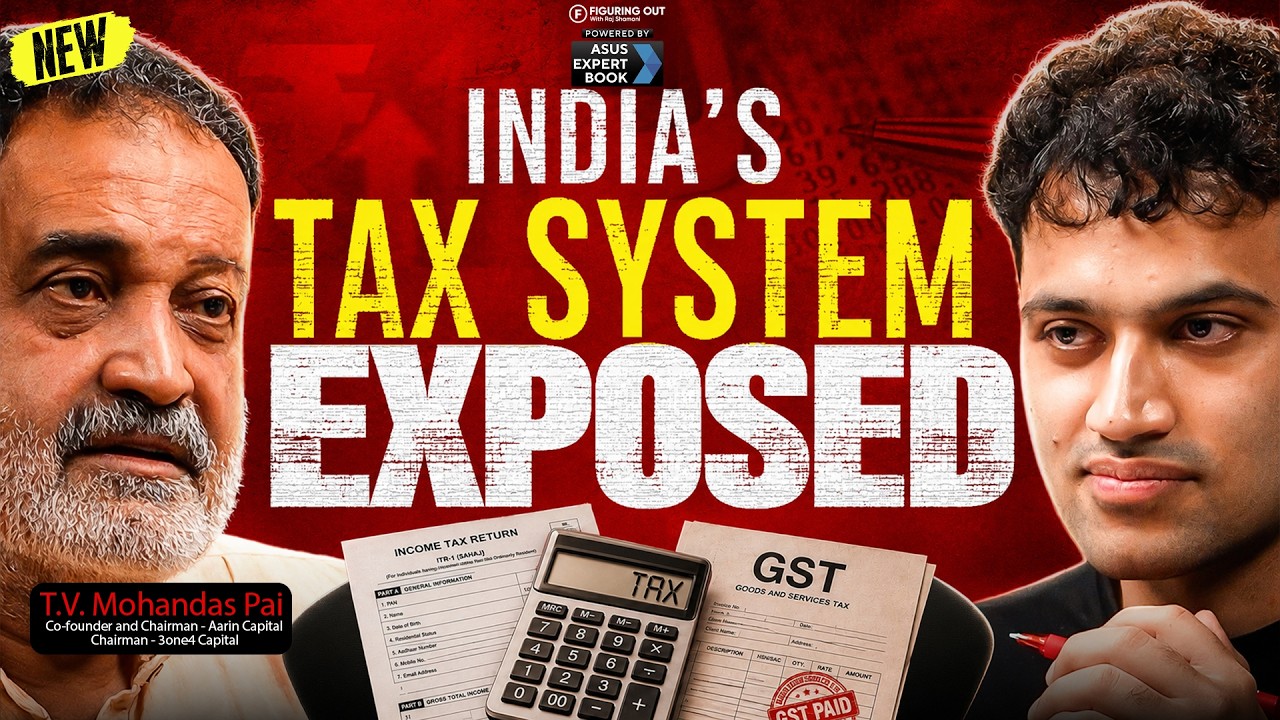
Truth About India's Tax System: Why Honest Taxpayers Get Punished | Mohandas Pai | FO539 Raj Shamani
Executive Summary
Pai connects financial curiosity, workplace respect and reporting discipline with his career. He also offers views on government responsibilities, work culture and financing risk. These notes cover selected source-read passages, not a full review of the tax and political discussion; his recollections, figures and judgments are not current financial or legal guidance.
Key Takeaways
Curiosity preceded a formal career
Pai recalls reading newspapers, company accounts and annual reports because he wanted to understand how figures worked. His account describes sustained interest rather than a single secret to success. The number of reports is his recollection, not independently checked, and reading many reports alone does not establish investment skill.
Humiliation shaped his view of respect
He describes a family-company dispute in which he felt demeaned by being called a servant. His conclusion is that one should not humiliate others. The lesson concerns the way a colleague is treated, not the idea that some kinds of honest work deserve less respect.
Expectations affect the experience of a workplace
Pai describes happiness as the gap between expectation and reality, connecting it with expecting respect and not receiving it. This is his personal philosophy rather than a validated psychological formula. It is useful for examining a mismatch without concluding that mistreatment is merely the employee’s expectations.
Joining Infosys involved room for disagreement
He recalls being invited into Infosys by its leaders, initially as a consultant and then as CFO. His account emphasizes respect and the possibility of disagreement. It is a personal career recollection, not an independently verified chronology of every role or evidence that every strong workplace operates identically.
Reporting discipline needed working systems
Pai recalls promising a highly accurate month-end P&L and Murthy checking whether it arrived on time. The account links a standard with the systems needed to sustain it as the company grew. His numerical accuracy and time claims are attributed; they are not a universal audit requirement or a reason to skip reconciliation.
Hard-work arguments remain contested
Pai defends demanding work and generational sacrifice in the episode’s 996 discussion. These are his views, not a recommendation for a 72-hour week or an established health standard. A listener should distinguish a speaker’s work ethic from contractual obligations, sustainable workload and the needs of an actual team.
Policy uncertainty enters his financing argument
Pai links perceived risk, policy changes and justice delays with the cost of capital. His government-responsibility scorecard includes defence, rights and property, justice, currency and foreign affairs. These are his explanatory lenses, not verified current rates, tax rules or a complete legal account of government obligations.
The Conversation Breakdown
Workplace respect and a formative incident
⏱ 35:26Pai recounts feeling humiliated during a family-company dispute and says one should never humiliate anybody. The timestamp is the official owning-video chapter start, while the transcript quotes are untimed.
Core Frameworks & Ideas
Expectation and reality
Pai’s personal lens for understanding disappointment, not a clinical formula.
Reporting discipline
Set a clear cadence and build systems to meet it without hiding reconciliation limits.
Government-responsibility scorecard
Pai’s five-part lens for evaluating institutions, not a current legal checklist.
Actionable Next Steps
- ✓Read a company report and write which figures or assumptions you do not understand.
- ✓Set a realistic reporting cadence and list its reconciliation limits.
- ✓Notice whether a difficult workplace conversation preserves the other person’s dignity.
- ✓Check current rules independently rather than acting on an episode’s tax or financing claims.
Notable Quotes
“Happiness is the delta between expectation and reality.”
“You should never humiliate anybody.”
“I collected 2,500 reports, read all of them.”
The One Thing to Remember
Financial discipline and respect for people should be examined together.