

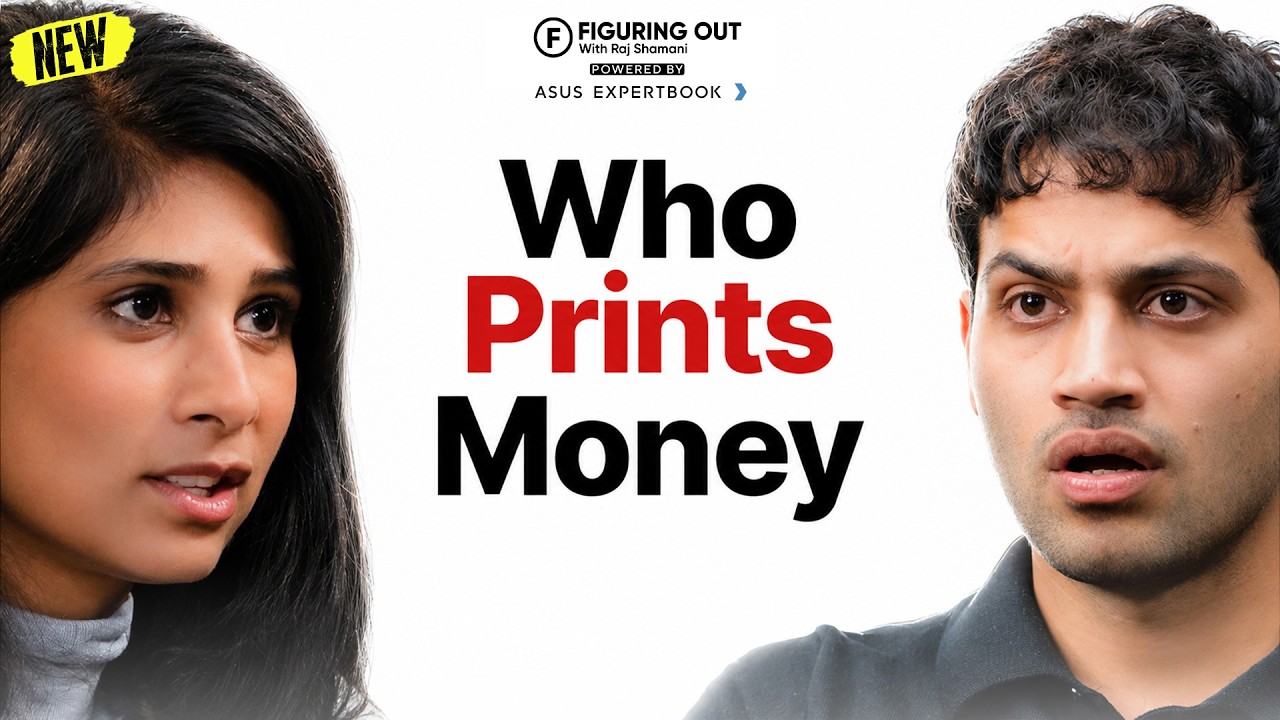
How Money Is Created: Central Banks, Money Printing & Inflation | Gita Gopinath | FO585 Raj Shamani
Executive Summary
Gita Gopinath - former IMF chief economist, Harvard professor - gives Raj a ground-up economics masterclass. Where money comes from: a world awash in savings (aging populations save most in their 40s-60s) is why record government debt hasn't spiked interest rates; central banks exist to keep money supply matched to demand at an inflation target (US 2%, India 4%+/-2%). Why printing isn't free: the cycle of government forcing the central bank to fund deficits ends in hyperinflation - Zimbabwe, Argentina. Why the US borrows $38 trillion yet stays the safest destination: ability to tax, hope of AI-driven growth, and sheer market liquidity - though Japan's debt-to-GDP (230%) dwarfs America's (~100%). Her 20-year call: 'the dollar will remain the dominant currency of the world' - no BRICS currency makes sense without a central bank behind it; the yuan stays undervalued because China keeps consumption at 40% of GDP and capital under hyper-control. On tariffs: the incidence falls mostly on US importers and consumers, while China reroutes through Vietnam, Mexico and Europe at real cost to itself - youth unemployment at highs, property in trouble, 'weak demand, slowing growth.' Her frame for the moment: 'the great gamble' - AI and geopolitics as two giant forces, a world more integrated and more diffuse in power than ever, rolling the dice with no guardrails; so far the positives (AI boom) offset the negatives (tariffs, oil, wars), 'everything has changed and yet somehow nothing has.' On AI valuations: 'I personally think that there will be a correction' - a trillion dollars of 2026 investment against unclear profits, Nvidia-lab circularity, and unregulated shadow-bank exposure; a big correction means at least zero-to-negative US growth. On the IMF's Pakistan loan: the fund is a 'financial firefighter' - lending decisions are membership votes (US veto doesn't apply to lending), nobody has ever defaulted to the IMF, and walking away from a country in crisis is not its job. On debt: global debt heads to 100% of GDP - post-WWII territory; the trigger would be another crisis pushing US deficits from 6.5% toward 10% of GDP, with 'my debt, your problem' spillover into world interest rates. Her advice for a 25-year-old: fight 'cognitive surrender' - write the essay start to finish even though AI can do it in two seconds; build expertise first (AI complements experts, substitutes non-experts); social sciences are more AI-proof than math; protect study groups and salons. The advice nobody should follow: 'be like me' - copying a famous person's path 'is crap.' And the cost of becoming Gita Gopinath: not sacrifice but choice - 'I would never use the word sacrifice.'
Key Takeaways
Savings glut explains 'no crisis yet'
Record government debt hasn't spiked rates because aging world populations save heavily in their 40s-60s. US 10-year borrowing went from ~2.5% to 5% - higher, not danger zone. The window to fix debt is now, while savings are abundant.
Printing money is never free
The cycle: government overspends, lenders refuse, central bank prints, hyperinflation wipes out the currency - Zimbabwe and Argentina. Milei's Argentina is her example of ripping the band-aid after repeated crises.
Dollar dominance has no real challenger
Her 20-year call: the dollar stays dominant. A BRICS currency is fiction without a central bank to defend it; the yuan is held back by China's own capital controls and consumption-suppressing model; depreciation is possible, dethroning is not.
Tariffs hit the importer's side
Evidence shows the vast majority of tariff incidence falls on US importers, split between margins and consumers. China pays too - rerouting through Vietnam/Mexico/Europe costs profits and jobs - but the trade didn't stop, it moved.
The great gamble
AI and geopolitics are two huge forces with no guardrails: record global integration plus diffuse power. So far positives offset negatives ('everything has changed and yet somehow nothing has'); the risk is the slow attrition nobody notices until 10 years later, Brexit-style.
Why she expects an AI correction
A trillion dollars of AI investment in 2026 alone against unclear profits, chip obsolescence risk, Nvidia-lab circular funding, and opaque shadow-bank linkages - 'I personally think that there will be a correction.' A big one takes US growth to zero or negative.
Cognitive surrender is the near-term scare
Students outsourcing thinking to AI mirror the pandemic's lost learning years. Her protocol: use AI to generate harder problems and tailor learning, never to replace the work; build expertise (AI complements experts, substitutes non-experts); keep study groups - social sciences are more AI-proof than math.
The Conversation Breakdown
How money actually works
⏱ Untimed topicSavings, banks and capital markets; the central bank's inflation-target role; the rate-hike transmission chain to your rent and loans; and why printing money ends in hyperinflation.
Debt, dollar and the yuan
⏱ Untimed topicWhy the US borrows $38 trillion safely (tax base, growth hope, liquidity), Japan's 230% debt-to-GDP, the 20-year dollar call, BRICS-currency skepticism, and why the yuan stays undervalued by design.
Tariffs, China and the great gamble
⏱ Untimed topicWho actually pays tariffs, China's rerouting and weak domestic demand, the shift from rules-based trade, and why integrated-plus-diffuse power makes this a gamble unlike the Cold War.
AI: correction risk and cognitive surrender
⏱ Untimed topicThe trillion-dollar investment question, circularity and shadow-bank linkages, what a correction does to growth, and the pandemic-style learning loss she sees in students - with her protocol for learning in the AI age.
Inside the IMF and India
⏱ Untimed topicWhy the IMF lent to Pakistan (firefighter mandate, membership votes, no US veto on lending), India's supply-chain opportunity and its judicial/corruption choke points, big-bang reforms, and her personal philosophy on choices versus sacrifice.
Core Frameworks & Ideas
The great gamble lens
Two transformative forces (AI, geopolitics) at peak global integration with diffuse power and no coordination: outcomes can be very good or very bad, and nobody is steering. Read every macro signal through which force it belongs to.
Follow the savings
Demographics drive savings, savings drive rates: aging populations explain why debt hasn't triggered crises yet - and why the window for fiscal repair is now.
The firefighter test for institutions
The IMF lends because collapse hurts millions and contagion spreads; the test is whether new policies move the country from the abyss, not how many times it has come before. Nobody has ever defaulted to the IMF.
Complement, don't substitute
AI complements expertise and substitutes the non-expert. Use it to generate problems, challenge answers and tailor learning - but write the essay start to finish yourself, or you have no value added.
Actionable Next Steps
- ✓Students and professionals: adopt the no-outsourcing rule - produce the full work yourself first, then use AI to challenge and extend it.
- ✓Investors: separate dollar depreciation (plausible) from dollar dethroning (her view: not in 20 years) before acting on de-dollarization narratives.
- ✓Founders and policymakers watching India: the opportunity is supply-chain share; the blockers are judicial speed, land titles, harassment and skilling - track reforms there, not headlines.
- ✓Anyone reading tariff news: ask who absorbs the incidence - evidence says mostly the importing side, split between margins and consumers.
- ✓Build and protect real group learning: study groups and salons are the human-skill gym AI can't replace.
Notable Quotes
“the dollar will remain the dominant currency of the world”
“I personally think that there will be a correction”
“financial firefighter”
“everything has changed and yet somehow nothing has”
The One Thing to Remember
The world looks normal only because AI's boom is offsetting geopolitics' damage - Gopinath's 'great gamble' is that we're rolling dice with no guardrails, and the two things in your control are fighting your own cognitive surrender and building real expertise.