


Harvard MBA in 100 Minutes: Career Growth, Frameworks, Money & Skills | Ashwin | FO522 Raj Shamani
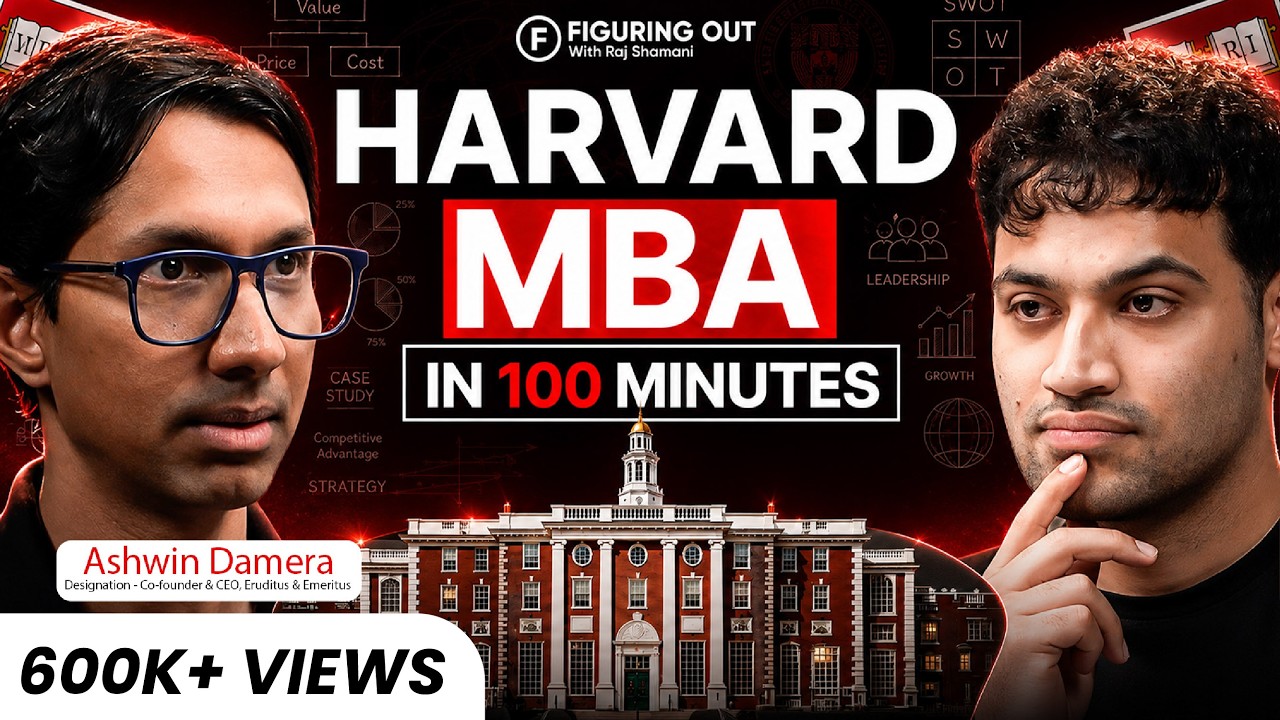
Executive Summary
Ashwin Damera discusses career capital, learning from cases and understanding what people want in a negotiation. Selected career and decision passages only; institutional rankings and promotional claims, health, political context, moral dilemmas and deal valuations omitted. Rough auto-captions have recognition errors and no speaker labels; quotes retain caption wording and attribution follows interview context. The official description confirms his name. Harvard grading remarks are his retrospective account, not current university policy. Untimed topics are not video chapters. Source: https://www.youtube.com/watch?v=YVlWj1LCv54
Key Takeaways
Career growth has more than a knowledge component
Damera describes career capital as intellectual capital plus social capital plus brand capital. It is his teaching framework, not a measured formula for predicting promotion. Review what you can do, whom you can learn from and what evidence of your work people see, rather than assume skills alone settle every career choice.
Strong and weak ties do different work
He describes close friends who helped him early and broader connections who can point toward information and introductions. Neither replaces the other. Develop relationships across functions while preserving genuine close ties, instead of treat every connection as an immediate transaction.
Reputation travels when you are absent
Damera includes what people say about someone who is not in the room in his view of personal brand. Credentials are only part of that. Make the quality of your work clear to collaborators rather than rely on a profile line to explain all your contribution.
Practice participating in an uncertain discussion
He recalls classroom participation being a large part of his experience at Harvard and talks about cases without one obvious answer. The claim is historical and personal, not a current grading rule. Practice stating a reasoned view while still being willing to change it when evidence changes.
Combine evidence into a recommendation
He recalls a professor telling him his answers were obvious because he only pointed to case material. He began combining information into scenarios and recommending a path. The skill is to explain why evidence supports a choice rather than only repeat the evidence.
Separate a stated position from its purpose
In negotiation, he distinguishes what someone says they want from the interest behind it. He illustrates that a refusal can involve something other than price. Ask respectful, open questions, while accept that understanding the interest still may not make a deal possible.
Know what happens without an agreement
He discusses the best alternative to a negotiated agreement and how it affects bargaining. The useful question is what realistic option remains if this discussion stops. Do not mistake an imagined fallback for an offer you actually have, or assume knowing your alternative guarantees a deal.
The Conversation Breakdown
Career growth has more than a knowledge component
⏱ Untimed topicDamera describes career capital as intellectual capital plus social capital plus brand capital. It is his teaching framework, not a measured formula for predicting promotion. Review what you can do, whom you can learn from and what evidence of your work people see, rather than assume skills alone settle every career choice.
Strong and weak ties do different work
⏱ Untimed topicHe describes close friends who helped him early and broader connections who can point toward information and introductions. Neither replaces the other. Develop relationships across functions while preserving genuine close ties, instead of treat every connection as an immediate transaction.
Reputation travels when you are absent
⏱ Untimed topicDamera includes what people say about someone who is not in the room in his view of personal brand. Credentials are only part of that. Make the quality of your work clear to collaborators rather than rely on a profile line to explain all your contribution.
Practice participating in an uncertain discussion
⏱ Untimed topicHe recalls classroom participation being a large part of his experience at Harvard and talks about cases without one obvious answer. The claim is historical and personal, not a current grading rule. Practice stating a reasoned view while still being willing to change it when evidence changes.
Combine evidence into a recommendation
⏱ Untimed topicHe recalls a professor telling him his answers were obvious because he only pointed to case material. He began combining information into scenarios and recommending a path. The skill is to explain why evidence supports a choice rather than only repeat the evidence.
Separate a stated position from its purpose
⏱ Untimed topicIn negotiation, he distinguishes what someone says they want from the interest behind it. He illustrates that a refusal can involve something other than price. Ask respectful, open questions, while accept that understanding the interest still may not make a deal possible.
Know what happens without an agreement
⏱ Untimed topicHe discusses the best alternative to a negotiated agreement and how it affects bargaining. The useful question is what realistic option remains if this discussion stops. Do not mistake an imagined fallback for an offer you actually have, or assume knowing your alternative guarantees a deal.
Core Frameworks & Ideas
Career capital - guest framework
Consider knowledge, relationships and reputation together rather than as substitutes.
Position and interest - discussed distinction
Separate the stated demand from the purpose behind it before explore possible terms.
Best alternative - discussed negotiation concept
Identify the realistic option available if no agreement is reached.
Actionable Next Steps
- ✓Write a recommendation with the evidence and alternatives behind it.
- ✓Have one useful conversation outside your usual function.
- ✓Ask what purpose lies behind a negotiation request.
- ✓Write the real fallback if a current discussion does not reach agreement.
Notable Quotes
“Start building these ties”
“This is somebody you can call up at 3:00 a.m. and say I need help.”
“A, B, C, you should do this versus saying they should do this.”
The One Thing to Remember
Make your reasoning clear, and understand both the interest and the alternative before negotiate.