


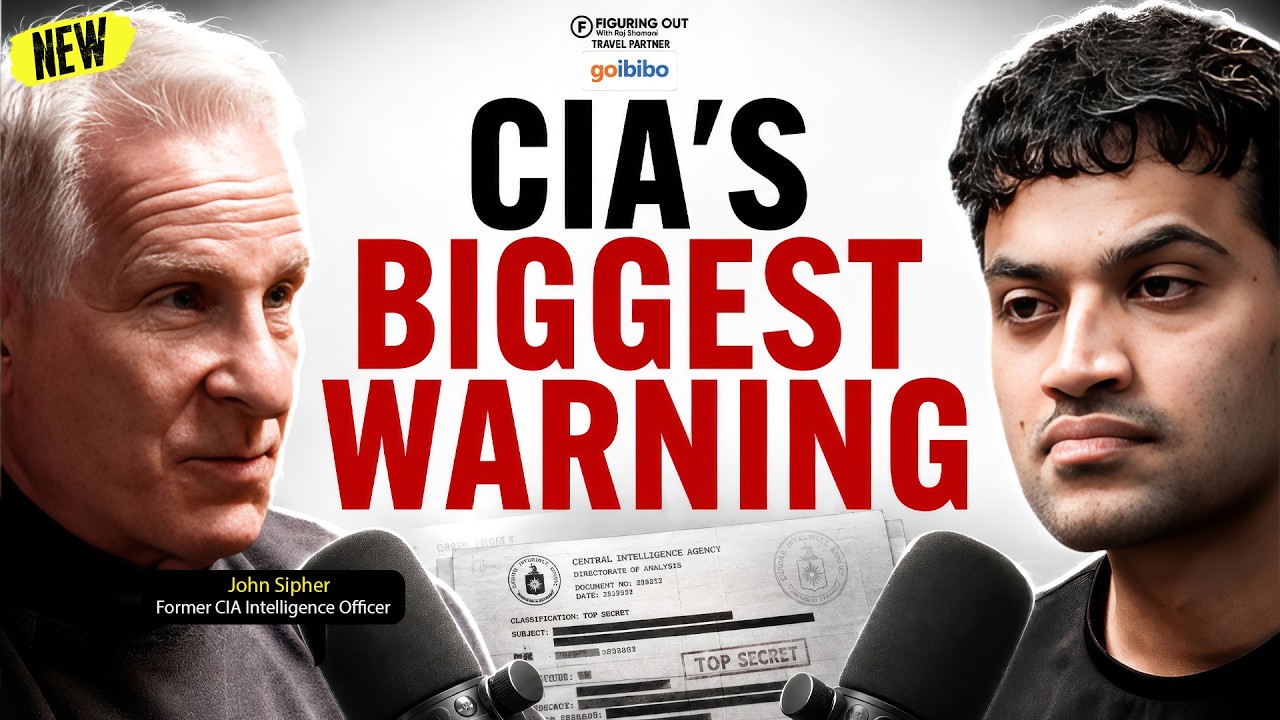
Former CIA Agent's Warning: China Doesn't Need A War To Beat America |John Sipher |FO544 Raj Shamani
Executive Summary
John Sipher's central warning: America's real superpower was never secrecy or gadgets - it was trust. Most CIA reporting comes from relationships with partner services, and people risk their lives to spy for the US because of what America represented; if it becomes 'just another country with hands in your pockets,' that advantage dies. He maps how security services differ by origin: revolutionary states like Russia, China and Iran built theirs for regime security (protect the leadership), which is why Russia - 'losing the 21st century' - exports chaos through subversion while China, who wants to own the century, plays the long game with trade, relationships and cyber. His verdict: 'Overwhelmingly, China is the biggest long-term challenge threat' - more English speakers working intelligence than all Five Eyes services combined, and big data plus AI are erasing the old one-on-one spy game. On Russia he is blunt: an intelligence state run by Chekists, with Putin shaped by watching his country collapse while stationed in East Germany. On the craft itself: spying is applied human nature - spot, assess, develop, recruit, handle, terminate - and 'you can bring intelligence to a policy maker, but you can't make them think.'
Key Takeaways
What the CIA actually is
Two halves: a small espionage arm - 'there's more FBI special agents in New York City than we have worldwide' - running human sources undercover, and an analytic cadre like a midsize university covering every economy, navy and missile system on earth. And 70-80% of clandestine reporting comes from relationships with foreign security services, not lone spies.
Regime security vs national security
Services born from revolutions - Russia's Cheka in 1917, China's, Iran's - exist to keep the leadership in power, not the country safe: kill the opposition first, build foreign arms later. In the US and India, professionals stay as leaders change; in those systems, if the leadership falls, the service falls with it.
Russia wants chaos, China wants the century
Russia, 'losing the 21st century,' overthrows the board: subversion, disinformation, useful idiots, amplifying Americans' own divisions. China benefits from the system - trade, money, relationships - and builds patiently while using cyber to weaken rivals. Pakistan is 90% focused on India. The CIA's overwhelming long-term concern is China's scale and speed.
Trust is the actual weapon
Sipher is 'embarrassed and ashamed' by the mafia-style treatment of allies: Five Eyes is a sharing relationship, not a paid service, and Australia or Britain can reach places the US can't. 'Being big and being powerful doesn't guarantee success' - he argues the US is losing in Iran precisely because bombing doesn't build what alliances do.
Trump, from a case officer's view
Not a Manchurian candidate, in his assessment, but useful to Russia: the brazenness, the disregard for norms, the comfort with the criminal side. Roy Cohn's rules - attack, never accept defeat, never admit fault - work in real estate, not against geopolitical reality. His strongest claim: the biggest disruptor in the world is now America itself. All of this is Sipher's personal political opinion.
The recruitment cycle
Spot, assess, develop, recruit, handle, terminate. It's friendship with a purpose: find the person with access, learn what they care about, build real trust - 'no one's going to put themselves at risk and spy for you unless they trust you' - then move to secret meetings, dead drops, and commitments like relocation and lifetime support.
Data changed espionage forever
The post-9/11 manhunt era produced 'targeters': analysts who build a full picture of a person - family posts, academic records, movements, even car-tire sensors - before an officer ever says hello. The FBI-CIA split persists: cops rewarded for arrests vs robbers rewarded for recruitments; evidence for court vs intelligence as patterns. 'You can bring intelligence to a policy maker, but you can't make them think.'
The Conversation Breakdown
Inside the Agency
⏱ Untimed topicSipher demystifies the CIA: one piece of the national security apparatus, with an analytic side receiving everything from satellites to academic papers, and a small spy side tasked with the questions policymakers can't answer openly. Officers overseas work undercover, liaise openly with local services like RAW, and hunt the rare person angry or idealistic enough to spy. His family life: spouses are told, kids are told when mature enough - his own children, shown around headquarters, were unimpressed.
Why every service is different
⏱ Untimed topicFrom the Bolsheviks' 1917 Cheka - Dzerzhinsky: 'we are a terrorist organization' - to today: revolutionary regimes build services for regime survival, and that DNA persists. Russia: a security state run by former KGB men, punching worldwide above an economy the size of Portugal. China: revolutionary control at home plus global ambition, trade and cyber. Pakistan: 90% focused on India, creator of the Taliban, now fighting its own terrorism problem. Israel: superb but neighborhood-scoped. India: real external interests anchored to China, Pakistan and internal security.
America's trust deficit
⏱ Untimed topicThe Five Eyes flap, the bullying-is-strength worldview, and why Sipher argues the US is losing in Iran and didn't win in Iraq, Afghanistan or Vietnam: power without relationships underdelivers. Immigration and allies are the two American advantages China cannot copy - and both, he says, are being thrown away. Why Pakistan is a 'weird relationship' Washington can't simply drop: nuclear weapons, instability, and real counterterrorism history - while India is the natural ally geopolitics keeps deferring.
Trump and the asset question
⏱ Untimed topicWould Trump make a good spy? Terrible - he'd never follow rules or show up on time. But the Russian model doesn't need him to be: corrupt mutual scratching is enough. Sipher's blunt personal assessment: a narcissist, a charlatan on manufacturing promises, an executive-order enemy who stripped clearances from critics like Sipher himself - with a cult-like base that flips positions when he does. The succession race: Rubio vs Vance on the right; governors and ex-intelligence women like Abigail Spanberger on the Democratic bench.
Understanding Putin
⏱ Untimed topicChekists celebrate December 20th; Putin makes sure he's at FSB/SVR offices that day. A KGB officer in East Germany when the Soviet Union collapsed - the elite of a superpower watching the motherland fall apart. The KGB held the Communist Party's foreign money, so when everything else disintegrated, the security men kept power. 'Once a Chekist, always a Chekist': subversion, kompromat and asymmetric weakness-hunting as state policy - which is why Sipher compares ignoring Russia today to ignoring al-Qaeda before 9/11.
Tradecraft: recruiting a spy
⏱ Untimed topicThe full cycle - spot, assess, develop, recruit, handle, terminate - as applied human nature: parties, attache circuits and school gates in the old days; writing everything up for Washington's databases; then the careful transition from open friendship to dead drops. How 15-20 years of big data created targeters who profile a source before first contact, and why AI is accelerating the shift away from one-on-one intuition.
Cops and robbers, and a brick
⏱ Untimed topicFBI counterintelligence tracks foreign spies on US soil and hands promising recruits to the CIA; friction is cultural - arrests for promotion vs sources for reporting, evidence vs intelligence. His unlimited-budget answer: civic training at home and strengthening allied democracies until America 'gets itself back together.' And the brick from Bin Laden's Abbottabad compound next to his Berlin Wall brick - a memento of the Cold War to the war on terror, and of the years of patient work behind one night.
Core Frameworks & Ideas
Origin determines behavior
A security service built for regime security protects the leader; one built for national security serves the state through transitions. Before judging any institution's behavior, ask what it was founded to protect - the founding purpose survives every reorganization.
Spot, assess, develop, recruit, handle
The recruitment cycle generalizes to any high-stakes trust ask: identify who actually has what you need, learn their motivations before pitching, build genuine mutual trust, make the ask explicit with its risks, then maintain the relationship deliberately - and know how to end it cleanly.
Intelligence vs evidence
Evidence is built to survive a courtroom; intelligence is a pattern assembled from partial sources. Different standards, different incentives - the FBI is rewarded for arrests, the CIA for sources. Know which standard your decision actually needs, and don't let a verdict-shaped culture make intelligence-shaped calls.
Actionable Next Steps
- ✓Before your next high-stakes ask (hiring, partnership, funding), run spot-assess-develop deliberately: confirm the person has what you need and learn what they care about before you pitch.
- ✓Label the key beliefs behind your current big decision as 'intelligence' or 'evidence' - pattern-based or proven - and price your risk accordingly.
- ✓Check your team's incentive scoreboard: does it reward visible short-term wins (arrests) or long-term value (recruitments)? Adjust one metric that rewards the wrong one.
- ✓List the five relationships your work most depends on and invest in one this week before you need it - trust is built in peacetime and spent in crisis.
Notable Quotes
“Overwhelmingly, China is the biggest long-term challenge threat.”
“you can bring intelligence to a policy maker, but you can't make them think.”
“the culture of the FBI are cops and the culture of the CIA are robbers.”
The One Thing to Remember
Power built on bullying spends itself; power built on trust compounds - Sipher watched allies, informants and whole countries cooperate with America because of what it stood for, and warns that this asset, once lost, cannot be bought back.