


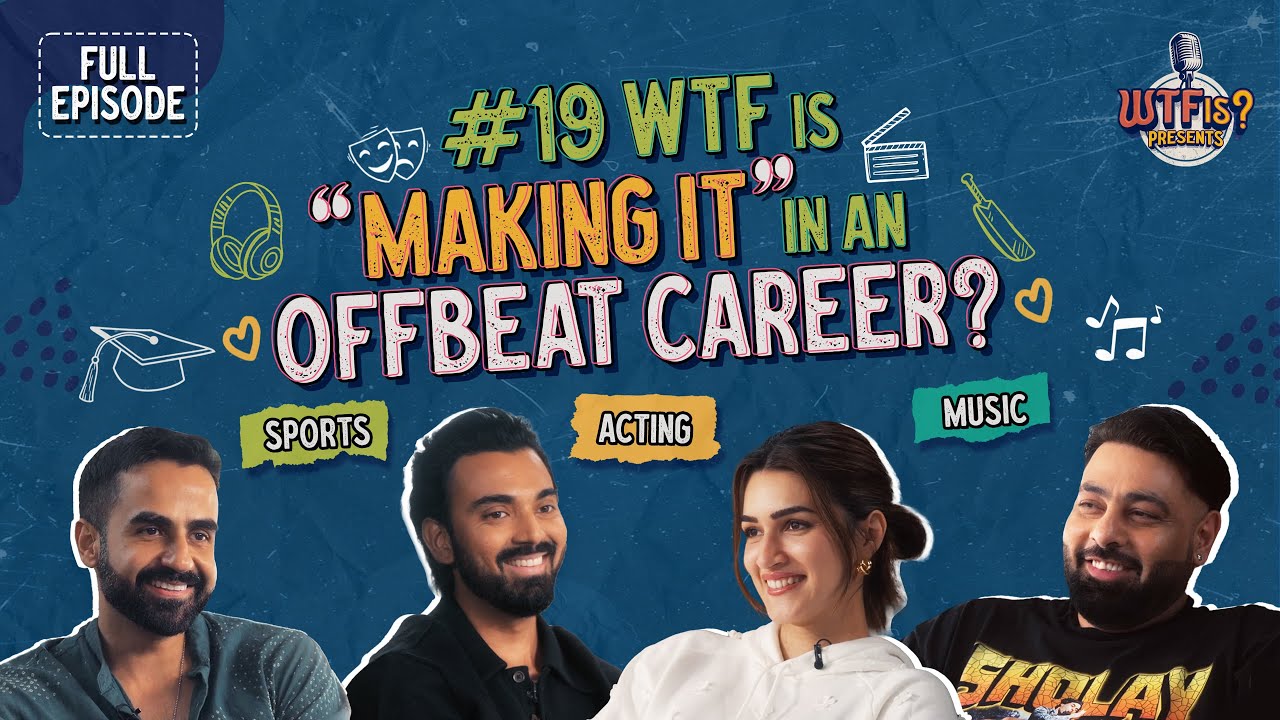
Ep. #19 | WTF is "Making it" in an Offbeat Career? Nikhil Kamath Ft. Kriti Sanon, Badshah & KL Rahul
Executive Summary
Nikhil's goal for the table - Kriti Sanon, Badshah, KL Rahul - is to reverse-engineer three unconventional careers for a 20-year-old watching. Kriti: professor mother, CA father, the 90%-plus kid who chose science, loved physics, went to engineering because she could - then cried after her first photoshoot and ramp walk, took her mother's advice to be 'thick skinned,' kept modeling, failed her first auditions badly, and learned to 'get up and give it another shot' until she was good at it. Her philosophy: happiness is a choice ('you can have everything and not be happy'), peace outranks validation, financial independence is the ingredient that makes choices real, and she says yes to roles she doesn't know how to approach - fear plus preparation is her method. KL Rahul: Mangalore, two teacher parents, a plastic bat at two and a half, cricket-football-swim-study days, academy selection as the ladder, and a single dream with no Plan B - 'I never had Plan B and I never had to think about a Plan B.' On talent: hand-eye coordination is born, not built; at every stage the game tells you whether you're good. On longevity: the minute he turned 30 he could see the shelf life - 'all this ends' - so COVID became his financial education for life after cricket. On trolling: he quit social media for a year and a half. Badshah: Bal Bharati Pitampura, junior-engineer father, teacher mother, Punjabi music to schoolyard rap, a math job as SDO in Himachal's BBMB while writing on the side, underground Delhi days with Honey Singh, the 2011 split, then 'Saturday Saturday' - the song Dharma tried to replicate, couldn't, and called him for. His craft takes: YouTube tutorials teach you everything ('you can learn how to make a bomb'), the audience buys experience not purity (Travis Scott isn't the best rapper), and his advice to anyone who wants to be popular and rich: don't do music - do it only if you love it. The shared closing answers for the 20-year-old: be original even though it's easier said than done; do not give up - 'patience and hard work over a long period of time' is Badshah's formula; outwork your competition; pick sectors with tailwinds, not flavors of the season; and evolve before relevance expires - all three agree adaptability is the survival skill.
Key Takeaways
The crying phase is the filter
Kriti cried after her first photoshoot and ramp walk; her first auditions were 'really bad.' Her mother's rule - be thick skinned - plus falling and getting up again and again 'till you become good at it' is the entire early game in any offbeat field.
No Plan B can be a strategy
KL Rahul: one dream since childhood, 'never had Plan B.' The counterweight he adds: sports and stage careers have shelf lives - at 30 he started planning life after cricket. Total commitment to the craft, total honesty about its expiry.
Born talent vs built skill
Rahul's claim: hand-eye coordination is born, not made; every stage of sport tells you if you have it. The panel extends it to creative fields - some people process differently. The honest move is trying enough things to find which one you're wired for.
Happiness is a choice; peace is the currency
Kriti's hierarchy: you can convert peace into happiness but not happiness into peace; validation-seeking costs peace almost every time. Financial independence is what turns these philosophies into real options.
Craft serves the audience, not the purist
Badshah: the audience buys experience, not technical purity - loops and production tools don't mar creativity, ignoring the audience does. And if the goal is popular-and-rich, don't pick music; pick it only if you love it.
Trolling and the escape hatch
People innately enjoy watching the powerful fall - 'once you become too big you become the establishment.' Rahul's answer was a year and a half off social media; Kriti's is detachment and chosen people; Badshah's is humor.
The 20-year-old's closing checklist
Be original despite inspiration's pull; patience and hard work over a long period of time; outwork the competition; choose tailwind sectors over flavors of the season; and keep evolving - relevance ends quietly for those who stop adapting.
The Conversation Breakdown
Kriti: the topper who chose the stage
⏱ Untimed topicProfessor mother and home-marked tests, engineering because she could, the crying first shoots, thick skin as a family inheritance, failed auditions, and her peace-over-validation philosophy with financial independence as its backbone.
KL Rahul: one dream, no Plan B
⏱ Untimed topicMangalore childhood, the plastic bat at two and a half, the academy ladder, born-versus-built talent, shelf-life planning after 30, quitting social media over trolling, and what sport teaches about being told you're not good enough.
Badshah: from SDO to Saturday Saturday
⏱ Untimed topicPitampura to Himachal's BBMB day job, Punjabi classics to school rap, the Honey Singh years and the split, producing the song Dharma couldn't replicate, and his unsentimental views on music, money and the audience.
The inner game
⏱ Untimed topicStage fright and preparation, detachment versus connection, religion and remembering where you came from, relationships as stability, forgiveness as the underrated quality, and the favorite-animals game.
The advice
⏱ Untimed topicData in cricket and Bollywood, passion industries as bad businesses, investing lenses (demographics, tailwinds, Indian brands abroad), and the closing formula: originality, patience, hard work, evolution.
Core Frameworks & Ideas
The thick-skin protocol
Enter an offbeat field expecting the crying phase: bad first attempts, public judgment, trolling. The ones who make it simply keep returning - 'another shot till you become good at it.'
No Plan B, but plan the ending
Total commitment to one dream, paired with shelf-life realism: Rahul's post-30 financial planning and Kriti's age-appropriate role evolution show commitment and exit-planning are not contradictions.
Peace over validation
Kriti's decision filter: peace converts to happiness, not vice versa; every unit of validation-seeking costs peace. Choose roles, work and people accordingly - financial independence buys the right to choose.
Audience over purity
Badshah's craft rule: the audience pays for experience and connection, not technical perfection - so optimize for what lands, keep learning the tools (YouTube teaches everything), and stay original within it.
Actionable Next Steps
- ✓Aspiring offbeat-career builders: commit fully, but write down your shelf-life plan - what happens at the end of the peak years deserves the same seriousness as the debut.
- ✓Anyone in the crying phase: treat it as the filter, not the verdict - the panel's shared story is bad first attempts survived through repetition.
- ✓Creators: build financial independence early; it is what converts artistic choices from compromises into actual choices.
- ✓Performers: optimize for audience experience over insider purity - study what lands, not just what's technically best.
- ✓Everyone: audit your validation budget - notice what each external-approval habit costs your peace, and cut the expensive ones.
Notable Quotes
“you can have everything and not be happy”
“still have the courage”
“never had Plan B”
“patience and hard work”
The One Thing to Remember
Three different industries, one pattern: no Plan B, thick skin through the crying phase, and relentless repetition until you're good - then evolve before the shelf life ends.