


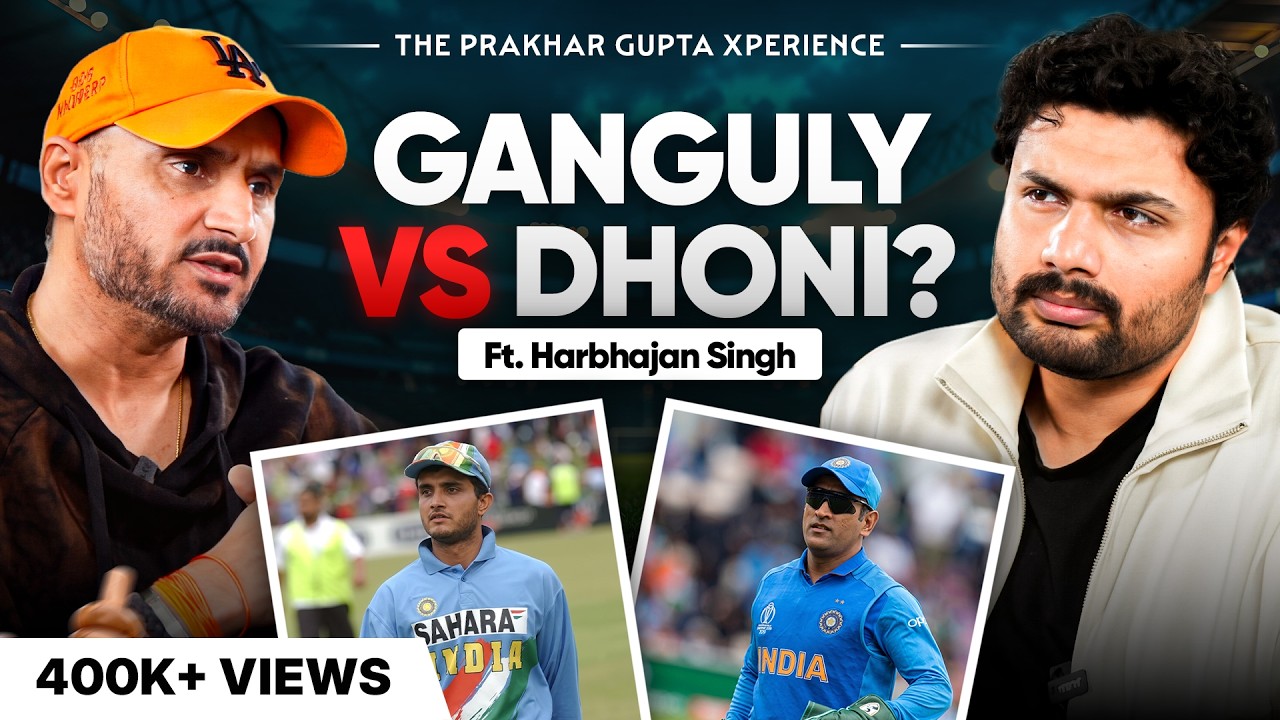
How Ganguly and Dhoni's team fell apart | Harbhajan Singh opens up
Executive Summary
Prakhar sits with Harbhajan Singh - 100+ Tests, the first Indian to take a Test hat-trick - for the story behind the turbanator: the father who died just before the 2001 Australia series, the Air India job that paid Rs 8,000, and how close Indian cricket came to losing him. 'Jab wo guzre to aisa laga ki zindagi khatam ho gayi,' he says of his father's passing (translated from Hindi). With sisters to marry off, no family income, expelled from the NCA for tearing up a diet chart that promised eggs and milk but delivered the same dal-roti daily, and Punjab's own selectors trying to bench him, he was planning to emigrate for work. Then one Ranji season: 28 wickets while the next spinner had 12-15, a camp where John Wright told Ganguly to look at him, and a debut series where he took 4, then 13, then 15 wickets - including the hat-trick (Ponting, Gilchrist, Warne) he bowled with one instruction to himself, told to Ganguly: 'Sirf stump mein aage ball' - just put the ball on the stumps and let the batsman make the mistake (translated from Hindi). 'Mere liye har match aisa tha ki is match mein agar nahi kiya to bahar' - every match felt like his last chance (translated from Hindi). He is unsparing on the Greg Chappell years - a divide-and-rule dressing room he calls Indian cricket's worst period - and precise on what separated the greats he bowled with: not technique ('Technique sabke paas hai, game sabke paas hai') but focus - Dravid's next-level focus, Sehwag as 'our generation's Viv Richards,' Tendulkar's humility at unimaginable fame. He gives Virat Kohli full credit for dragging Indian fielding and fitness to Australia's level, wants both Rohit and Virat at the 2027 World Cup, and makes a structural argument about Indian sport: the country has '100 Neeraj Chopras' sitting undiscovered, and medals will follow only when nutrition, coaching and long-term athlete planning are treated as a shared national responsibility. On the 2003 final he admits the team simply did not know what a World Cup final felt like; on 2011, a team so confident the pre-final meeting lasted one minute. Now retired ten years, softened by fatherhood - 'family se oopar kuch nahi' - he plays the WCL legends league and has written a book, due January, promising to name the people who tried to end his career.
Key Takeaways
Survival before stardom
Weeks before the 2001 hat-trick series, Harbhajan was planning to leave cricket - father gone, NCA expulsion, Punjab benching him. One Ranji season (28 wickets) was all he controlled, and he controlled it.
Every match felt like the last
'Is match mein agar nahi kiya to bahar' - that survival pressure, not confidence, was the mindset behind 32 wickets in his debut series.
The hat-trick was kept simple
With Ganguly asking what he'd bowl, the plan was one line: put it on the stumps, let the batsman miss. Ponting, Gilchrist, Warne - history made by shrinking the moment.
Focus, not technique, separates the greats
'Technique sabke paas hai, game sabke paas hai' - Dravid's focus, Sehwag's fearlessness, Tendulkar's humility are what he saw divide good players from generational ones.
Chappell's era broke a great team
He calls 2005-07 Indian cricket's worst period: divide-and-rule politics, media-fed negativity, and a bonded 2003-04 dressing room destroyed from inside.
India has 100 Neeraj Chopras
One Olympic gold from a country this size is a systems failure - protein-deficient diets, no long-term athlete planning. Medals follow infrastructure, coaching and timely advice, not just talent.
Leadership is backing people
Ganguly stood behind players and fought; Dhoni stayed unreadable and used each player's strengths. Both got 'combined effort' - no individual wins a World Cup.
The Conversation Breakdown
Almost gone before 2001
⏱ Untimed topicHis father's death, the Rs 8,000 Air India job, sisters to marry off, the NCA expulsion over the torn diet chart, and the Ranji season that forced selectors to pick him.
The Kolkata hat-trick
⏱ Untimed topicHayden's 97 dismissal as the real turning point, bowling with 'last match' pressure, and the one-line plan he gave Ganguly for the hat-trick ball.
The Chappell years and the World Cups
⏱ Untimed topicDivide-and-rule in the dressing room, 2003 final naivety, 2007 T20 chaos and Yusuf's three saved runs, and the one-minute meeting before the 2011 final.
What made the greats different
⏱ Untimed topicTendulkar's humility, Dravid's focus, Sehwag the new Viv Richards, Dhoni's unreadable calm and keeping, Rohit's invisible hard work, and Kohli's fitness revolution.
The broken 2011 team and '100 Neerajs'
⏱ Untimed topicWhy the dominant post-2011 side was scattered by selectors, and his structural case for nutrition, coaching and planning in Indian sport.
Life after cricket
⏱ Untimed topicWrestling fandom and Punjabi music, how fatherhood calmed the game's angriest competitor, the WCL, and the January book that will name names.
Core Frameworks & Ideas
Last-match pressure
Treat every opportunity as the one that decides whether you stay - Harbhajan credits survival urgency, not security, for his peak performances.
Shrink the big moment
The hat-trick ball plan was one sentence: hit the stumps, let the batter err. Pressure moments are won by simplifying to one executable thought.
Focus as the separator
At the top everyone has technique and game; focus - Dravid's immovability, Tendulkar's steadiness - is the only remaining differentiator.
Medals are a systems output
Athlete results = nutrition + coaching + fitness + multi-year planning, owned jointly by coach, physio and federation - not the athlete alone.
Actionable Next Steps
- ✓Audit your own 'survival seasons': identify the one stretch of work you fully control and over-deliver on it, as Harbhajan did in that Ranji season.
- ✓Before any high-pressure moment, write down a single-line plan - one executable thought, like 'stump mein ball' - and commit to it.
- ✓When building a team, back people publicly through failure; fear of failure ('fail hue to bahar') is what actually ends careers.
- ✓Athletes and parents: treat protein, recovery and a 3-year progression plan as non-negotiable infrastructure, not extras.
- ✓If you lead a strong team, protect the culture from divide-and-rule politics early - Harbhajan's warning is that even a champion dressing room can be destroyed in two years.
Notable Quotes
“Jab wo guzre to aisa laga ki zindagi khatam ho gayi. (translated from Hindi)”
“Mere liye har match aisa tha ki is match mein agar nahi kiya to bahar. (translated from Hindi)”
“Technique sabke paas hai, game sabke paas hai. (translated from Hindi)”
“Ek Neeraj aise kaise possible hai na. (translated from Hindi)”
The One Thing to Remember
Technique and talent are everywhere at the top level - what separates a Tendulkar, Dravid or Kohli is focus, and careers (like Harbhajan's own) turn on surviving the one bad season long enough for time to change.