


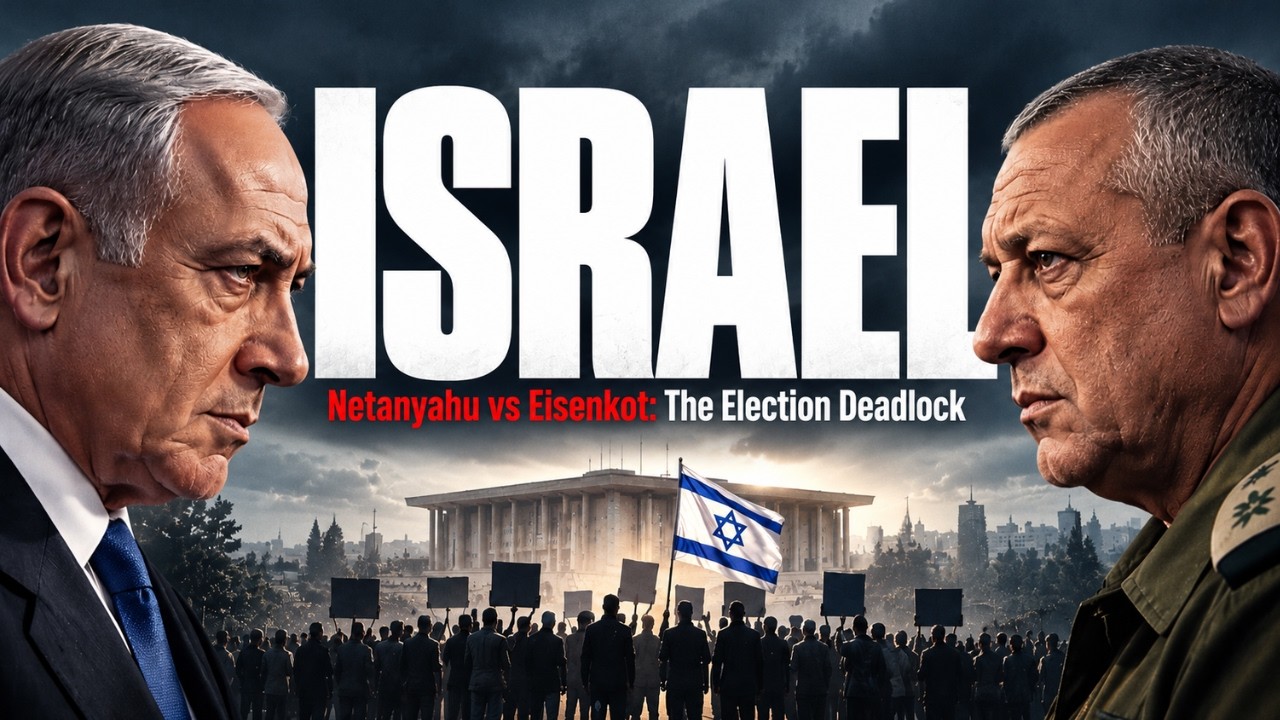
Israel's Election Shock! | How Netanyahu Lost His Majority and Why the World Is Watching?
Executive Summary
Think School on Israel's election deadlock: Netanyahu's bloc 53, Eisenkot's 48, majority needs 61 - and a record 19 Arab-party seats hold the balance. The episode explains why Israel's pure proportional representation guarantees coalition chaos (37 governments in 78 years), why the world cares (Red Sea and Hormuz chokepoints that move global prices), why India cares more (biggest Israeli arms buyer, and the IMEC trade corridor's missing link runs through Israel), and why Eisenkot's promise to never govern with the Arab parties makes his 67-seat path unusable - unless he breaks it.
Key Takeaways
53, 48 and the magic number 61
Netanyahu's bloc won 53 seats and Eisenkot's 48 in the 120-seat Knesset - nobody near the 61 needed to govern. The decider: Arab parties with a record 19 seats on unpredicted turnout, who say they will do everything to end Netanyahu's rule and even offer Eisenkot support without asking for a single ministry.
Proportional representation built the instability
Israel gives seats in exact proportion to votes above a 3.25% bar - so more than a dozen parties fit into 120 seats, Netanyahu's 32-seat Likud needs a six-party coalition, and any two parties walking out collapses the government overnight. The scoreboard: 37 governments in 78 years, five elections in four years, three years without a budget, and once an 'alternate prime minister' post.
First-past-the-post has its own disease
The episode contrasts India: win 40,000 of 100,000 votes in a constituency and the other 60,000 get ignored - so politicians can win by serving one community's 40,000 and ignoring the rest. Israel's system lets every minority voice into parliament; India's concentrates power. Each system's design rewards different political behavior.
A tiny country with a global lever
Israel is believed to be the Middle East's only nuclear power, fields the renowned Iron Dome, and its wars move the world economy: when it struck Gaza, Iran-backed Houthis cut Red Sea container traffic by about 90%, forcing Cape of Good Hope reroutes that added two weeks and 4-5x shipping costs. Iran's February 2026 closure of Hormuz - 20% of world oil - made it worse.
India's stake is direct
India is the single biggest buyer of Israeli weapons, and the India-Middle East-Europe Economic Corridor - India to Europe via UAE, Saudi Arabia, Jordan and Israel - promises goods up to 40% faster and 30% cheaper, plus a land backup to the Red Sea route, energy pipelines and data cables. The missing link runs through Israel, so Indian trade depends on Middle East peace.
Same outcome, opposite philosophies
Both contenders want Iran stopped from getting a nuclear weapon: Netanyahu wants the Tehran regime wiped out even at the cost of all-out war; Eisenkot calls regime change unrealistic and prefers targeted strikes on the nuclear program plus financial strangulation. On Gaza both want Hamas disarmed - Netanyahu by military pressure, Eisenkot via a US-backed peace plan handing Gaza to Palestinian technocrats.
The kingmaker paradox
Eisenkot plus the Arab parties equals 67 - a majority. But he has promised never to form a government with them. So the kingmakers hold the crown and nobody wants to take it from their hands. On November 4 the results go to the president, leaving three exits - Eisenkot swallows his promise, Netanyahu poaches seats, or a unity government - or Israel votes for the sixth time in seven years.
The Conversation Breakdown
The result that changed everything and nothing
The result that changed everything and nothing: 53 for Netanyahu's bloc, 48 for Eisenkot's, 61 needed - and an AI-generated image of Tel Aviv under nuclear attack posted two days before the vote
Why the world watches a country of 10 million
Why the world watches a country of 10 million: believed nuclear weapons, Iron Dome, and wars that turned the Red Sea into a 90% traffic collapse and 4-5x shipping costs
The Hormuz shock
The Hormuz shock: Iran controls the strait carrying 20% of world oil, and its February 2026 closure - in the video's telling - caused one of history's biggest oil shocks
Israel's paradox
Israel's paradox: a NASDAQ-heavy startup nation with 6,000 startups built on 37 governments in 78 years, five elections in four years, and an invented 'alternate prime minister'
Two electoral systems dissected
Two electoral systems dissected: Israel's pure proportional representation versus India's first-past-the-post - minority voices everywhere versus winner-takes-the-constituency caste math
Why India cares more than anyone
Why India cares more than anyone: biggest buyer of Israeli weapons, and the IMEC corridor to Europe whose missing link runs straight through Israel
Netanyahu versus Eisenkot on Iran and Gaza, the Arab parties' record...
Netanyahu versus Eisenkot on Iran and Gaza, the Arab parties' record 19 kingmaker seats, his promise never to govern with them, and the four ways November 4 can go
Core Frameworks & Ideas
The kingmaker paradox
When no bloc can reach the majority, the smallest cohesive group holding the swing seats owns the outcome - even if both rivals refuse to sit with them. Map any deadlocked negotiation by asking who holds the 19 seats, not who shouts loudest.
Rules write the politics
Proportional representation produces coalition fragility; first-past-the-post produces ignored majorities and community-targeted politics. Same voters, different incentives. Analyze any system - electoral, corporate, marketplace - by the behavior its rules reward, not the intentions of its players.
Chokepoint leverage
Small actors wield outsized power when they sit on chokepoints: Red Sea shipping, the Strait of Hormuz's 20% of world oil, Israel's position in the IMEC corridor. Local conflicts become global inflation through geography, not size.
Actionable Next Steps
- ✓Before dismissing a distant election or conflict, trace your own exposure to it - fuel, groceries, EMIs, shipping costs - through its chokepoints.
- ✓In your next deadlocked negotiation, list every party holding swing votes and what each would accept; the smallest cohesive bloc usually writes the outcome.
- ✓When judging an institution, read its rules first: write down what behavior the incentives reward before blaming the people inside it.
- ✓Watch the November 4 milestone: official results go to Israel's president, and the coalition math - promise-breaking, poaching, unity government or a sixth election - gets decided.
Notable Quotes
“do not test us.”
“The country is in a deadlock.”
“No party has won the majority.”
The One Thing to Remember
Israel's kingmakers hold the crown but nobody wants to take it: the Arab parties' 19 seats can make Eisenkot prime minister - and he has promised never to accept them.