


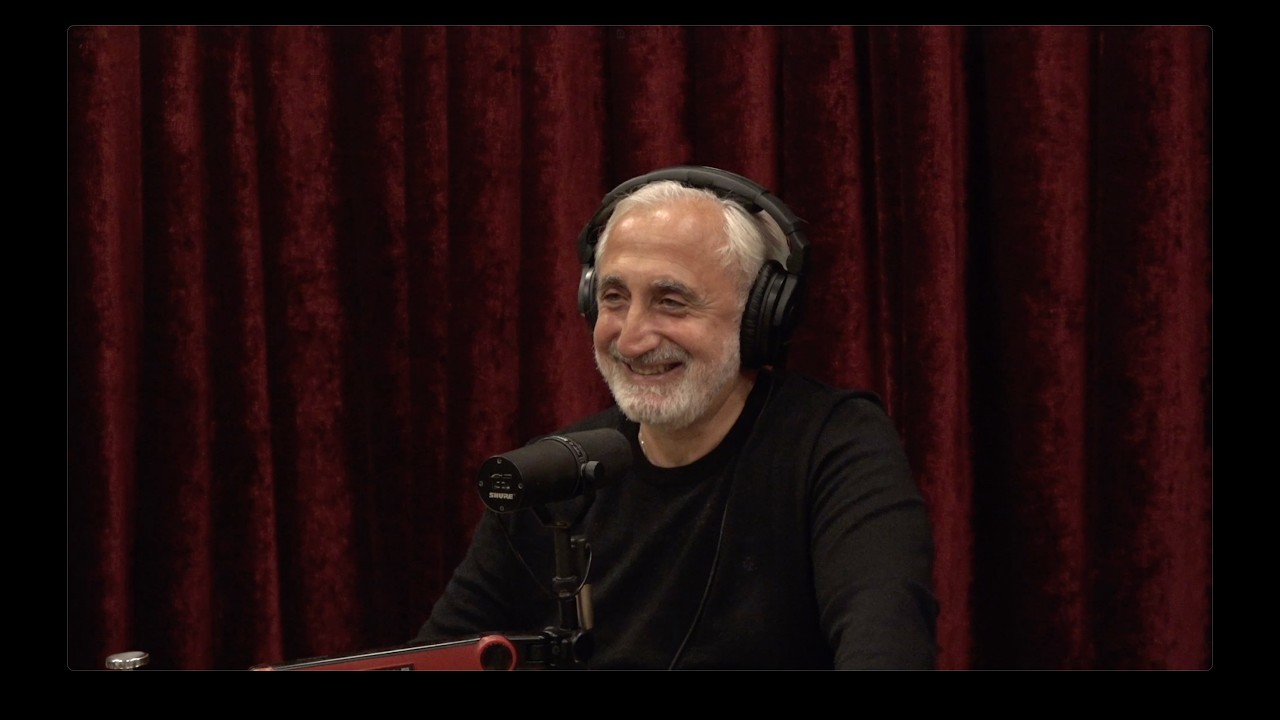
Joe Rogan Experience #2497 - Gad Saad
Executive Summary
Gad Saad introduces his book Suicidal Empathy and relates it to his earlier idea of a parasitic mind. He proposes that persuasion can act on both reasoning and emotion and uses a parasite story as a metaphor for losing judgment. Saad says he is not arguing against empathy itself; his concern is what he considers misplaced or excessive empathy. Rogan sometimes offers a different interpretation, including signaling rather than empathy and concern about Gaza's destruction as a motive. The discussion includes cultural assumptions, public safety and group identity. Selected coverage: these notes cover the supplied opening captions through the introduction of cultural theory of mind and early background discussion, not the entire episode. Specific criminal anecdotes, broad claims about political camps, religions or immigrants, and clinical or evolutionary explanations are not independently verified. They must not be taken as evidence about a whole population. The frameworks below are Saad's arguments to examine critically, not endorsed scientific models. Original: https://www.youtube.com/watch?v=6jdaXp0iwtw .
Key Takeaways
Saad distinguishes his argument from rejecting empathy
Saad explicitly says that empathy matters for a meaningful conversation and argues for what he calls well-modulated empathy. The distinction is central to understanding his thesis. Whether a particular act is misplaced empathy remains a separate judgment requiring facts, rather than something settled by the book's label.
Reasoning and emotion are different targets in his persuasion model
He contrasts advertising that offers reasons with advertising that evokes a feeling. He connects that distinction to his two books, one about ideas and one about affect. It is his explanation of persuasive mechanisms, not proof that an opponent's judgment has been hijacked.
A biological metaphor does not establish a social mechanism
Saad uses a parasite and cricket story to illustrate an organism acting against its interests. He extends it metaphorically to ideas and emotions. A vivid analogy can explain his concern while still leaving the empirical claim about human behavior untested.
Rogan questions the explanation of one example
When Saad offers an anecdote about a judge's response to a defendant, Rogan suggests it is signaling rather than suicidal empathy. This disagreement shows that even sympathetic speakers may interpret a claimed event differently. Neither motive can be established from the conversational account alone.
Context can change an account of a political position
Rogan argues that concern about destruction in Gaza may motivate a position Saad describes in ideological terms. He then distinguishes concern for people from support for rulers or an ideology. The exchange matters because the motive and the precise object of support should not be collapsed into one label.
Cultural theory of mind is offered as a proposed framework
Saad extends the idea of considering another person's perspective to considering a culture's values. The framework asks whether a person assumes shared interpretations across settings. His sweeping examples do not establish that all members of a culture think alike; individual variation and evidence still matter.
Extraordinary anecdotes need more than rhetorical force
The speakers discuss criminal cases, rehabilitation and cultural practices with strong emotional language. Those accounts are not independently checked in these notes. Evaluating the argument requires separating a specific event, its legal record, the speaker's interpretation and any broader generalization.
The Conversation Breakdown
Saad distinguishes his argument from rejecting empathy
⏱ Selected coverageSaad explicitly says that empathy matters for a meaningful conversation and argues for what he calls well-modulated empathy. The distinction is central to understanding his thesis. Whether a particular act is misplaced empathy remains a separate judgment requiring facts, rather than something settled by the book's label.
Reasoning and emotion are different targets in his persuasion model
⏱ Selected coverageHe contrasts advertising that offers reasons with advertising that evokes a feeling. He connects that distinction to his two books, one about ideas and one about affect. It is his explanation of persuasive mechanisms, not proof that an opponent's judgment has been hijacked.
A biological metaphor does not establish a social mechanism
⏱ Selected coverageSaad uses a parasite and cricket story to illustrate an organism acting against its interests. He extends it metaphorically to ideas and emotions. A vivid analogy can explain his concern while still leaving the empirical claim about human behavior untested.
Rogan questions the explanation of one example
⏱ Selected coverageWhen Saad offers an anecdote about a judge's response to a defendant, Rogan suggests it is signaling rather than suicidal empathy. This disagreement shows that even sympathetic speakers may interpret a claimed event differently. Neither motive can be established from the conversational account alone.
Context can change an account of a political position
⏱ Selected coverageRogan argues that concern about destruction in Gaza may motivate a position Saad describes in ideological terms. He then distinguishes concern for people from support for rulers or an ideology. The exchange matters because the motive and the precise object of support should not be collapsed into one label.
Cultural theory of mind is offered as a proposed framework
⏱ Selected coverageSaad extends the idea of considering another person's perspective to considering a culture's values. The framework asks whether a person assumes shared interpretations across settings. His sweeping examples do not establish that all members of a culture think alike; individual variation and evidence still matter.
Extraordinary anecdotes need more than rhetorical force
⏱ Selected coverageThe speakers discuss criminal cases, rehabilitation and cultural practices with strong emotional language. Those accounts are not independently checked in these notes. Evaluating the argument requires separating a specific event, its legal record, the speaker's interpretation and any broader generalization.
Core Frameworks & Ideas
Cognitive and affective persuasion
Saad's distinction between engaging reasoning and engaging feeling can be used as a question about a message, not a diagnosis of its audience.
Metaphor versus mechanism
Treat an analogy as an explanation of a viewpoint until direct evidence supports a causal claim.
Motive alternatives
Compare possible explanations such as empathy, signaling or concern about harm instead of assuming one from the outset.
Actionable Next Steps
- ✓State a speaker's thesis accurately before deciding whether you agree with it.
- ✓Verify a dramatic anecdote using a reliable primary record before generalizing from it.
- ✓Separate concern for people from agreement with a government, group or ideology.
- ✓Ask what evidence would distinguish competing explanations of a person's behavior.
Notable Quotes
“I'm not saying that empathy is a bad thing”
“I think that's signaling”
“I also need to zombify your affective system”
The One Thing to Remember
Separate empathy, ideology, signaling and evidence before assigning motives to people or generalizing from a dramatic anecdote.