


Life is Good: Print-on-Demand and a Wholesale Shock - Historical NPR Live Q&A (September 2020)
Executive Summary
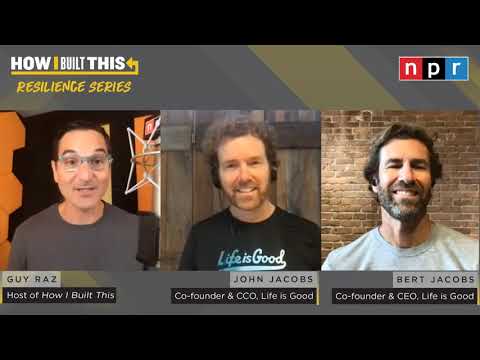
In this historical NPR Resilience Edition live Q&A from September 2020, Guy Raz asks Life is Good co-founders Bert and John Jacobs how they responded when wholesale orders collapsed. They describe direct garment printing, a shorter supply chain and designs made for the moment. Notes cover selected business passages from the full public auto-captions, not the emotional-wellbeing and nonprofit discussions. This is a COVID-era live session, not their standard founder profile. Date is the verified YouTube upload date. Sales, investment and operating claims are the founders' account of 2020, not current results or independent verification. Their workplace precautions are historical descriptions, not medical or safety guidance.
Key Takeaways
The wholesale shock
Half the business was wholesale. Retailers closed and cancelled orders, and the business was close to decimated. They discussed bankruptcy and laying off at least half the staff.
The best defense is offense
One evening they chose to jump into a strategy they had been developing: collapsing a 12 to 18 month supply chain window into a couple of days, with the leadership team backing the plan.
Direct garment printing
After researching for about five years, just before COVID they spent several million dollars on technology that prints every order to order. It costs more per unit but gives close to perfect inventory, which they say is the thing that kills businesses.
An operating plan alongside a commercial pivot
The founders describe changes at their New Hampshire distribution centre, including spacing workstations and bringing in a nurse, as part of keeping operations running. These were their stated 2020 precautions. They do not establish that a workplace was safe, and should not be used as a current safety standard.
Design for the moment
They designed shirts speaking to the moment, such as 'stay calm, stay cool, stay home' with an eagle in a bandana, without Life is Good branding, and a baseball shirt, 'longest rain delay in history', that sold hundreds a day.
E-commerce doubled
They say e-commerce has doubled over last year and replaced much of the wholesale revenue, which fell to next to nothing. They worked around the clock for the first 60 days to switch the model.
Art and message drive sales
They say the business is not about the t-shirt. It is high-quality basics, and the point of difference is seeing the world through an optimistic lens.
The Conversation Breakdown
The wholesale shock
⏱ Untimed topicHalf the business was wholesale. Retailers closed and cancelled orders, and the business was close to decimated. They discussed bankruptcy and laying off at least half the staff.
The best defense is offense
⏱ Untimed topicOne evening they chose to jump into a strategy they had been developing: collapsing a 12 to 18 month supply chain window into a couple of days, with the leadership team backing the plan.
Direct garment printing
⏱ Untimed topicAfter researching for about five years, just before COVID they spent several million dollars on technology that prints every order to order. It costs more per unit but gives close to perfect inventory, which they say is the thing that kills businesses.
An operating plan alongside a commercial pivot
⏱ Untimed topicThe founders describe changes at their New Hampshire distribution centre, including spacing workstations and bringing in a nurse, as part of keeping operations running. These were their stated 2020 precautions. They do not establish that a workplace was safe, and should not be used as a current safety standard.
Design for the moment
⏱ Untimed topicThey designed shirts speaking to the moment, such as 'stay calm, stay cool, stay home' with an eagle in a bandana, without Life is Good branding, and a baseball shirt, 'longest rain delay in history', that sold hundreds a day.
E-commerce doubled
⏱ Untimed topicThey say e-commerce has doubled over last year and replaced much of the wholesale revenue, which fell to next to nothing. They worked around the clock for the first 60 days to switch the model.
Art and message drive sales
⏱ Untimed topicThey say the business is not about the t-shirt. It is high-quality basics, and the point of difference is seeing the world through an optimistic lens.
Core Frameworks & Ideas
Inventory versus unit cost
Made-to-order printing raised cost per unit but reduced the need to commit to stock that might not sell. Compare the whole inventory burden, not just production cost.
A shorter demand-to-production loop
The founders wanted to replace a long planning window with a few days. They could watch sales and print what customers actually ordered.
Purpose as a product filter
The brand's optimistic point of view guided topical designs. The founders distinguish their message and artwork from simply selling a basic T-shirt.
Actionable Next Steps
- ✓Look for a project already in the works that a crisis makes urgent.
- ✓Weigh the extra unit cost of made-to-order against the cost of unsold inventory.
- ✓State your company's purpose in a sentence that guides what you make.
- ✓Compare a small topical product test with committing to a large batch of stock.
Notable Quotes
“the best defense is offense”
“inventory is the thing that kills businesses”
“the small things are the big things”
The One Thing to Remember
the best defense is offense