


People with The Prime Minister Shri Narendra Modi x Nikhil Kamath | Episode 6 | By WTF
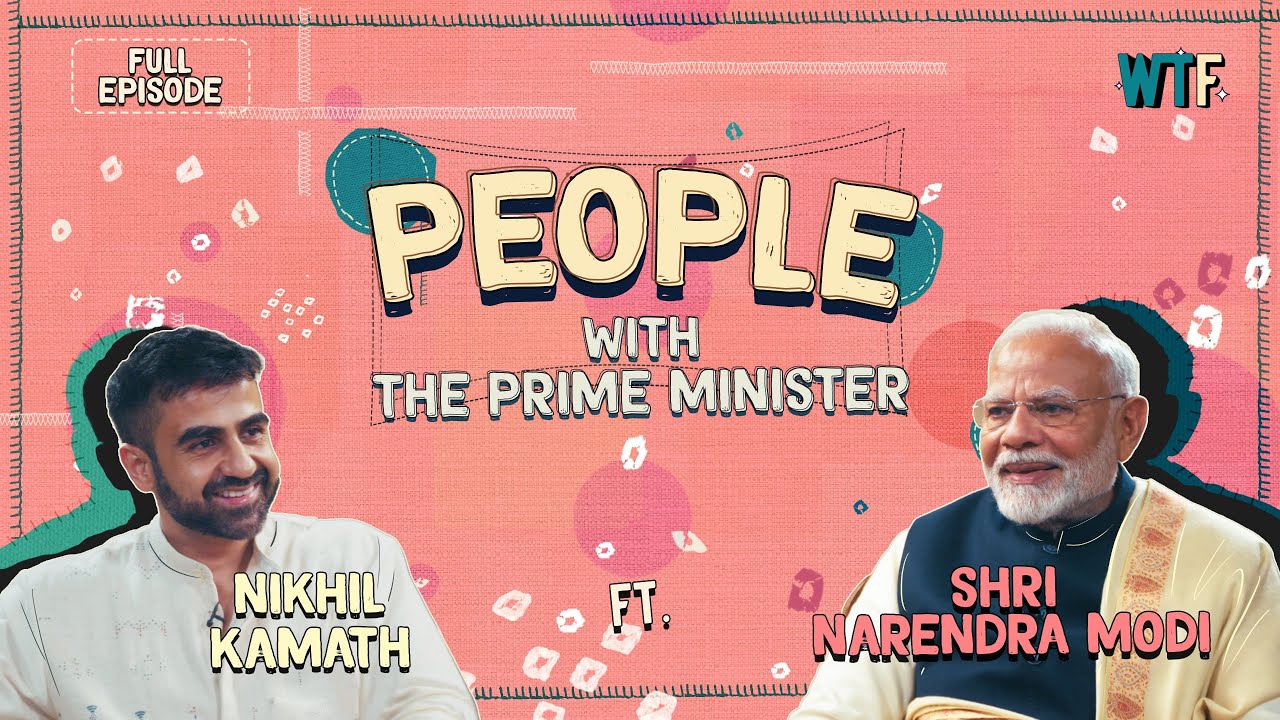
Executive Summary
Prime Minister Narendra Modi's first-ever podcast, a two-hour Hindi conversation with Nikhil Kamath recorded in Delhi's winter. Modi on his Vadnagar childhood: an ordinary student who fled competition, the teacher who told his father 'he is so talented, but he's not focused,' selling tea at the railway station where he learned Hindi from UP buffalo traders, the military-school dream his father couldn't fund, and the Ramakrishna Mission that turned him away. On the person: leaving home young, wandering the Himalayas and the Kutch desert (the white Rann sight he later turned into Rann Utsav), his 'I go to meet myself' retreats, the first call to his mother after hoisting the flag at Lal Chowk, and her 100th-birthday words - 'Work with intelligence, live with purity.' On politics: come with a mission, not ambition; win hearts by living with people; Gandhi led through way of life, not oratory ('His way of life did the talking'); politics needs sensitive people, not thick-skinned ones; and social media strengthens democracy because claims can now be verified. On governance: the 2002 earthquake rebuild with officers made 'chief minister of a block'; sending his secretaries back to their first-posting villages; minimum government as 40,000 removed compliances and about 1,500 abolished laws; UPI and direct benefit transfers; the Taiwan lesson of PhD ministers. On the world: the 2005 US visa refusal and his reply that 'the world would stand in line for a visa' to India; 'I am on the side of peace' on Russia-Ukraine; and the 2047 frame - his 'AI' is 'Aspirational India' - with a closing appeal for women (50% panchayat reservation now, 30% ahead) and one lakh young people in politics across all parties.
Key Takeaways
Vadnagar made him: the ordinary student with the encyclopedic curiosity
A self-described ordinary student who ran from competition but joined every activity - essays, drama, wrestling and 5 a.m. Mallakhamba. He wrote to the Chinese embassy about Xuanzang's stay in his village as a boy (a connection Xi Jinping later raised with him), ordered military-school details with a one-rupee money order his father couldn't act on, and learned Hindi selling tea to buffalo traders at the station.
His first setbacks were rejections he still remembers precisely
The military school his family couldn't afford; the Ramakrishna Mission that found him unfit for its rules; years of wandering among monks that 'wasn't very successful either.' His conclusion: he learned to love problems because they teach - and the uncontrollable Jeep lesson (engine off to save petrol, no brakes) is his proof that mistakes are the curriculum.
The four things he did for himself as CM were all reckonings with his past
He invited 30-35 school friends to the CM house (and found they saw the CM, not the friend - no one calls him 'tu' anymore except one 93-year-old teacher's letters); he publicly honoured about 30 of his teachers before the Governor; he dedicated a day to his extended family; and he hosted the families who had fed him during his Sangh years.
His political philosophy: mission over ambition, life over oratory
Enter politics to stand with people in good and bad times, as a team player, never ego-driven. Gandhi is his proof that leadership isn't the professional package: thin, no orator, yet 'His way of life did the talking.' Communication beats speechifying. And 'to take, to get, or to become' as a motive guarantees a short lifespan in public life.
Thick skin is the wrong goal - he argues politics needs sensitive people
His answer to trolling is the Amdavadi scooter joke ('He is just giving, but he is not taking anything') plus a foundation of truth. Abuse exists in offices and families too, he says; the response is sensitivity, not callousness, because 'in public life, without sensitivity, you can't help people.' Social media, in his view, strengthens democracy by making verification possible.
His risk theory: selflessness is unlimited risk capacity
He claims his risk-taking capacity has increased multi-fold precisely because he doesn't think about himself - no 'what happens to me' calculation. The Chandrayaan-2 crash is his leadership case: he went despite warnings, told the scientists at 7 a.m. that the failure was his responsibility, and Chandrayaan-3 succeeded. Detachment from personal outcome, in his account, is what allows decisive action under anxiety - the same frame he applies to Godhra in his third day as MLA.
Governance as method: deadlines, ownership and removal of friction
Earthquake rehabilitation pulled from a March fiscal-year target to December by making each officer 'chief minister of a block'; secretaries sent back to their first-posting villages to confront 25 years of stasis; 'minimum government, maximum governance' defined as process reform - about 40,000 compliances removed and 1,500 laws abolished - plus UPI and 30-second direct transfers as democracy-friendly technology.
The Conversation Breakdown
Two non-interviewers agree to talk
⏱ Untimed topicNikhil explains the People format and warns about his Hindi; Modi says he's no Hindi speaker either and no journalist - an unusual opening for the Prime Minister's first podcast, recorded in Delhi's winter with an entrepreneurship-focused audience in mind.
Vadnagar: the ordinary boy with the unusual memory
⏱ Untimed topicGaekwad-state villages and their libraries; washing clothes at the pond to earn a swim; teacher Veljibhai Chaudhary's complaint ('so talented, but not focused'); the Xuanzang letter to the Chinese embassy and Xi Jinping's village-connection revelation in 2014; Rasikbhai Dave's inscribed-stones pile; tea-selling at the station and Hindi learned from buffalo traders; the military-school setback and the Ramakrishna Mission rejection.
Wandering, and the four reckonings of a Chief Minister
⏱ Untimed topicLeaving home young and losing every thread to his past; the desert journey to Dhordo and the white Rann that became Rann Utsav; the 'I go to meet myself' retreats; then as CM - the school-friends dinner that showed him the gap, the public honouring of his teachers, the family day, and the dinner for the families who fed him.
What makes a politician: mission, sensitivity, communication
⏱ Untimed topicModi's advice framework: stand with people, be a team player, mission above ambition; Gandhi as the anti-template leader whose way of life did the talking; communication over oratory; the freedom-movement model where most served outside politics; politics needs sensitive people, not callous ones; social media as a verification tool that strengthens democracy; and the voter as a politician too.
Anxiety, setbacks and the responsibility of the chair
⏱ Untimed topicHis first three days as MLA colliding with Godhra and the fight to reach the site; the bombings and the police-control-room insistence; the Chandrayaan-2 crash and the 7 a.m. pep talk ('If there is a failure, then it is my responsibility'); his risk theory - no self-interest means unlimited capacity; and why he never calculates worst cases, tracing it to a background where a teaching job would have made his mother distribute sweets.
The working methods: earthquakes, secretaries and 40,000 compliances
⏱ Untimed topicRebuilding after the 2001 earthquake with block-level ownership and a December deadline; the secretaries sent back to their first villages; minimum government as friction removal (about 40,000 compliances gone, roughly 1,500 laws abolished, decriminalization); UPI, Jan Dhan and 30-second subsidy transfers; Taiwan's PhD ministers; the snake-charmer answer ('we play with a mouse'); the diaspora as national ambassadors; and the 2005 US visa refusal with his counter-prediction about the world queuing for India's visa.
The world, and the 2047 close
⏱ Untimed topic'We are not neutral - I am on the side of peace' on Russia-Ukraine; Corona and Nepal evacuations and the doctor who discovered the value of tax; the Abu Dhabi temple land; Arun Jaitley's restaurant encyclopedia and Modi's menu ignorance; 'Modi is the same person who once used to sit on the floor'; his oratory secret (speak from lived experience); first versus third term thinking; 2047 and 'Aspirational India'; and the closing appeal - women into local leadership ahead of the 30% reservation, and one lakh young people into politics across all parties, not just his own.
Core Frameworks & Ideas
Mission over ambition
Modi's filter for public life: if the goal is 'to take, to get, or to become,' the career will be short; if the goal is a mission above ambition, capability and position follow. Applies to founders equally - the episode draws the parallel explicitly between entrepreneurial 'grow' and political 'give.'
Way of life as the message
Gandhi had none of the professional leadership attributes - build, oratory, office - yet led a nation because how he lived communicated more than what he said. Modi's rule: communication outranks oratory, and the strongest signal is conduct people can verify.
Detach to decide
His method for functioning through anxiety (Godhra, bombings, Chandrayaan-2): the chair requires rising above natural emotional reactions, and the capacity for risk scales with how little you calculate personal outcomes. Responsibility claimed publicly ('the failure is mine') is what keeps teams attempting hard things.
Actionable Next Steps
- ✓Young people considering politics: test your motive against his question - are you coming 'to take, to get, or to become,' or with a mission? Only one of those survives contact with public life.
- ✓Leaders facing a team failure: copy the Chandrayaan-2 move - show up fast, claim the failure as yours publicly, and convert the setback into confidence for the next attempt.
- ✓Founders and managers: borrow the 'block CM' device - give each person full ownership of one defined territory with a hard deadline, then ask what rule is actually stopping them (often, as in his story, the rule-makers are in the room).
- ✓Anyone entering public-facing work: adopt his verification habit - before reacting to a claim, check it across platforms; his argument is that social media rewards the verifier, not the loudest.
Notable Quotes
“His way of life did the talking.”
“Work with intelligence, live with purity.”
“I am on the side of peace.”
“communication is more important than the art of speech”
The One Thing to Remember
Modi's central teaching for anyone entering public life: the goal cannot be 'to take, to get, or to become' - politics is winning hearts through mission-driven service and living with people, and everything else (positions, elections, power) is a by-product.