


Rishi Sunak & Akshata Murty: Power, Identity & Why Patience Beats Ambition | Nikhil | People by WTF
Executive Summary
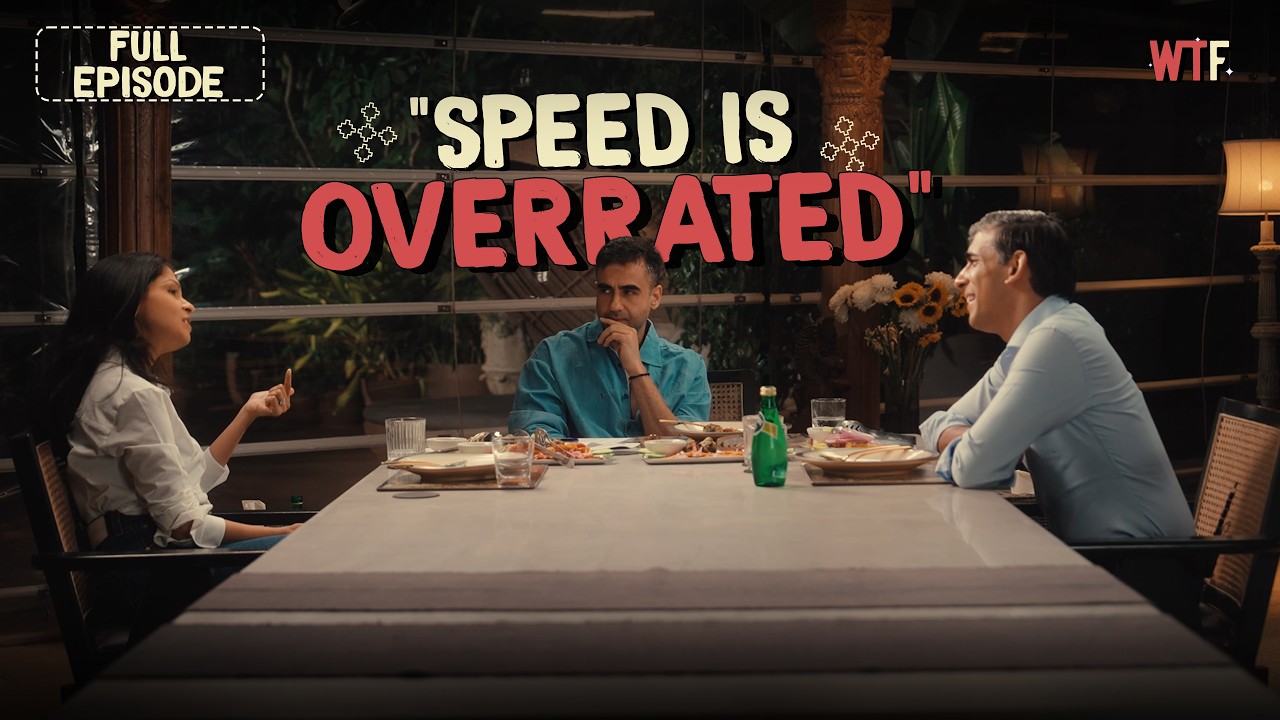
Rishi Sunak became the UK's youngest Prime Minister in 200 years and now calls speed overrated: 'I used to think speed was the most important thing. And I've come to appreciate that patience is almost a bigger competitive advantage' - because arriving too early can be worse than arriving late. His preconditions for politics: resilience, patience, and motivation by service more than ambition - plus a career and financial independence first, so you don't see the world 'through a political prism.' Change, he argues, is a movement not a moment: William Wilberforce spent 20 years to pass one bill and 40 to abolish slavery, from the backbenches, by adding economic and patriotic cases to his moral one. On losing the election publicly, what carried him was the Gita's framing: duty over outcomes - 'that was my dharma.' Akshata Murty, told she could be read as her father's daughter or her husband's wife, answers with her own blank canvas: identity built on impact, values (compassion, curiosity, personal integrity), and the middle path - Kipling's 'If' and Hesse's Siddhartha as operating manuals. Their practical agenda for young people: master something deeply AND build horizontal skills (critical thinking, feedback, people judgment), learn how to learn, use AI as a tutor but never let it do your thinking - Sunak never writes with it - and if you want change at scale, come inside the institutions and do the work.
Key Takeaways
Patience beats speed
Sunak: 'I used to think speed was the most important thing. And I've come to appreciate that patience is almost a bigger competitive advantage.' Even as the youngest PM in 200 years, he argues arriving too early can be worse than arriving late - you want the experience and judgement to be at your best when the role comes.
Do something before politics
His consistent advice: build a career and financial independence first. Career politicians see every problem through a political lens; outside experience breaks that prism, and financial security lets you serve without compromise. Entrepreneurs, he says, make better later politicians.
Change is a movement, not a moment
Against the cinematic myth of the speech that fixes everything: William Wilberforce abolished the slave trade as a backbench MP - 20 years to the first bill, 40 years to abolition, dying three days after. He layered economic and national-security arguments over his moral one, and Thomas Clarkson did the painstaking documentation. Voice matters; participation changes things.
Duty is the anchor in public failure
Losing an election is failing in front of friends, family and colleagues who lose their own seats. What carried him: remembering why he took the job when inflation was at a ten-year high and his party 36 points behind - the Gita's teaching to focus on duty, not fruits. Then extract lessons without self-pity: not all your fault, not all someone else's.
The AI-era skill stack
Break every job into tasks: AI takes some, not others. The surviving stack is horizontal skills - critical thinking, knowing what to ask the model, judgement, feedback, dispute resolution, compassion - plus genuine deep mastery of one domain, powered by passion. He uses Claude daily for research and even generated a physics revision booklet for his daughter - but never lets AI write for him: 'it's got to help you think, it can't do the thinking for you.'
Sovereignty is a portfolio, not a wall
His three-part strategy for countries: control one critical supply-chain link (the 'ASML strategy'), diversify to avoid vendor lock-in (air-gapped for national security, open source or domestic for sensitive data, cheap foreign models for commodity uses), and keep trusted partnerships. Tariffs and supply-chain weaponisation are structural, he warns, not one president's whim - and China's record trade surplus will keep forcing reactions, as the EU's EV tariffs show.
Identity from impact, not labels
Akshata: neither 'my father's daughter' nor 'the PM's wife' - 'a Bangalore girl with a British accent,' part of the diaspora's living bridge between India and Britain. Her validation comes from impact, her values are compassion, curiosity and personal integrity, and her philosophy is the middle path: triumph and disaster as two impostors, ambition balanced by what Nikhil calls validation through meaning.
The Conversation Breakdown
The Foundery and India's consumer boom
⏱ Untimed topicNikhil describes the Foundery - a three-month residential incubator near Alibag building 20 consumer brands (candy, chocolate, toothpaste, jeans) with about $500k each, an AI quiz funnel from thousands of applicants to 25, and a seven-episode show to 'make them heroes before the product hits the market.' Rishi and Akshata are visibly excited: India's consumer sector grows at 12-13% while GDP grows 6-7%, young Indians are saving less and borrowing to spend, and consumer startups can raise as easily as tech there - the opposite of the West.
Storytelling, parents and the making of a PM
⏱ Untimed topicAkshata's mother (Sudha Murty) once narrated a ten-minute story about the god of crematoriums at a funeral - storytelling as superpower. Rishi's parents, a GP and a pharmacist in Southampton, worked seven days a week for their children's schools; delivering medicines on his bike, he heard patients' stories about them and learned one person can move a community - his reason for entering politics. Both families: education as 'the passport to a better life.'
Education in the AI age
⏱ Untimed topicAt Stanford she pushed him toward interpersonal dynamics and organisational behaviour while he chased finance classes - 'you were right on that,' he admits, because leadership failures are people failures, not DCF errors. For their daughters' generation: breadth plus depth, learnability as the compounding skill, and AI as personal tutor - with the rule that it explains but never thinks for you. Akshata's Stanford essay asked how to build equality of opportunity; both see AI lifting the floor through democratised health and education.
Speed, patience and the blank canvas
⏱ Untimed topicThe TGI Friday afternoon after losing to Liz Truss, then the sudden Diwali promotion: his mother's 70th birthday, his daughter's 10th, and tea-and-mithai with the new King. Now, for the first time, no next milestone - 'it's liberating.' At 45, with more working years ahead than behind, he refuses to believe the high already happened: the second chapter starts with wisdom the first one lacked.
Identity and the living bridge
⏱ Untimed topicTaking oath on the Gita, lighting diyas at Downing Street - 'I wasn't going to change who I was.' Akshata on the G20 return to India: British or Indian, neither or both? Her answer is Modi's phrase, the living bridge - she belongs to the bridge itself, working in arts, culture and entrepreneurship to connect the two. Rishi on Britishness: the UK took his Hindu faith in stride, 'and that's a good thing.'
Geopolitics: sovereignty, tariffs and China
⏱ Untimed topicDe-risking, not de-globalisation: supply chains move from just-in-time to just-in-case; cricket's one World Cup has become twenty leagues. His sovereignty stack - an ASML-style critical capability, no vendor lock-in, trusted partnerships - and why COVID and Huawei permanently changed government thinking. On trade: a free-trader who says trade must be fair; China's subsidised export model isn't a level playing field, tariff baselines won't fall under any future US president, and the infant-industry argument (Birmingham) has its limits.
Failure, fiction and whether we need poets or politicians
⏱ Untimed topicHis metacognition habit - thinking about the thinking - plus the tech executive's reassurance: 'your judgement is on average better; trust it.' He wishes he'd read more fiction: non-fiction teaches the what and how, fiction the why and the who. Akshata's closing verdict on the poets-versus-politicians question: both - idealists who move people with words, and people of integrity who turn that into outcomes at scale. 'It's all validation,' Nikhil concludes - 'the pathway is different.'
Core Frameworks & Ideas
Nested timeframes
Short-term and long-term aren't in conflict when they're aligned: your weekly rhythm should serve the one-year plan, which serves the three-year strategy and five-year vision. And you must do enough in the short term to survive - 'earn the right to be there over time' - because the long term is just a succession of short terms you didn't get kicked out of.
The sovereignty portfolio
For nations or companies dependent on critical technology: (1) own one indispensable link, (2) diversify suppliers so no one holds a kill-switch, (3) keep trusted partners for what you can't do yourself. Match the sensitivity of the use case to the depth of control - air-gapped for the crown jewels, commodity suppliers for commodity work.
Movement over moment
Durable change comes from inside institutions: pick a mission, expect decades, build coalitions by translating your moral case into the listener's language (economic, patriotic, practical), and outlast the votes you lose. Ambition gets you in; only service keeps you effective.
Actionable Next Steps
- ✓Write your current weekly priorities next to your one-year and three-year goals; drop or realign anything that doesn't connect upward.
- ✓Before chasing the next title or milestone, ask whether you'd arrive at your best - and what one more year of experience or financial padding would change.
- ✓Take your most recent visible failure and rewrite its story twice: once with zero self-blame removed, once with zero excuse - then act on what the honest middle version teaches.
- ✓Pick one task you already give to AI and upgrade your prompt discipline for a month - treat it like piano lessons: the skill is knowing what to ask, and it compounds.
Notable Quotes
“I used to think speed was the most important thing. And I've come to appreciate that patience is... almost a bigger competitive advantage.”
“If you want to go into politics, you are far better off having done something first.”
“The person you have to be kindest to first is yourself.”
The One Thing to Remember
The story you tell yourself about failure decides whether you grow from it: reject the victim narrative, ask honestly what you misjudged, fix the process - and be as kind to yourself first as you would be to anyone else.