


The Battery Everyone Uses Is The One They'd Never Build | EnerVenue x HiNa | WTF are Batteries?
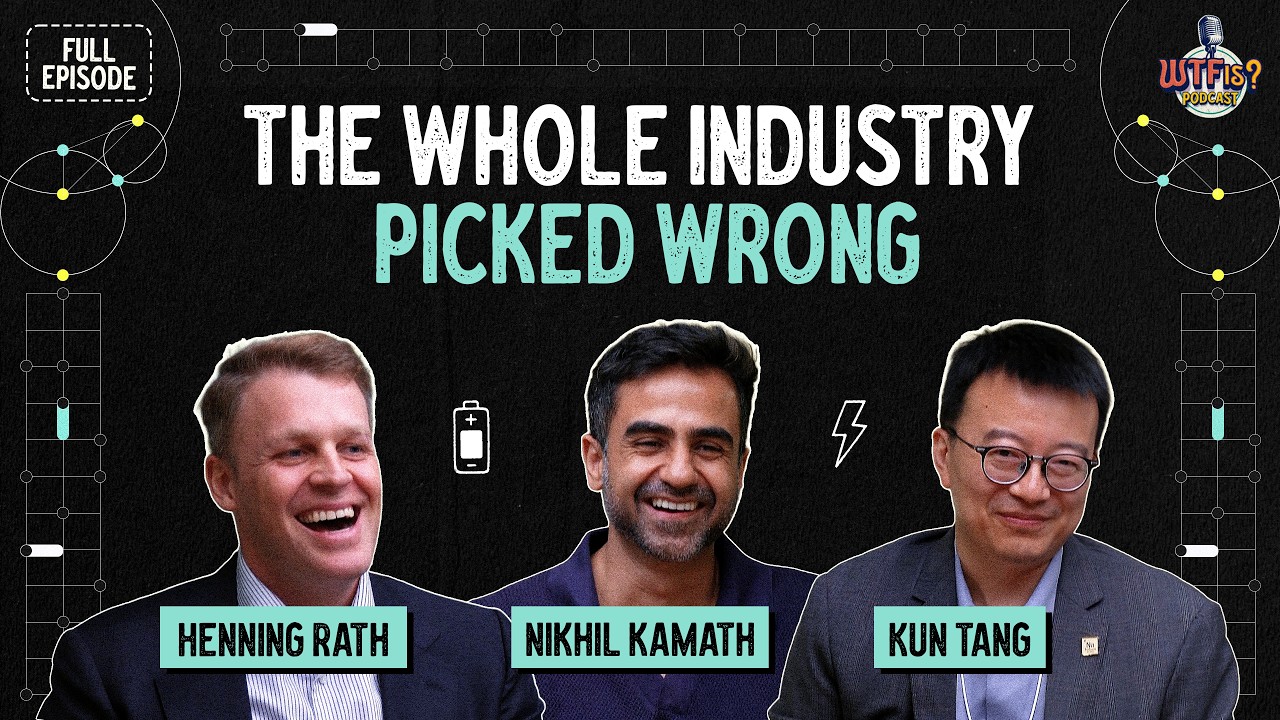
Executive Summary
Two battery CEOs give Nikhil Kamath a founder's tour of the industry the energy transition actually runs on. The core lessons: a battery is trade-offs, not perfection - LFP won mobility on cost and energy density but carries thermal-runaway risk (14,000 fires last year), while the next generation plays the trade-offs differently: Henning's nickel-hydrogen cells run 30,000 cycles on water-based electrolyte that cannot catch fire, and Tang's sodium-ion cells use materials costing a tenth of lithium carbonate that every country can source locally. Both fail on energy density, so they target the grid and data centers, not cars. The strategic punchlines: lithium refining lives in China and geopolitics will not improve, so decouple your supply chain; solid state is years from product; diesel backup in data centers is ripe for replacement; and the three supercycles worth building in are energy, manufacturing capability and AI. China's own EV war - 400 brands down to a handful - was deliberate industrial policy: fund twenty, let five become world leaders. FULL COVERAGE: captions appear complete. Sponsor: none stated. Not investment advice.
Key Takeaways
A battery is a bundle of trade-offs
Energy density, power density, cycle life, degradation, temperature resilience and cost pull against each other; cell design is the art of choosing which to sacrifice. Henning's rule: there's no perfect battery, but there's always a perfect match for its application.
Why LFP won - and what it costs
The industry standardized on lithium iron phosphate for its high energy density at newly low cost (cell-to-pack designs now push EVs to 1,000 km range). The trade-offs: poor performance in extreme temperatures and thermal runaway - an unstoppable self-heating spiral that turns one cell into a vehicle fire. 2025 saw over 14,000 LFP fires; quality matters too, which is why CATL sells at a 10% premium over tier-two makers.
Thermal runaway is physics, not a bug
A battery stores energy the way a pump holds water at height; the higher the energy density, the more violent the release when the 'tube' breaks. Higher energy density intrinsically means more safety risk - which is why incrementally safer LFP is possible, but never perfectly safe.
How China won the electric car
Tier-zero suppliers let anyone order a car and design a brand; BYD spent 20 years vertically integrating from batteries into semiconductors and mining; and the state ran 'government venture capital' - fund 20 companies per strategic sector, let five survive to become world leaders. From 400 EV brands, only a handful remain, and German carmakers, says Henning (a German), were simply too slow.
Nickel-hydrogen: NASA's 30,000-cycle cell
EnerVenue's aqueous metal cell - incubated at Stanford from NASA technology - uses nickel, steel, water-based electrolyte and glass fiber: no fire trigger, minimal losses from -10 to +45C, and 30,000 cycles. The trade-off is energy density, so it lives in 20-40ft containers serving grids, buildings and AI data centers. The nickel itself is rented via an SPV and recycled at 98% after a 30-year life.
Sodium-ion: the geopolitics-proof battery
HiNa's chemistry needs only sodium carbonate (a tenth the price of lithium carbonate, from salt, everywhere) plus iron and phosphate - no lithium, no rare earths, no chokepoints. It passes every safety test at lower energy density, suits storage and sub-500km scooters and three-wheelers, and Tang argues India is ideal: local materials, millions of scooters, and no competition with China's lithium cost curve.
Where to build: $50M and three supercycles
Both CEOs put the entry ticket for a battery company near $50 million, point to data centers as the hottest customer (operators fear LFP fires near billion-dollar facilities), dismiss solid state (TRL 4 of 9) and near-term nuclear (SMRs at 5x cost), and frame the opportunity as three supercycles - energy, manufacturing capability and AI - with generation and storage placed as close to the consumer as policy allows.
The Conversation Breakdown
A selfish question in Dalian
⏱ Untimed topicNikhil frames the energy-transition problem: generation is solved, storage and movability are not - and asks two CEOs to teach him batteries from zero.
What a cell actually is
⏱ Untimed topicCathode, anode, separator, electrolyte; ions inside, electrons outside; why a pumped-hydro dam counts as energy storage but not a battery; and the trade-off dashboard that defines every chemistry.
LFP, thermal runaway and 14,000 fires
⏱ Untimed topicHow LFP displaced NMC, what a thermal runaway does, why battery management systems matter, and the production-quality gap that lets CATL charge 10% more.
Why China won the electric car
⏱ Untimed topicTier-zero suppliers, BYD's 20-year vertical integration, subsidy wars, and the 'government venture capital' model behind batteries, EVs and solar.
The challengers: nickel-hydrogen and sodium-ion
⏱ Untimed topicEnerVenue's water-based, 30,000-cycle nickel-hydrogen container and HiNa's lithium-free sodium-ion cell - chemistries chosen to delete supply-chain risk, not maximize density.
Solid state, diesel and data centers
⏱ Untimed topicWhy solid state stays at TRL four despite weekly headlines, why data centers pay premiums for fire-safe backup, and the case for retiring diesel gensets.
The founder's map: cars as micro data centers
⏱ Untimed topicGeneration and storage next to the consumer, every parked car as a grid-stabilizing token factory, India-specific advice, and the three-supercycle closing framework.
Core Frameworks & Ideas
The Trade-off Dashboard
Capacity, energy density, power density, voltage, cycle life, C-rate, temperature range and cost: evaluate any battery (or any technology) as a vector of trade-offs against a specific application, never as an absolute ranking.
Government as Venture Capital
China's industrial-policy model: pick five strategic sectors on a 20-30 year vision, fund twenty companies in each, accept that most die, and let the five survivors become world leaders - repeated across batteries, EVs and PV modules.
Local-for-Local Decoupling
In a fragmenting world, design products whose inputs your home market already controls: EnerVenue's nickel-steel-water and HiNa's sodium-iron-phosphate are both deliberate escapes from lithium and rare-earth chokepoints.
Actionable Next Steps
- ✓Founders in energy: before picking a chemistry or product, map the trade-off dashboard for your exact application - grid storage, mobility and data centers each crown a different winner.
- ✓Audit your supply chain for single-country chokepoints (lithium refining is the textbook case) and price in a decade of worsening geopolitics, not a return to old globalization.
- ✓If you operate or invest in data centers, treat battery fire safety as a balance-sheet issue: a premium for non-flammable storage is cheap insurance beside a billion-dollar facility.
- ✓Investors: screen energy-transition bets against the three supercycles - energy, manufacturing capability, AI - and prefer companies that sit at their intersection.
Notable Quotes
“there's no perfect battery, but there's always a perfect match for its application.”
“Don't start a battery company where you need rare earths. Decouple your supply chain from lithium and rare earths.”
“Last year, 2025, the world had over 14,000 LFP fires.”
The One Thing to Remember
There is no perfect battery, only a perfect match for an application - so the winning move is not building a better lithium cell but choosing a chemistry whose supply chain your own country controls.