


The Man Who Calls BS On AI: They're LYING About AI, 2027 Is When It All Breaks! | Ed Zitron
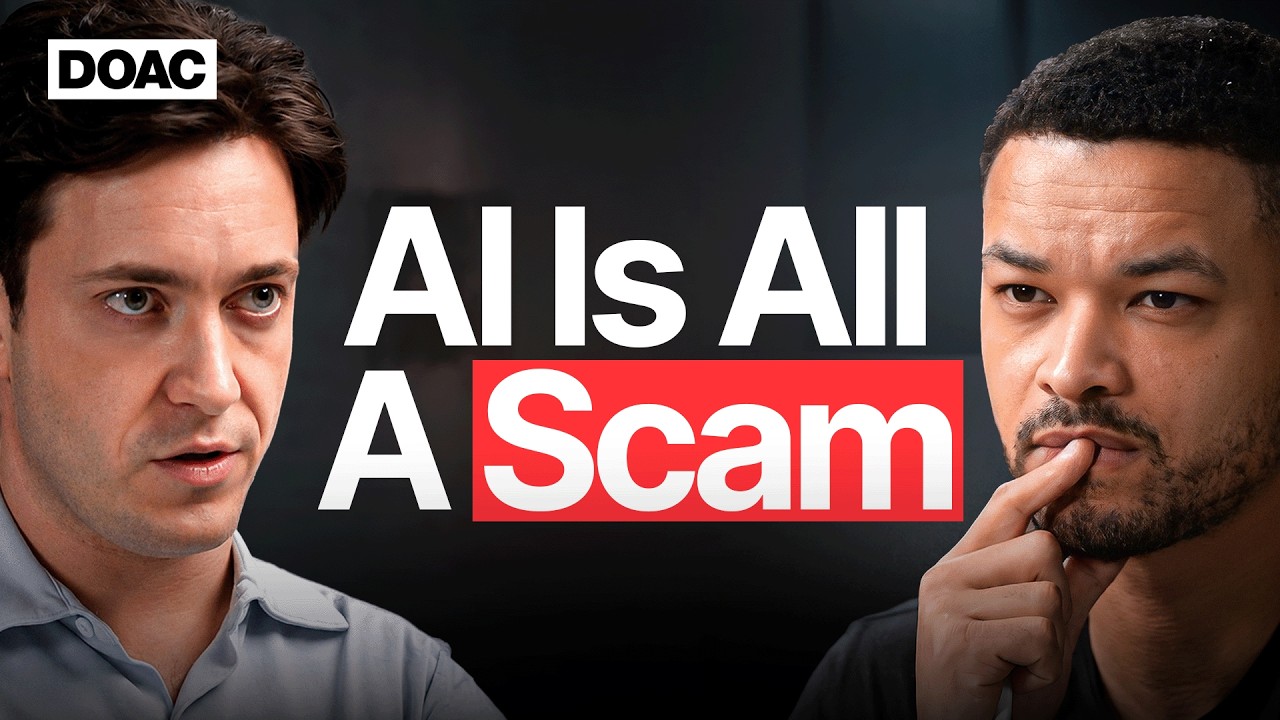
Executive Summary
Zitron argues that generative AI is marketed with exaggerated claims about capability, future progress and economics. He questions whether subsidized use demonstrates durable demand and asks how errors, trust and pricing change the value of a tool. The episode is a critical perspective rather than a balanced assessment. Its accusations, financial figures and predictions are his claims, not independently verified findings or investment advice.
Key Takeaways
The core accusation is his, not an established finding
Zitron calls generative AI a con and says companies overstate capability and financial prospects. These are serious allegations made by the guest. The notes preserve that authorship instead of turning his rhetoric into a factual verdict about every company or product.
Usage and sustainable demand are different questions
He argues that cheap access can make a tool popular without proving people would pay its full cost. The useful distinction is between enjoying a subsidized service and having a sustainable business model. His interpretation still requires evidence about costs, willingness to pay and actual customer value.
Input and output affect the bill
The conversation explains token-based pricing as payment for the material supplied to and produced by a model. Zitron uses that structure to question the cost of large-scale usage. Pricing varies by service and time, so this account is a concept to understand rather than a current rate card.
Errors must be assessed in the task they affect
Zitron discusses hallucinations and challenges comparisons that treat AI mistakes as equivalent to human mistakes. The consequence depends on the work: a fluent answer can still be wrong in a way a user does not notice. This critique does not prove every output useless; it asks for task-specific evaluation and review.
The intern analogy can hide responsibility
He questions the habit of describing a model as an intern who merely needs supervision. A real worker brings context and accountability that may not transfer to generated text. The decision is not only whether an answer looks plausible, but what verification and responsibility are needed before relying on it.
Growth stories need an honest-cost test
Zitron asks whether adoption would remain strong at a price that reflects the real cost of providing the service. That turns a broad technology story into a concrete economic question. His figures and forecasts should be checked independently, and his pessimism should be compared with evidence and competing views.
The Conversation Breakdown
Costs, errors and the case against hype
⏱ 12:00Zitron uses token pricing and subsidy to question whether current usage translates into sustainable demand. He then discusses hallucinations, the comparison with human error and the intern analogy. The critique asks what a tool would cost without subsidy and what review is required for its output, while leaving his accusations and predictions visibly attributed.
Core Frameworks & Ideas
Honest-cost test
Ask whether a product remains useful and affordable at a sustainable price. This is a question to investigate, not proof that current demand is false.
Task-specific error test
Evaluate mistakes by their consequence in the actual workflow, not only by the fluency of the output.
Claims and evidence
Separate observed performance, company promises and a critic's forecasts. Compare each with independent evidence before adopting a conclusion.
Actionable Next Steps
- ✓Check the cost and revenue evidence behind a technology claim before using it in a business decision.
- ✓Ask the people doing a task what the tool changes and what extra review it creates.
- ✓Test a workflow at realistic usage and pricing rather than relying on a single demonstration.
- ✓Compare this critical interview with independent evaluations and alternative views; do not treat it as investment advice.
Notable Quotes
“I think generative AI is at its heart a con.”
“I don’t think it is sold as honest software.”
“I think that they overstate both what it can do, what it will do, and the underlying financials to the point that they are misleading the entire world and they’re actively exploiting the weaknesses in journalism, in our economies, and indeed within the responsible parties with sell-side analysts, governments, and all over the shop.”
The One Thing to Remember
Ask what the tool actually does, what errors matter and what it would cost without subsidy. Zitron's critique urges scrutiny, but his conclusions also need independent testing.