


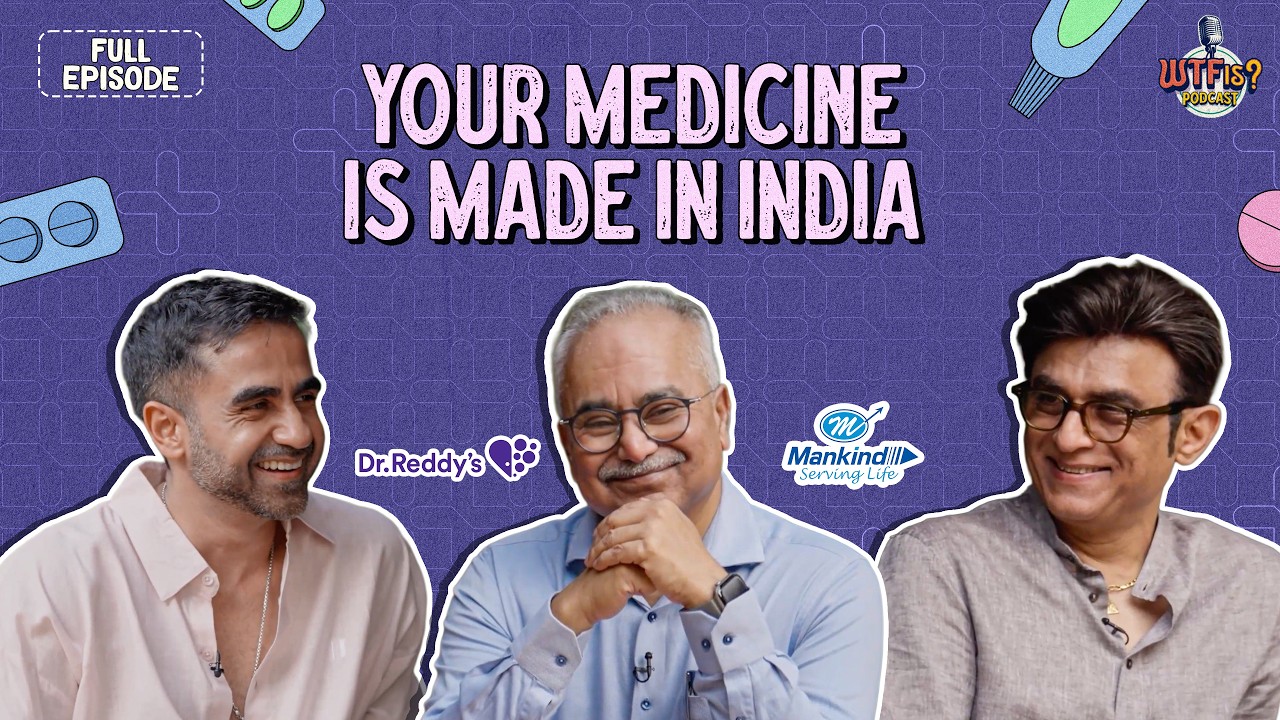
Two Pharma Giants Who'd Never Met | Mankind & Dr. Reddy's | WTF is Pharma?
Executive Summary
India is the pharmacy of the world by volume - roughly 60% of global generics - but barely a rounding error by value, because post-patent prices collapse 95%+. The money in Indian pharma is made in branded generics: a Rs 100 MRP splits 20% to the pharmacy, 10% to the wholesaler, 2-4% to the distributor, and the doctor's choice is won by 10,000-17,000-strong rep armies, which is why Mankind went bottom-up to tier-2/3 towns at 40-60% lower prices. On science: small molecules are India's mastery, but the pipeline is shifting to biologics and peptides where China is way ahead - and GLP-1 drugs (a gut-hormone peptide Novo Nordisk made stable) are a genuine revolution for the clinically obese, with muscle loss as the catch and a supplements-and-counseling ecosystem as Mankind's strategy around it. For founders: skip online pharmacy and GLP-1 branding (prescription drugs can't be advertised), and look at wellness (17% growth), CDMO services (China+1), AI-for-pharma, and unglamorous niches like certified destruction of expired medicines. Their shared closing advice: never follow a set formula, find a mini market and win it first, and budget a decade. FULL COVERAGE: captions appear complete. Sponsor: none stated. Not medical or investment advice.
Key Takeaways
Pharmacy of the world - by volume only
India supplies roughly 60% of global generic drug volume but captures only a small single-digit share of value: once five or more generic players enter post-patent, US prices fall more than 95% below the innovator's. The domestic market is about $30 billion, exports another $30 billion, growing 8-10% a year.
The Rs 100 MRP anatomy
Of a Rs 100 retail price, the pharmacy takes about 20%, the wholesaler/stockist 10%, and the C&F/distributor 2-4%; gross margins run 60-70% in India, EBITDA 22-25%. With 95% of the market being branded generics, the doctor's prescription is the battleground - and it is won by relationships built by thousands of medical reps (Mankind fields 17,000; average PCPM about Rs 7 lakh a month).
The Mankind playbook: bottom-up and contrarian
Started in 1995 from Meerut, Mankind skipped metro strongholds, went village-first with prices 40-60% below rivals, expanded region by region (west UP, then east UP, Haryana, Punjab), used OTC products like Manforce (about Rs 600 crore) purely for name visibility, and deliberately holds EBITDA at 25-26% - choosing topline growth over margin every time.
Prasad's China contrarianism
Against the 'China controls our APIs' narrative: India still leads APIs and captures more value from finished products - China sells cheap intermediates, India converts them, and during COVID Chinese supply proved more reliable than Indian. The real gap is higher up: China played a long game into innovation (29% of new cancer drugs, most novel biologics/ADCs, $50 billion in global deal-making) using talent repatriation, government-VC co-investment and mayoral meritocracy.
The science, in one sitting
API is the active molecule (paracetamol in the tablet); formulation is the delivery engineering that must match the innovator's release curve within 20%. Small molecules (molecular weight under ~1,000) are chemistry; biologics are grown in living cells - monoclonal antibodies are the 'silver bullets'; peptides like semaglutide sit between. Stem-cell therapies are largely unproven and not FDA-approved.
GLP-1: real revolution, real catch
GLP-1 is a gut hormone that signals satiety; Novo Nordisk's semaglutide stabilized it. Prasad is 'for it' for the clinically obese (diabetes, cardiovascular risk), but warns that users lose muscle along with fat - so Mankind's strategy is the gold-rush-picks play: the drug up front, with protein, supplements, vitamins and counseling as the actual ecosystem business.
The 25-year-old's map of doors
Closed: online pharmacy (Tata 1mg raised about Rs 800 crore and is still unprofitable), distribution (mature), GLP-1 branding (prescription drugs cannot be advertised in India), drug discovery without deep science and capital. Open: wellness and prevention (17% growth), sexual wellness online (50-60% growth on anonymity), CDMO services (China+1, the Biosecure Act - Anthem Bio went from rented premises to a roughly Rs 20,000 crore market cap), AI-for-pharma services, and unglamorous gaps like certified destruction of expired medicines (1.5-2% of all medicines).
The Conversation Breakdown
Two giants, two origin stories
⏱ Untimed topicJuneja: a Meerut medical store, a decade as a medical rep, a family partition and Mankind's 1995 start. Prasad: a US return, CEO of Cheminor Drugs in 1990, the 2001 merger into Dr. Reddy's, and Dr. Anji Reddy's 'unfinished agenda'.
The industry's real economics
⏱ Untimed topicVolume versus value, the $30B+$30B market, top-50 concentration at 75-80%, and why branded generics are 95% of Indian pharma.
Anatomy of a Rs 100 MRP
⏱ Untimed topicPharmacy, wholesaler and distributor cuts, the rep-doctor relationship engine, and PCPM numbers from 17,000 reps.
The Mankind contrarian playbook
⏱ Untimed topicVillage-first expansion, affordability as strategy, Manforce as a branding vehicle, and why EBITDA is deliberately capped at 25-26%.
Science class: APIs to peptides
⏱ Untimed topicActive ingredients, formulation and the 20% equivalence rule, biologics and monoclonal antibodies, stem-cell skepticism, and the GLP-1 mechanism.
China's long game
⏱ Untimed topicFrom cheap intermediates to innovation dominance, the sea-turtle talent program, India's biologics lag, tariffs and the Biosecure Act.
Where a 25-year-old can (and cannot) play
⏱ Untimed topicClosed doors: online pharmacy, distribution, GLP-1 brands. Open doors: wellness, CDMO, AI services, expiry-destruction logistics - and the closing advice: never follow a set formula, win a mini market first, and budget a decade.
Core Frameworks & Ideas
Bottom-Up Beachhead
Enter where incumbents won't go (villages, tier-2/3), win deepest coverage in one mini market, then expand region by region - Mankind's alternative to the all-India launch formula.
The Yin-Yang of Innovation
Innovators earn monopoly profits through patents and fund the next discovery; generics challenge patents to shorten monopolies and democratize access - each side needs the other to exist, and they are separate businesses with opposite risk profiles (many small bets vs few huge ones).
Gold-Rush Picks
When a product wave hits (GLP-1), the durable business is the ecosystem around it - protein, supplements, counseling - because the front-end drug is prescription-bound and commoditizes as 20 brands enter.
Actionable Next Steps
- ✓Founders: identify the 'tier-3 town' of your industry - the segment incumbents consider beneath them - and win it completely before expanding.
- ✓Before entering any market, map its MRP anatomy: who takes what share of the final price, and whose relationship actually decides the purchase.
- ✓Deep-science or technical founders: look at CDMO and AI-for-pharma services - incumbents openly admit they cannot attract this talent.
- ✓Whatever you build, budget a decade and spend the first years inside the industry - the guests' unanimous advice is to learn on someone else's capital before risking your own.
Notable Quotes
“India is called the pharmacy of the world, but that's by volume. By revenue, we're barely a rounding error. We make the drugs, but someone else makes the money.”
“Never ever follow a set formula.”
“they were playing a long game.”
The One Thing to Remember
Pharma rewards patience and position, not hustle: the durable money sits in trusted brands, rep relationships and hard science built over decades - so pick a neglected niche, win it completely, and let compounding do what shortcuts cannot.