

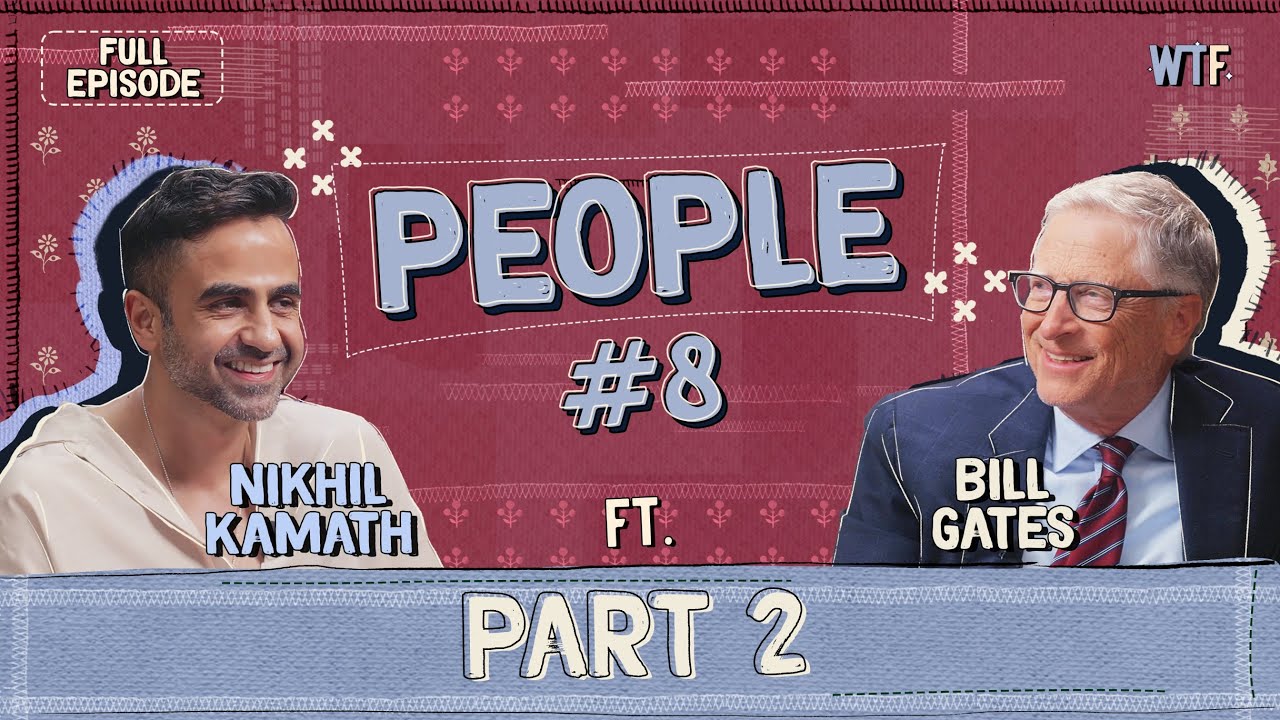
Bill Gates x Nikhil Kamath Part 2 | People by WTF | Ep.8
Executive Summary
Gates punctures the adversity myth first: his childhood was stable and loving, his drive was set before his friend Kent Evans died at 17, and the real engine was a genetic-seeming ability to sit with confusion until it resolves (his grandmother's card-counting 'state machine' he had to figure out alone). On the next 20 years, he predicts AI plus robots with good hands end the shortages of doctors, teachers, and factory labor - 'free intelligence' - forcing a philosophical rethink of time itself, one he admits hasn't come into focus even for him. On motivation, he's unusually candid: making money and giving it away are both highs, neither is pure, and the vaccine work is real regardless. On peers: Jobs was singular, Zuckerberg is 'a pretty normal person' who genuinely likes extreme sports, and Paul Allen had everything yet never found comfort. His closing advice to a 38-year-old Nikhil: ego should shrink with age, and not caring what people think is, ironically, the definition of cool.
Key Takeaways
His childhood was 'almost ideal' - no trauma origin story
Against Nikhil's theory that capitalist success is bred by childhood adversity (Jobs was adopted; Musk had a hard father), Gates describes stability: a lawyer father with sixth-grade-educated roots who modeled calm values, and a mother whose pressure to fit her mold backfired into him wanting to exceed it. His one childhood tragedy - Kent Evans's death at 17 - came after his ambition was already set.
Focus is partly genetic: live with the confusion
Asked where his ability to cram hours of deep work comes from, Gates points to a strong genetic component - the willingness to be very confused, sit with it, and almost give yourself a hard time until it resolves. Early evidence: working out that his grandmother beat him at cards by running a mental state machine, a secret she never gave away, forcing him to think it through alone.
AI ends the shortage economy in about 20 years
His extrapolation: white-collar AI plus robots with hands good enough for factories, construction, and hotel rooms eliminate the shortages of doctors, teachers, and labor that markets are built on. 'We will have created free intelligence.' The consequence - early retirement, shorter weeks, and a philosophical rethink of how time should be spent - is so foreign to someone who spent 70 years in a world of shortage that he says it hasn't come into focus for him either.
Humans will reserve arenas for humans
If nobody has to work, status hierarchies don't disappear - we're too adapted to scarcity. Gates predicts societies will create competitions and fence off activities from machines: robots won't play cricket even if they could win, and countries may reserve roles like nurses or psychiatrists for humans. Pure equality, he adds, is unnatural for humans because trust doesn't scale with group size.
Making money and giving it away are both highs
On Nikhil's 'motivational pluralism' - wanting to make money and give it away at once - Gates is candid: philanthropy has ego in it (Ted Turner blamed the Forbes list for discouraging giving), nothing is totally pure, and quiet giving can be 'almost more intoxicating' than capitalism. The test that matters to him: the vaccine work happened regardless of motive.
Microsoft's winner-take-all years ran on fear
Building Office meant watching entire competitor categories disappear, and losing mobile to Android ('nobody remembers there was a Windows mobile thing') showed the same game in reverse. In his 20s and 30s he was driven by ego plus the fear of being exposed as not good enough, conjuring existential risks at company retreats - until the foundation, he says, made his life saner.
What 70 years of access taught him about happiness
His answer to 'what do you know that I don't': science, and pattern-matching instincts about who to hire and partner with. The harder lesson came from watching peers - Buffett's wisdom helped with life, not business, and Paul Allen, key to Microsoft's success, never shook the feeling people would take advantage of him. Incredible intelligence, Gates notes, doesn't automatically map onto great relationships with your kids.
The Conversation Breakdown
India trip, cricket with Sachin, and reading Source Code
⏱ Untimed topicGates, energized on coffee before a long flight, talks about a packed India trip - more minister meetings than ever, innovators, and a playful cricket-tennis mashup with Sachin Tendulkar that Nikhil's production company helped stage. Nikhil explains he spent 14-15 hours reading Gates's memoir Source Code across cars and flights, setting up a conversation about what the book left out.
The childhood question: adversity theory vs an 'almost ideal' home
⏱ Untimed topicNikhil tests his presumption that successful entrepreneurs come from difficult families. Gates resists it for himself: his father worked long hours and modeled values, his mother was the key relationship whose pressure made him want to exceed her expectations, and his sisters were playful but distant in age. He concedes the pattern for others - Jobs's adoption, Musk's complicated father - but notes his own ambition predates his one real childhood loss.
Focus, cards with his grandmother, and the tech-CEO authenticity question
⏱ Untimed topicThe origin of his concentration: a genetic-seeming tolerance for confusion, visible early when he had to reverse-engineer why his grandmother won every card game. On whether Silicon Valley performs vulnerability (Zuckerberg's chains and extreme sports), Gates says Zuckerberg is genuine - a normal person and serious family man - while Jobs was 'pretty singular': not an engineer but unmatched at sensing people and design, where Gates's own skills don't overlap.
Hard on yourself, wrong about IQ, and why he still works
⏱ Untimed topicGates's rule: if you want to work hard without fooling yourself, be hard on yourself - but it made him a poor early manager who hired only people like him. His youthful model of talent was embarrassingly narrow: if you can do math, you can do anything. The foundation forced him to blend field workers, scientists, and government people. He still works full-time at 70 because it's fun - smart people, constant learning, and an Africa exposure Microsoft never gave him.
Population, AI, and the end of shortage
⏱ Untimed topicAsked whether a huge population is a boon or bane in ten years, Gates zooms out: in about 20, AI and capable robots dissolve the labor shortages capitalism prices - doctors, teachers, factory hands - creating 'free intelligence' the way his generation created free computing. He engages Keynes's old question - what does the world do if it doesn't have to work - and admits the answer isn't in focus, only that his grandkids will live it. He predicts humans will reserve activities for humans and build new hierarchies rather than accept sameness.
Motivational pluralism: ego, giving, and the Paul Allen lesson
⏱ Untimed topicNikhil confesses his own shifting drivers - money, power, validation, altruism - and asks how Gates holds both making and giving away money. Gates doesn't claim purity: philanthropy has ego, giving quietly is its own intoxication, and what matters is that the work is real. He reflects on Paul Allen, who had everything and never enjoyed it, on Buffett's life wisdom, and on why the smartest people can still fail at happiness.
Wine vintages, generational blind spots, and closing advice
⏱ Untimed topicAsked what assumptions his generation gets wrong, Gates laughs about being email-centric to his daughter's despair, then turns serious: his edge was seeing free computing early, but AI is a revolution everyone already sees - and its rate of change outruns the 60-year farming transition, compressing skill obsolescence into a single generation. His advice: surround yourself with young people. He accepts Nikhil's compliment that not caring what people think makes him cooler to the youth, credits kids and age for shrinking ego, and signs off with an internship tip for Nikhil's AI curiosity: maybe the OpenAI guys - 'those guys are wild. They are very good guys.'
Core Frameworks & Ideas
Shortage economics vs free intelligence
Markets price scarce resources - today including a doctor's or teacher's intelligence. Gates's frame: computing went from expensive to free in his lifetime; intelligence is next. When a previously scarce input becomes abundant, expect the institutions built on its scarcity (careers, wages, education pipelines) to need redesign, not just adjustment.
The live-with-confusion skill
Deep focus isn't just hours - it's tolerating being confused without resolving the discomfort prematurely. Gates treats it as partly genetic but demonstrates the mechanics: withhold the answer (as his grandmother did), sit with the problem alone, and let understanding arrive slowly. Applicable to any hard domain.
Winner-take-all fear
In software markets where the loser disappears (Windows Mobile vs Android), rational paranoia fuels the winner: Gates 'engaged every emotion' - ego plus fear of exposure - to drive himself, and alarmed colleagues at retreats with survival worries. Useful fuel while competing; he credits leaving for the foundation with restoring sanity. Recognize when the fear has outlived the game.
Reserved-human domains
When machines can do everything, societies won't let them. Expect deliberate reservations - sports, caregiving, psychiatry - chosen because human participation is the point, not because machines can't compete. A forecasting tool: ask not what AI can do, but what we'll forbid it from doing.
Actionable Next Steps
- ✓Pick one hard problem this month and stay with it past the point of confusion - no quick lookups, no AI summary - the way Gates reverse-engineered his grandmother's card system. The discomfort is the exercise.
- ✓Founders and managers: audit whether you're hiring only people who think like you; Gates calls his early 'math IQ or nothing' filter his big miss, and talent turned out to be far more varied.
- ✓Take Gates's personal-life ledger seriously: list the relationships your success is supposed to serve, and check whether your intelligence is actually being applied there - he watched Paul Allen have everything but comfort.
- ✓If AI makes part of your skill set abundant, decide now which human-only arenas you'll compete in - judgment, relationships, taste - the equivalents of 'robots won't play cricket' in your own field.
Notable Quotes
“We will have created free intelligence.”
“I sort of thought, if you can do math, you can do anything, and if you can't do math, you can't do anything.”
“we're not going to have robots play cricket.”
“I know super successful people who aren't that happy.”
The One Thing to Remember
Gates's self-diagnosis for why he works the way he does: an inherited willingness to be very confused and live with the confusion until you figure it out. It's a learnable posture - pick problems you can't solve in an afternoon and stay in the room with them, the way his grandmother's silent card-counting forced him to work out the system himself.