


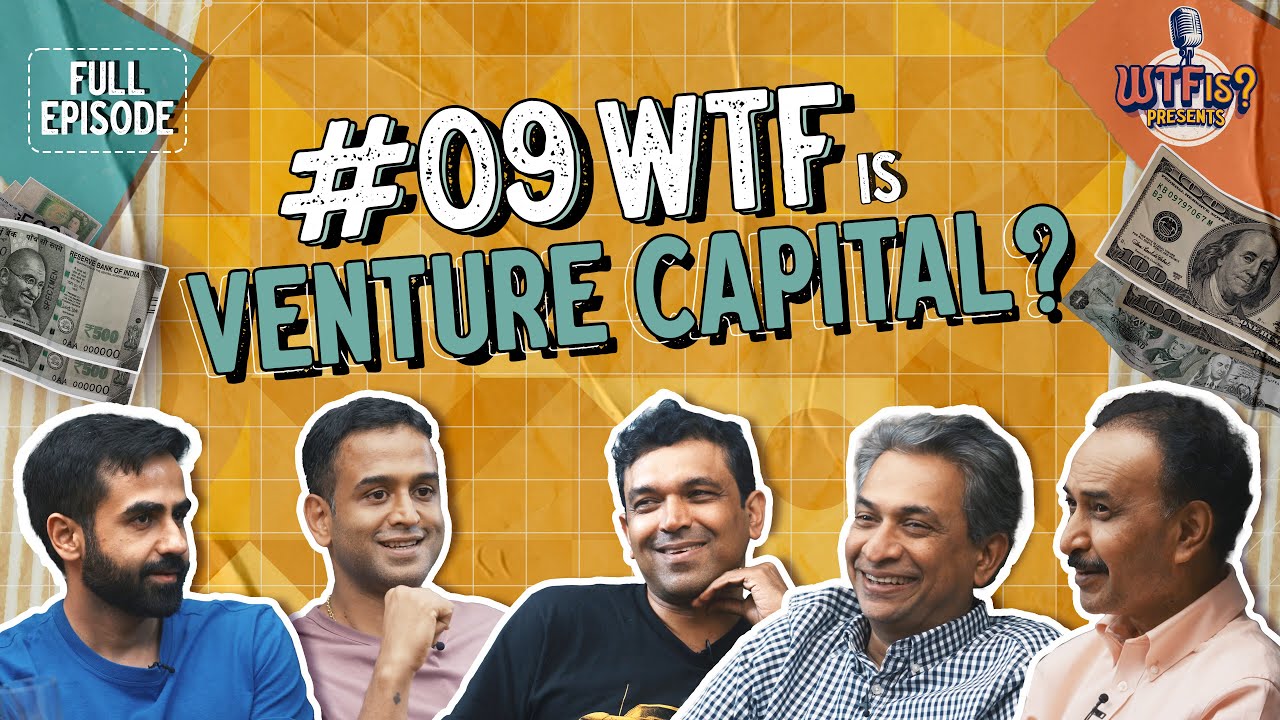
Ep #9 | WTF is Venture Capital? Ft. Nikhil, Nithin, Rajan A., Prashanth P. & Karthik R.
Executive Summary
This five-person roundtable demystifies how angel investing, venture capital and private equity differ; how a fund’s time horizon, fees and exits shape its decisions; why a handful of outsized winners drive returns; and how founders can choose problems and sectors for a decade-long horizon. The investors also debate India’s opportunity in mobility, manufacturing, climate and energy transition, and how its scale and digital infrastructure can turn local needs into major markets.
Key Takeaways
Build for durable opportunity, not a hot funding cycle
Nikhil frames the conversation around founders choosing what to build over the next decade. The panel returns to the idea that entrepreneurs should pursue a meaningful problem with long-term potential, rather than chase current investor fashion. This guidance is also summarized in Blume’s companion article about the episode.
Venture capital is institutional capital for high-growth companies
The investors distinguish VC from angel investing (individuals investing their own money, often hands-on at a very early stage) and private equity (usually investing in more mature, profit-generating businesses with a nearer exit window). VC pools outside capital into organized funds and supports companies from early stages toward scale.
A fund is a long-horizon commitment with defined economics
The discussion describes typical VC funds as around ten years, sometimes with extension options. Management fees support the team and operations; carried interest is tied to realized gains after exits and distributions. Founders should understand how follow-on reserves, exit timing and fund life interact.
Returns follow a power law
The panel describes venture returns as highly concentrated: a small number of companies can account for most of a portfolio’s returns, while many others return less or fail. This makes portfolio construction, long holding periods and the ability to support winners important; it is not a promise that any individual startup will succeed.
India’s strengths create opportunities across sectors
In discussing mobility, manufacturing, digital infrastructure, climate and energy transition, the investors weigh India-specific advantages and constraints. The practical lesson is to investigate whether a sector has a durable local problem, enabling infrastructure and customers, rather than assume an attractive global trend translates automatically.
Persistence and founder-market fit matter in hard markets
The conversation returns to the founder’s connection to the problem, commitment through difficult periods and ability to keep learning. Investors assess resilience in context, not by one isolated signal; market conditions and founder-specific evidence both matter.
The Conversation Breakdown
Why build a company? The investors meet
⏱ 00:00Nikhil introduces the aim: a peer conversation to help aspiring founders understand what to build, where funding fits and which sectors may have tailwinds or headwinds. The five participants bring experience from investing and entrepreneurship and set out to discuss what worked in the prior decade, what did not, and how the next generation of founders can learn from it.
From angel checks to institutional venture funds
⏱ 00:22Karthik explains that angel investors deploy personal money and may invest informally or through networks, while venture capital is organized institutional capital raised from limited partners. The group unpacks fund sizes, investment stages, management fees and carried interest, fund life, follow-on rounds and why an investor may need a decade or more to realize returns. They contrast VC’s early-stage uncertainty with private equity’s focus on more mature businesses and nearer exits.
Power laws, exits and what investors look for
⏱ 00:43The panel explains portfolio power laws, fund return targets and what it means when a handful of investments account for most outcomes. They discuss how angel syndicates differ from professional funds, how funds realize gains through IPOs, strategic sales or later-stage investors, and how fund life and exit clocks shape incentives. They also examine the distinction between VC and private equity, including time to exit and company maturity.
Fund maturity, company stage and the Indian market
⏱ 01:00The guests compare early-stage venture with private equity’s later entry into established, often profitable companies and shorter path toward an IPO or other exit. They debate sectors that may matter in India, including mobility, manufacturing, energy transition and climate technology, and how local digital infrastructure and policy shape the opportunity. The panel emphasizes that founders should investigate market realities rather than assume capital or a global trend guarantees success.
Core Frameworks & Ideas
Power-law portfolio economics
Venture returns are concentrated in a small fraction of portfolio companies. The panel discusses why a few large outcomes can drive overall fund returns and why managers need to keep investing in potential winners over long time horizons.
Problem-first, decade-long founder fit
A durable venture is built around a customer problem and a mission the founder can sustain. Follow long-term opportunity rather than shifting sector fashions; investment capital follows evidence and potential, not the other way around.
Actionable Next Steps
- ✓Write a ten-year view of the customer problem and the size of the opportunity before choosing a sector or fundraising strategy.
- ✓Before considering an investment offer, model the fund’s time horizon, follow-on capacity, decision process and intended exit path. Discuss these assumptions explicitly with the investor.
Notable Quotes
“An entrepreneur should go build a business solving a problem which he cares most about.”
“Venture capital is basically institutional capital, where these are organized fund managers in a firm.”
“An entrepreneur should never choose a business idea based on the cyclical ups and downs of a sector.”
“People will say that one can start a business solving a problem which one cares most about”
The One Thing to Remember
Build around a problem you care about and where opportunity will be a decade from now, not whichever sector happens to be attracting money today.